
Weekly Market Makers

Back in Business Again

Jason-00011_cmykby Jason Norris, CFAExecutive Vice President of Research


Back in Business Again

It has been a volatile year for equities and as we head into the holiday season, that doesn’t look to dissipate. After the 12 percent sell-off investors went through over the past few months (Fed rate hike concerns, China market crash, Greek debt issues and the constant geo-political flare-ups), the S&P 500 has rallied back, culminating with its best week of the year. While 2014 proved to be a narrow market, 2015 is even more so. When you look at the 10 largest U.S. companies (see table below), you notice the majority of them, have enjoyed significantly greater returns than the 3 percent for the S&P 500.

first image


Source: FactSet data through Nov 20, 2015

What is even more dramatic is that three stocks were responsible for all of this return: Amazon, Alphabet/Google and Facebook.

There have been prior periods of large cap driven markets, coupled with a handful of names driving that performance. But what we have experienced this year is less than a handful of mega cap names delivering all the index returns.

One thing to note on this narrow focus is the emphasis on “growth.” The sell-off we experienced this summer was a classic “growth” scare. Investors believed that due to the strong dollar and the slowdown in China would cause global economic growth to slow. While we’ve seen some stabilization in the equity market, there is still concern over global economic growth. As such, investors have been willing to “pay up” for growth companies and avoid cheaper names that are tied to the face of economic growth. For instance, the three stocks mentioned earlier trade at substantial premiums to the overall market.

second image


Source: FactSet data through Nov 20, 2015

Investors are paying a lot more for a  dollar of earnings for a select few names due to the concern over growth. This has resulted in growth stocks returning roughly 7 percent this year, while value stocks are down 2 percent.

Takeaways for the Week:

  • Different “styles” can come in and out of favor, the key is to remain focused on the long term and not chase short-term performance
  • As the global economy improves, value stocks should regain some leadership in 2016

Our Takeaways for the Week

Disclosures

A Lack of Household Formation Participation Trophies

Brad-00447-cmyk by Brad Houle, CFA Executive Vice President

Millennials get a bad rap. They are characterized as the generation that was born between 1980 and 2000 and are often considered to be indulged and coddled. They are often accused of being the by-products of a society where everyone receives a participation trophy. This is quite different than the baby boomer generation, born at the end of World War II through the mid-60s and often considered wealthy, active and the result of an economic boom. And while the millennial birth rate in 1990 matched the 1957 baby boomer birth rate with greater than 4 million births, similarities between the two generations begin and end there.

Following the baby boom of the 1950s, there was a significant pick up in household formations roughly 20 years later. Consumer spending on the acquisition of homes, furniture and other durable goods define household formations, which makes up almost 70 percent of our gross domestic product or, said differently, our national income. This consumer consumption of household formation drives the economy and the millennials cannot keep up the pace. According to Federal Reserve data from 1997 to 2007, about 1.5 million households were formed on average each year in the United States. Then the Great Recession hit, and in the ensuing three years, the rate fell to 500,000 per year.

In addition, the Great Recession resulted in a drop in millennial independent living. The Pew Research Center, in the first third of 2015, found that 67 percent of millennials were living independently, compared with 69 percent of 18-to-34 year olds living apart from family in 2010 and 71 percent in 2007. Also, unemployment in the millennial demographic shot up over 12 percent during the recession. Moving back in with Mom and Dad and/or possibly pursuing further education became a viable option for many in the group.

Today we learned that current unemployment has dropped to around 5 percent. This begs the question: If unemployment has improved, why are millennials still so reluctant to leave the nest? The rising cost of tuition, the student loan debt that results and an increased home down payment are thought to be a few of the culprits of these nest-bound millennials. The College Board, responsible for several standardized college tests such as the SAT, points out that the average “published tuition and fees at public four-year colleges and universities increased by 13 percent in 2015 dollars over the five years from 2010-2011 to 2015-2016, following a 24 percent increase between 2005-2006 and 2010-2011.” As a result, according to the Brookings Institute, the average balance of outstanding student loan debt for households with some debt was $25,700. In addition, following the financial crisis the required down payment on a home was raised to 20 percent. Considering these factors, it is possible this generation is making rational economic choices by living at home as opposed to a desire to have their parents clean their room for them.

Ned Davis Research estimates that there are roughly 3 million incremental millennial households that have yet to be formed. As millennials leave the comfort of their parent's basement, pay off their student debt and join the real world, this household formation could be a tailwind for the housing market as well as the consumer economy.

The employment report for the month of October was released on Friday and was much better than expected. 271,000 jobs were created in October and there was an upward revision to the number of jobs created in the prior month. As mentioned earlier, unemployment dropped to 5 percent and the average hourly earnings was up more than expected rising 2.5 percent on a year-over-year basis. With this stronger-than-expected data the implied probability of a Federal Reserve rate increase is now at 70 percent for the month of December.

Our Takeaways from the Week

  • Employment numbers positive
  • More anticipation of movement with the millennial generation that could be a tailwind for consumer spending

Disclosures

Monster Mash

Ralph-00338_cmykby Ralph Cole, CFAExecutive Vice President of Research

Monster Mash

No holiday better describes earnings season than Halloween.  When companies announce earnings, investors are hoping for treats but often times end up getting tricks. In our view, improving corporate earnings are the catalyst to improving stock market returns in the coming year. As we close out the best month for the stock market since 2011, we should review some of the tricks and treats of earnings season.

Treat

Apple reported earnings earlier this week and beat expectations on almost every level. IPhone sales continue to grow at a robust pace around the world. The company sold 48 million iPhones in the third quarter, up 22 percent from last year. Analysts expect the company to sell 79 million iPhones in the final quarter of the year.  Average selling prices of the phones continue to rise, which enhances profitability and will lead to $60 billion in free cash flow this year alone.

Tricks

As expected, the energy sector has had a rough time of it this earnings season. Earnings for the S&P 500 energy sector were expected to be down 73 percent this quarter and that indeed has been the case. During these distressing times all companies begin to dramatically scale back investment and reduce headcount. We feel that higher quality companies with good assets, low debt levels and quality management teams will benefit from the eventual rise in oil prices.

Trick and Treat

In no place is the bifurcations of earnings season more evident than in footwear. Nike reported earnings that beat analyst estimates by 12 percent and the stock responded with a nine percent pop the next day. Nike also reported a solid outlook for the coming quarters as well. Sketchers, on the other hand, tricked investors and missed earnings by a whopping 21 percent last week and the stock dropped 31.5 percent with the news.

Why have stocks responded so positively to a mixed earnings environment? Expectations for third quarter earnings had been lowered so much that companies have been able to meet and often beat those reduced forecasts. Also, the much advertised slowdown in China has not had as big of an impact on earnings as investors feared. While the investment slowdown in China has hurt some industrial companies, the Chinese consumer has actually helped the likes of both Apple and Nike.

Takeaways for the week

  • There have been more treats than tricks this earnings season which has driven the S&P 500 higher by nine percent this month
  • Earnings season continues to be very volatile and stock selection has been key

Disclosures

May Days and Where Fall May End Up

Jason-00011_cmykby Jason Norris, CFAExecutive Vice President of Research

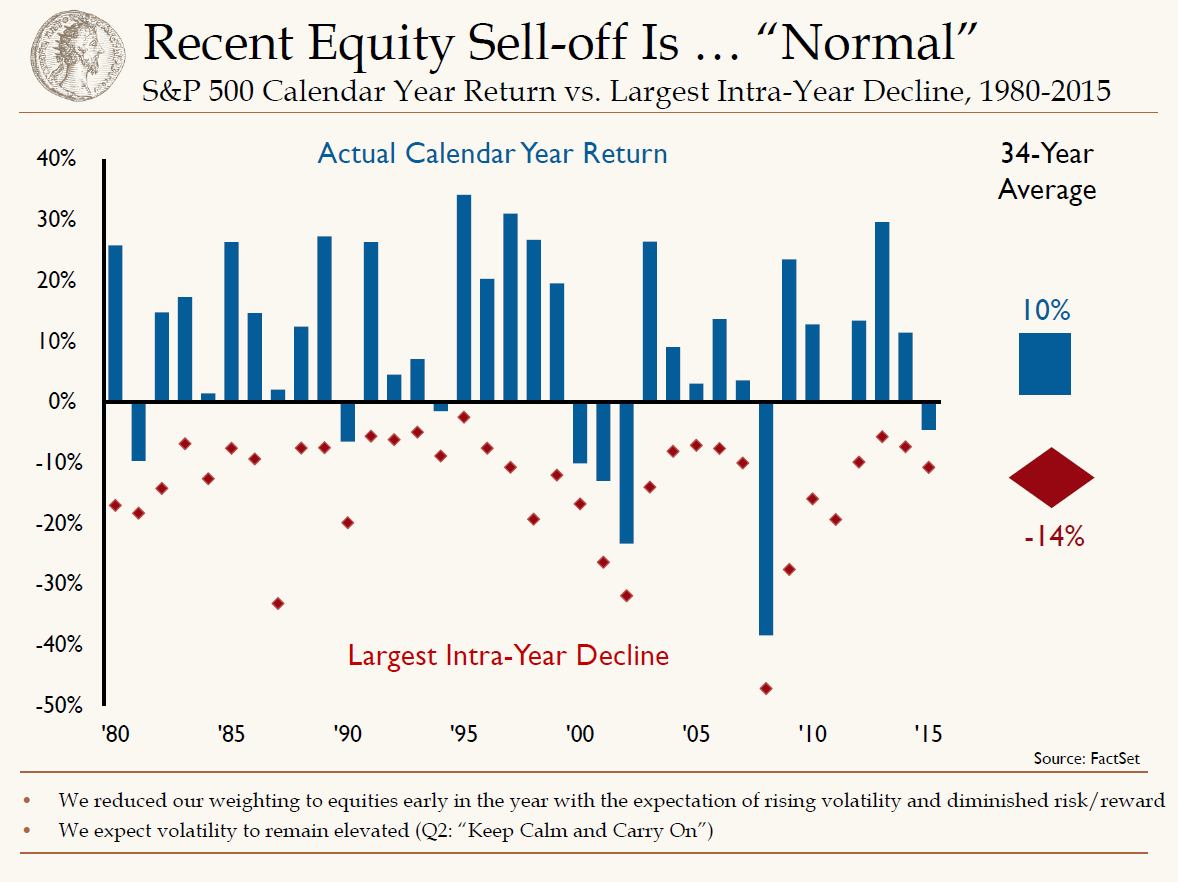
Volatility reigned supreme over the summer. The old Wall Street adage of, “Sell in May and go away,” was prophetic in 2015. Investors had become somewhat complacent the first several months of the year. The market was trading in a relatively tight range and volatility was at a minimum. In mid-May, the S&P 500 closed its all-time high of 2,130.82. As we rolled into June, the media was posing the question, “Should investors sell and move to the sidelines?” June through September is historically the worst period for investing; however, stocks are still positive. Selling in May and going away, in hindsight, would have been the right move. Emerging markets, notably China, Russia and Brazil, began to cause concerns. A major selloff in Chinese equities, lower-than-expected economic growth and a currency devaluation resulted in a major sell off in equities globally. The S&P 500 hit a low of 1,867 for the year at the end August and volatility increased meaningfully. During this period, we had to remind clients that volatility is very common; we have just been in a period of low volatility. In 2013 and 2014, only 15 percent of the time, the S&P 500 was up or down over 1 percent. In 2015, that is closer to 25 percent, which is more in-line with the long-term average. Also, the chart below highlights intra-year volatility; however on average, stocks are still positive.

Capture

Over the last 35 years, the average largest intra-year decline has been 14 percent, as shown by the red diamonds. Even in the face of these declines and volatility, the average return for the S&P 500 is 10 percent. This year, we saw a 12 percent drop from peak to trough and we believe that we have already seen the lows of 2015.

As we move into earnings season, the S&P 500 is roughly flat on the year. The volatility experienced in the summer continues as investors sort out exactly how slow global, primarily emerging market, economic growth is? How healthy is the U.S. consumer? And when will the Federal Reserve finally raise interest rates?

Regarding the Fed, the market is discounting a 30 percent chance of a December rate hike. While the employment picture in the U.S. continues to improve, low inflation and global uncertainty has kept the Fed on the sidelines. We believe that the likelihood is closer to 50/50 for a year-end rate. Whenever it occurs, the pace will be a lot slower than previous tightening cycles.

The emerging markets continue to be a headwind to U.S. growth. With recessions in Russia and Brazil, coupled with massive currency devaluations, U.S. exports continue to struggle in those markets. China, while still growing, is slowing. Earlier this month, the Chinese reported GDP growth of 6.9 percent for the third quarter. We believe that the real growth is lower, but positive. The primary slowdown is coming from the industrial areas, while the consumer continues to remain relatively strong. We’ve seen this in the individual companies we follow. For instance, Caterpillar is showing major declines in their business in China, while Apple and Nike are still experiencing growth.

Finally, while exports to emerging markets have been a headwind for the U.S. economy, the key factor is still the consumer. We believe that the state of the U.S. consumer is strong and continues to get better. Consumer confidence is high and wages are slowly moving up. The factor that we are not yet seeing on a meaningful basis is increased spending. The drop in gas prices has resulted in consumers paying down debt, rather than spending more. We believe that eventually this savings will be deployed into the economy as gas prices remain. This will result in an additional tailwind for U.S. economic growth.

With this backdrop, we believe that with interest rates rising and U.S. economy delivering healthy growth, investors should not shy away from equities. If they got out of the market earlier this year due to the volatility, we would be putting those funds back to work.

Our Takeaways for the Week

  • Volatility is more common than investors perceive
  • We continue to be positive on the U.S. economy and consumer

Disclosures

Opening the Floodgates

Shawn-00397_cmykby Shawn Narancich, CFAExecutive Vice President of Research

All Over the Board

Investors anxious to put concerns about the broader economy behind them and focus on the “micro” view of company earnings were treated to a barrage of numbers this week that varied in impact as far and as wide as the industries represented. In many ways, what investors are seeing in the early days of earnings season is representative of key themes year-to-date: heightened levels of mergers and acquisitions are exemplified by Dell’s record-breaking $67 billion deal for EMC, hit-or-miss economic data that once again has Wall Street prognosticators pushing the first Fed rate hike further into the future, and an earnings picture that’s as eclectic as a Picasso. And no list of key themes from 2015 would be complete without acknowledging closely-followed remarks from oilfield services leader Schlumberger opining about tightening oil markets that point to a brighter future ahead for beleaguered energy investors.

Changing of the Guard

Retailing doesn’t typically jump off the front pages of business news this early in reporting season but what came out of the folks from Bentonville, AR earlier this week turned heads. Investors have known for some time the challenges Wal-Mart Stores Inc. faces with Amazon’s web-based retailing model, smaller format dollar stores that have chipped away at its store traffic, and rejuvenated competitors like Kroger that have made life tough on the company that derives 55 percent of its sales from the grocery aisle. That said, few foresaw the bomb that management dropped on investors when it slashed earnings guidance next year by 12 percent amid new forecasts calling for flat sales and a prolonged decline in profits. While the degree of Walmart’s business deterioration is surprising, what isn’t is how investors responded: taking the stock down by 10 percent Wednesday and destroying $22 billion of market capitalization in the process. Investors tempted to bottom fish this one should be forewarned – the workout for Wal-Mart will be neither quick nor painless.

In a related vein, broader retail sales data reported this week was disappointing, declining sequentially even after adjusting for lower priced gasoline.  Notwithstanding the weaker tone of September retail sales, we continue to believe that the consumer is in good shape, benefiting from the aforesaid decline in fuel prices, a healthy job market, and low interest rates.

Banking on Earnings

On the banking front, investors received earnings updates from the money center banks this week and, by and large, the results hewed to our expectations: weak results in trading and capital markets offset by solid single-digit loan growth amid challenged net interest margins. Bank of America and Citigroup stood out to the upside while J.P. Morgan and Goldman Sachs struggled with challenges in fixed income, commodities, and currency trading. The major banks appear to be doing everything they can to reduce discretionary expenditures in the face of ongoing pressure to core net interest income that is being disadvantaged by zero interest-rate policy from the Fed. We remain overweight financials with the expectation that rates will rise, boosting margins and unleashing substantially better levels of profitability.

Our Takeaways from the Week

  • The floodgates of earnings season opened this week, as money center banks and various other blue chip companies reported third quarter results
  • Disappointing retail data and nearly non-existent inflation have investors deferring rate hike expectations into 2016

Disclosures

Upside Down

Ralph-00338_cmykby Ralph Cole, CFAExecutive Vice President of Research

Upside Down

This has been one of the most interesting trading weeks of the year. The seasonal pattern of the stock market is to bottom in October, and rally through the end of the year. While this doesn’t happen every year, so far in October we are following that script. The S&P 500 sold off sharply following the Fed’s decision not to raise interest rates at the September meeting, but found bottom last Friday and has rallied ever since.

Often times the fourth quarter rally is led by names that have performed poorly in the first three quarters of the year. This week was no exception. Through the first nine months of the year energy, materials and the industrial sectors were down 21 percent, 17 percent and 10 percent respectively. Over the last week energy stocks are up 7 percent, the materials sector is up 6.5 percent and industrials are up 6 percent.

Two questions come to mind: First, why did this happen? Secondly, is it sustainable?

Growth stocks were in favor for the first nine months of the year. This is typical during periods of slow global growth as investors are willing to pay handsomely to get the kind of sales growth we have seen in Netflix, Amazon and the healthcare sector. At some point, these names become very expensive. The global slowdown has been led by China, and this past week economic data has been a little better in that country. Probably not enough to signal a huge change in their economy, but enough to spook investors regarding short positions in the more cyclical parts of the market.

As a firm, we believed that oil prices and the energy sector were due to rally because of supply and demand responses in the energy markets. Specifically, low oil prices have caused gasoline demand to rise here in the U.S., while simultaneously causing a drop off in oil production. Historically this combination has always led to higher oil prices and oil rallied nearly 10 percent this week alone.

Whether or not this change in the trend is sustainable remains to be seen. The developed economies of the world remain the engines of growth of the global economy. Demand from the U.S., UK and Europe need to rescue growth in flagging emerging market economies. We believe that this will be the case in the coming months, but doubt that the market will continue its recovery in a straight line. Slow growth accompanied by Fed uncertainty will lead to continued heightened volatility.

Our Takeaways for the Week

  • Fourth quarter rallies are common in the stock market, and so far this quarter we are up nearly 5 percent
  • We think global growth will accelerate as we move into 2015, supporting the more cyclical sectors of the S&P 500

Disclosures

To Beat or Not to Beat .... Expectations

by Brad Houle, CFA Executive Vice President

Today the Federal Reserve released the September change in nonfarm payrolls which came in at 142,000 jobs versus the estimate of 201,000 jobs. Also, August data was revised down from the originally reported 173,000 jobs to 136,000 jobs. This data was seen a disappointment and the bond market reacted negatively. According to Bloomberg data, the Federal Funds Futures Market, which is a market in which traders can speculate on the direction of the Federal Reserve raising interest rates, shows only a 2 percent probability of the Fed raising interest rates this month. The probability of the Fed to raise interest rates in December has dropped from a 40 percent probability early this month to a 29 percent probability as of today.

It is important to remember that the U.S. has created an average of 200,000 jobs for the last six months. Since the depth of the financial crisis, the unemployment rate has gone from over 10 percent to around 5 percent where it is today. We prefer to take the long view as opposed to changing opinion on every incremental piece of economic data. Payroll data is notoriously volatile and is a backward-looking indicator. U.S. consumer spending accounts for nearly 70 percent of our GDP or national income and continues to be robust despite a couple of months of job creation that does not meet expectations.

One of our research partners, Cornerstone Macro, published a note this morning with some facts about the U.S. consumer that are worth sharing:

  • Consumer income growth has been a solid 4 percent for the past five years
  • Real income expectations are rising for the first time in 20 years
  • Consumer confidence is trending higher across all income levels
  • Small businesses are having a hard time filling jobs
  • Increasing construction spending is a major support to construction employment
  • Increasing manufacturing construction is a support for manufacturing employment
  • Average hourly earnings is in a rising trend for finance, business services, construction, health and education
  • Auto sales came in at a seasonally adjusted annual rate of 18.2 million units, the most in more than 10 years

We still believe that the domestic economy and the U.S labor market are continuing to heal from the Great Recession. The headwinds from emerging market turbulence and a strong dollar are not large enough to derail this economic expansion.

 Our Takeaways from the Week

  • Job creation for September and the negative revisions for August did not meet economists’ expectations; however, the equity markets largely ignored the data finishing up modestly for the day
  • The bond market reacted more with the 10-year Treasury bonds finishing the day below 2 percent

Disclosures

Flying High Again

by Jason Norris, CFAExecutive Vice President of Research

Flying High Again

Earlier this week Democratic presidential candidate Hillary Clinton announced several healthcare proposals. The focus was to propose policies that aim to keep the price of drugs down. This was on the heels of a specialty drug price for AIDS being raised over 5000 percent from $13.50/tablet to $750 that has since been reduced. However, these proposals highlight the concerns over drug pricing, specifically specialty pharma drugs.

Clinton’s plan would attempt to cap the prices paid for Medicare recipients, increasing drug re-importation, reducing the patent exclusivity for biologics and getting rid of the tax deduction for advertising spending. Although many of these proposals have been presented in some form in the past, headlines were not friendly to the healthcare sector. Since disclosing her proposals, the pharma and biotech industries have fallen over 3 percent. Names that have high priced biologics, such as Gilead Science for Hepatitis C, fell even more. Despite viewing this as an overreaction for a variety of reasons, due to the headline risk, we are not in a big hurry to put new money back to work in the sector.

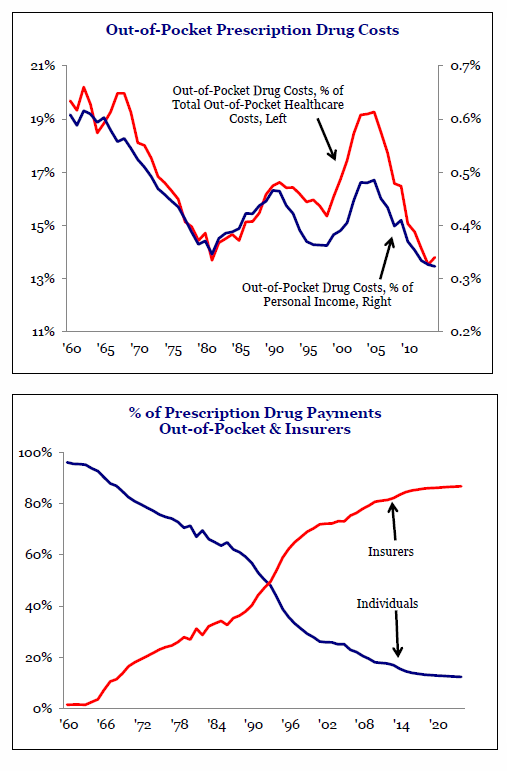
While drug costs are rising and patients are becoming more frustrated with this phenomenon, out-of-pocket costs are at historic lows for consumers. Drug payments are increasingly being paid out by the insurers (see charts).

Graphs

Even if Clinton is elected president, expectations are for the House to remain to the right, thus making it very difficult for any of her proposals to be enacted. The Republicans may be willing to negotiate something on drug pricing but it will probably have to come with broader entitlement reform. Right now it is too early to tell but headlines may reign as we move into the election season.

While insurance providers are paying an ever increasing amount of drug costs they continue to be active in minimizing this expense and are increasingly considering the total cost of treatment. I was able to meet with a handful of insurance companies over the last week and discuss their focus on the total cost of care and preventative medicine. If a drug is very expensive and it can cure a disease that was previously just maintained, they will be inclined to pay for it (i.e., Hep C). Also, they are increasing their focus on compliance and general health with the belief that this will decrease healthcare costs over the life of the patient. The monitoring of vital statistics (blood pressure, cholesterol, weight, etc.) should lead to lower longer-term health spending.

We still believe the healthcare sector offers some great opportunities but headlines will keep volatility elevated.

Our Takeaways for the Week

  • Drug pricing headlines will continue to add volatility to the sector
  • Health insurers are increasingly focusing on the total cost of treatment to manage costs

Disclosures

Slow Ride

by Brad Houle, CFA Executive Vice President


I had a terrible first car - a 1978 Honda Wagon. It came equipped with vinyl seats, a manual choke, AM Radio and was a shade of brown that resembled a very well-worn Buster Brown shoe from that time. Growing up in Montana, the 1978 Honda wagon also did not like to start in below zero weather. It required stomping on the gas several times and pulling out the manual choke as far as it would go. The Wagon had all of 60 horsepower which made driving up a hill or passing another car a tenuous endeavor and frequently required putting the gas pedal all the way to the floor. There was no difference in the Honda's power if the pedal was depressed completely to the floor versus let off a little. The same could be said for the Federal funds rate being effectively zero or .25 percent. There is not much difference in the impact on economic growth.

On Thursday, the Federal Reserve left the Fed funds rate unchanged, citing global growth concerns. Ultimately, this move seems to be more about the messaging to the markets rather than actually being impactful to economic growth. The Fed does not want to further upset the applecart given recent volatility in world markets by appearing too hawkish and therefore causing financial market participants to fear the Fed will tighten too aggressively.

The Fed funds rate is important as it is one of the tools the Federal Reserve has to stimulate or slow down the economy. Should there be an external shock that requires intervention, with short term interest rates at or near zero, the Federal Reserve has no "dry powder" to stimulate the economy. As such, the Federal Reserve is highly motivated to normalize interest rate policy to allow more flexibility should a crisis arise that requires them coming to the rescue.

With all the hand wringing around when the first rate hike since 2006 will occur, it is also important to remember that a rate increase is good news. It means that the economy is strong enough that the Federal Reserve wants to make certain that it does not get overheated. The labor market has finally healed from the financial crisis and our economy continues to grow.

Our Takeaways for the Week:

  • Domestically our consumption driven economy is doing well with a strong labor market and inflation that is well in hand.
  • Internationally, the economic uncertainty in China and resulting turbulence in emerging markets has caused the Fed to remain on hold

Disclosures

Waiting is the Hardest Part

Shawn-00397_cmykby Shawn Narancich, CFAExecutive Vice President of Research

Seeing the Forest through the Trees

The nexus of anxiety surrounding China and its slowing rate of growth eased this week as both the Red Giant and its neighbor Japan signaled tax cuts and infrastructure spending, the kind of expansionary fiscal policy many market watchers have been anticipating. Chinese leaders have been vocal in attempting to reassure markets about their economy but the latest evidence of declining exports and imports reported earlier this week continues to point to an economy struggling to make the transition away from investment-led growth. Though slower growth in China and recessions in Brazil and Russia are dampening the earnings of U.S. multinational companies operating in these countries, we see nothing more systematic in the latest stock market correction. As they say, this too shall pass.

All Over but the Yellen

All of which brings us to next week’s Federal Reserve meetings, at which time FOMC policymakers will convene to decide whether the U.S. central bank will finally lift short-term interest rates, which have been targeted to zero percent for nearly seven years. Arguably, the Fed has achieved its employment objective as measured by an unemployment rate approaching 5 percent and a job base that has joined GDP in record territory. What hasn’t been achieved is the Fed’s price objective of 2 percent inflation, and though Chairwoman Janet Yellen has signaled her belief that low oil prices and the inflation dampening effect of a strong dollar are transitory, some pundits question the sagacity of moving on rates with inflation so far from the target.

Will Tighter Labor Markets Hold Sway?

We agree with Yellen’s view on both points – our belief is that oil prices have bottomed and will rise from here, and that the best gains of the trade-weighted dollar have already been achieved. What’s driving Fed hawks to be pro-active in raising rates ahead of any visible inflation is the labor market which, according to this week’s Job Openings and Labor Turnover Survey (JOLTS), now sports the highest level of unfilled jobs in 15 years. High demand for jobs relative to the supply of labor could draw disaffected workers off the sidelines but tighter labor markets might also begin to force employers to raise wages and salaries to attract and retain talent. So while investors have yet to see the evidence of a tightening labor market in key statistics, like wage growth and rising unit labor costs, we would argue that the Fed is best served to be anticipatory in setting monetary policy.

Our Takeaways from the Week

  • Equities remain volatile as investors grapple with a slowing Chinese economy and uncertainty about Fed rate hikes
  • We believe the U.S. economy is healthy enough for the Fed to achieve lift-off from zero interest rate policy

Disclosures

Never Can Say Goodbye

Ralph-00338_cmykby Ralph Cole, CFAExecutive Vice President of Research

Never Can Say Goodbye

Market volatility has historically increased before and around Fed tightenings and 2015 is apparently no exception. The Federal Reserve has now held short-term interest rates at essentially 0 percent for nearly 7 years. This policy was deemed necessary to faster recovery from the Great Recession, the biggest financial crisis since the Great Depression. The good news is that the medicine has worked and the “patient”, the U.S. economy, has been out of intensive care for a number of years.

While the U.S. economy is doing fine to varying degrees, the rest of the world appears to be struggling, especially emerging markets. Higher U.S. interest rates will hurt countries that have dollar denominated debt. Slow growth and heavy debt loads have sent emerging market stocks plunging to 5 year lows. Furthermore, if an economy outside of the U.S. has debt that is denominated in U.S. dollars, a stronger dollar hampers their ability to pay back that debt.

All of these factors are now weighing on the Fed’s decision to embark on a tightening cycle. Many believe that a delay is in order because of recent market volatility. On the other hand, Fed governors have signaled that market volatility is not reason enough to delay. Today’s jobs report did not bring much clarity to the situation. Unemployment fell to a new cycle low of 5.1 percent, and jobs grew 173,000 in August. Revisions to the prior 2 months employment growth added another 44,000 jobs than previously estimated. The market sold off today because those numbers might be strong enough to justify tightening in September. The jury is still out on these decisions and we will simply have to wait and see what the data dependent Fed decides when they meet in two weeks. We continue to believe that modestly higher rates would be a “good” thing and are confident that the U.S. economy can handle slightly higher interest rates in the coming year.

Our Takeaways for the Week

  • Market volatility always accompanies the onset of a Fed tightening cycle
  • Despite higher rates, the U.S. economy and stock market can continue to prosper

Disclosures

A Light in the Black

by Jason Norris, CFAExecutive Vice President of Research

A Light in the Black

What a week! With concerns about growth in China, continued deterioration of the Chinese equity market and U.S. investors rushed to the sidelines by redeeming over $17 billion in equity mutual funds and ETFs. This, coupled with concern over when the Fed will raise rates, led U.S. equities to experience a 12 percent correction from recent highs on Tuesday (see last week’s blog for more detail). This was long overdue as it had been almost four years since the S&P 500 had corrected by at least 10 percent, which was the third longest period in history. However, after six consecutive days of selling, on Wednesday the near-term bottom was reached on the S&P at 1867, down from its all-time high of 2130 which was reached on May 21, 2015.

Understandably, rapid downward moves in equities can be disconcerting. We don’t know if we’ve seen the bottom; however, we believe there is a light at the end of this tunnel in the form of domestic market fundamentals. For example, U.S. GDP was revised higher on Thursday from 2.3 percent q/q annualized to 3.7 percent. This was driven by several factors - primarily capital spending and consumer spending. Earlier this month we also saw retail sales numbers revised higher. When this data was originally reported, we did view it with some skepticism since our bottoms-up analysis did show better strength than the broad government reports.

After analysis of the earnings reports for the companies we own, it revealed annual growth in earnings of 2 percent; however, excluding Energy, growth was close to 13 percent. Even when looking at the broad market, earnings growth (excluding Energy) was around 5 percent. This growth was driven by the U.S. consumer and healthcare. These fundamentals signal to us that the U.S. economy is healthy and improving.

Earnings Growth for the 10 Economic Sectors of the S&P 500

Q2 y-o-y growth 2015e
Consumer Discretionary 9.2% 11.3%
Consumer Staples 2.5% 1.7%
Financials 6.8% 15.9%
Healthcare 14.4% 12.7%
Industrials -4.5% -1.0%
Info Tech 4.5% 4.9%
Basic Materials 6.0% -1.0%
Telecom 8.5% 8.3%
Utilities 6.5% 1.6%
Total (ex. Energy) 5.3% 7.0%
Energy -55.7% -56.3%
Total -0.7% 1.0%

Source: FactSet

The table above highlights the underlying sectors of the U.S. market, showing both the actual growth rate for the second quarter and an estimate for 2015. The key to focus on is that commodity prices are bringing down Energy and Basic Materials, and the strong U.S. dollar and China is hurting Industrials. However, when you lift up the hood of the market, corporate America is still exhibiting solid growth.

Our Takeaways for the Week

  • Corporate earnings remain healthy
  • While volatility may remain until the Fed tightens, we still like equities long-term

Disclosures

Keep Calm and Carry On

Shawn-00397_cmykby Shawn Narancich, CFAExecutive Vice President of Research

Feeling Violated

Worries about competitive currency devaluations emanating from China’s small haircut to the yuan last week were supplanted this week by manufacturing related fears that the world’s second largest economy could be experiencing a hard landing. The result was a tough week for equity investors, as European stocks entered correction territory and U.S. stocks fell five percent.

Timing is Everything

As the sell-off accelerated into today’s close, we couldn’t help but wonder what market soothing policy moves the Chinese might institute next, nor could we ignore the palpable sense that the Fed’s lift-off from zero interest rate policy just got delayed again. Volatility in stocks will register with Yellen & Co. as they attempt to time this cycle’s first interest rate hike. However, more impactful will be the continued deflation in commodities that threatens to leave the price level far from the Fed’s stated goal of two percent inflation. As oil seeks out new cyclical lows and Treasuries benefit from a flight-to-quality bid, the trade-weighted dollar actually declined today. At a time of increased economic and market turmoil overseas, this hints of US monetary policy remaining easier for longer.

Reasons For Optimism

Low fuel prices and an increasingly healthy job market are combining to boost the collective spending power of U.S. consumers, helping drive the economy to what we believe will be a stronger second half of the year. Notwithstanding this week’s pullback in stocks, we look forward to a better second half of the year for corporate America, which should benefit from easier foreign currency comparisons and a turnaround in oil prices, two key factors that have helped keep earnings flat so far this year. As profit visibility improves, we expect stocks to make forward progress.

Ringin’ the Till

With all but a small number of companies having now reported, the sun is setting on a second quarter earnings season characterized again by companies under promising and over delivering. Retailers book-ended Q2 numbers this week by reporting a decidedly mixed bag of results. While America’s largest retailer struggles to grow, Wal-Mart’s rival Target came through with earnings just strong enough to make investors believe that this beleaguered retailer has put the worst of its merchandising and credit breech struggles behind it. Standing out to the upside was Home Depot, which reported another impressive quarter of sales driven by higher house prices and rising home improvement spending. While closing down for the week amidst market turmoil, Home Depot’s stock outperformed the broader market as management once again raised its profit forecast for the year.

Our Takeaways from the Week

  • A sell-off in global equities pierced the veil of U.S. market tranquility
  • Retailers concluded second quarter earnings season by reporting mixed results

Disclosures

All the Beer in China

by Brad Houle, CFA Executive Vice President


Currency markets are extremely difficult to grasp and most people’s experience with foreign currency is limited to travel. These experiences generally involve moments where someone realizes they just paid roughly six dollars for a Diet Coke at the Eiffel Tower or that they can buy a substantial amount of beer for the equivalent of a dollar in China. This week the news that China had devalued its currency the renminbi or (RMB) by two percent was headline financial news and drove market volatility around the world. Two percent is not a lot of anything so why does this matter so much? On the surface, having a strong economy and a strong currency should be the goal of every country. However, in times of economic weakness central governments only have a few leavers to pull to stimulate economic growth.

One of the obvious and favorite methods is to stimulate economic growth to lower interest rates. This has been done in the United States since the financial crisis and numerous other governments around the world have used this play from the economic rescue playbook. One of the other techniques is to have a weak currency. Having a weaker currency gives a country a potentially large economic tailwind because it makes goods that are exported from the country with a weak currency relatively less expensive when exported to a country with a stronger country. To use a beer analogy, Tsingtao beer from China is normally 8 dollars a six pack at the supermarket and Stella Artois from Belgium is also around the same price. If China devalues its currency, the beer distributor can then buy Tsingtao for a discount because the U.S. dollar buys more Chinese RMB and therefore more Tsingtao. The relative price of the Tsingtao is now less than the Stella Artois and consumers will substitute the less expensive good for the more expensive good. It can be broken down to an ECON 101 scenario of supply and demand and consumer preference. If you then multiply this effect by a billions of dollars of exports from China or another country devaluing its currency it becomes impactful.

Officially, most countries profess to maintain a strong currency policy as that is often associated with a strong economy. Zhang Xiaohui, an assistant governor of the central bank of China, was quoted in The New York Times stating that the RMB is a strong currency and there was "no basis for the continued depreciation of the renminbi." The decision to depreciate the RMB was characterized by the Chinese government as a move to make the currency more market-oriented.

The fear by investors is that this is a sign that China is struggling to keep its economy growing. While China's last GDP growth number was 7 percent year-over-year, there have been worries about the Chinese economy slowing and that the actual growth rate was materially lower than what was “officially” reported. Data has been mixed relative to economic growth in China with worries about a property market bubble and economic indicators such as auto sales being very weak.


Our Takeaways for the Week

  • Currency devaluation can be positively impactful to economic growth as it creates a tailwind for an export economy
  • The signal that the markets took from the Chinese currency devaluation this week was that the growth in China is possibly weaker than the government was officially reporting

Disclosures

Good News First

by Jason Norris, CFAExecutive Vice President of Research


Good News First

The jobs market continues to chug along adding 215,000 jobs in the month of July with upward revisions to June and May of 14,000. While this is a solid pace of gains, it hasn’t been strong enough to push wages higher.

Equity markets, on the other hand, have struggled the last several sessions, despite favorable earnings reports. We have seen the major declines in profits in the energy sector; however, the rest of the economy seems to doing well. With just under 90 percent of companies in the S&P 500 reporting second quarter earnings, year-over-year profit growth could very well be negative 1 percent. While nothing to write home about, the main culprit has been the energy sector. Energy earnings are going to be down close to 60 percent year-over-year. If you back out the energy sector, earnings for the rest of the market will be up 5 percent year-over-year. Healthcare, consumer discretionary and financials have led the way higher. We recommend that investors don’t get caught up in the headline numbers, especially now that one sector is having such a major impact on the overall number.

The price of oil won’t necessarily be helping out the energy sector in the third quarter. With WTI at $44, it is close to its March lows. We moved to an overweight in the energy sector six months ago with the belief that as prices fell, demand would increase and supply would decline. What surprised us was the supply side. While rig count has declined by 60 percent domestically, U.S. supply has been somewhat slow to respond to reduced drilling activity. Nevertheless, U.S. supply has peaked and should decline into the second half of the year. We contrast the ex-growth situation domestically with OPEC, where key producers Saudi Arabia and Iraq have combined to boost cartel volumes by 6 percent so far this year. Aside from flattened production domestically and OPEC’s production growth this year, the key to our call for higher oil prices is stronger than commonly perceived demand growth and production from non-U.S., non-OPEC regions around the world. Despite oil prices that reached $140/barrel in 2008, this key source of global supply has failed to deliver any additional production over the past eight years. Our bet is that if additional volumes weren’t forthcoming in more propitious times, this key source of approximately 54 million barrels/day of supply is likely declining at currently depressed prices. Therefore, it will increasingly help to balance the market. We still believe oil will be closer to $70 then $40 at year-end and are focusing on companies with strong balance sheets to weather this near-term storm.

Only a Matter of Time        

Recent economic data has not been conducive to a September Fed rate hike. While the unemployment rate at 5.3 percent is a positive sign, coupled with weekly jobless claims at historic lows, there is still a lot of slack in the labor market. There are currently over 5 million jobs that are available, which is an all-time high. While this data signals a tight labor market, the unemployment rate figure does not. Also, wages aren’t increasing at a rate that is a threat to inflation. Earlier this week, the Employment Cost Index showed only a 2 percent increase in labor costs, which comprised 2.1 percent in wages and 1.8 percent in benefits. Today’s jobs report confirmed this with hourly wages rising only 2.1 percent.

We believe a Fed rate hike will happen before the end of the year. Given current data trends, whether it is September or December is a toss-up. We have seen and read about indications that the Fed wants to start the process; however, we believe the data is still signaling uncertainty.

Our Takeaways for the Week

  • The Fed will raise rates by the end of 2015
  • Stocks continue to be weak, which could be seasonal, but we believe that fundamentals are still attractive


Disclosures

Summertime Blues (and Yoo-hoos)

by Ralph Cole, CFA Executive Vice President of Research

Summertime Blues (and Yoo-hoos)

Earnings season is a whirlwind period of companies reporting their most recent quarterly results. We believe that this tends to be a better indicator of what is going on in the than most aggregate economic statistics. Large U.S. corporations touch virtually every corner of the world, and then report back to Wall Street every three months. This real time data has proven to be more reliable than government economic statistics. What do we mean by that?

Let’s take first quarter GDP, for example. When the Bureau of Economic Analysis first reported U.S. GDP growth for the first quarter it was +.2 percent. While not robust, it was at least positive. The next month they updated their estimate, and decided that the U.S. economy actually contracted .7 percent in the first quarter of the year. Then, last month the BEA updated their numbers again and came back with -.2 percent. U.S. GDP is destined to be revised for years to come. As investors we have to rely on what the companies are telling us in order to anticipate the direction of the global economy.

Thus far, what we have learned from second quarter earnings reporting is that the consumer is in good shape, but they are discerning amongst brands and retailers. The oil and gas slowdown is for real and it is hurting not only energy companies, but industrial companies that sell into that market as well. Banks, technology and healthcare have all seen relatively healthy growth here in the U.S.

Globally companies are citing re-acceleration in Europe despite the headlines in Greece. Weakness is evident in commodity-dependent countries such as Canada, Australia, Brazil and Russia. The materials sector has fallen on weak prices, which is especially troublesome for companies with heavy debt loads.

A number of companies and industries have executed very well in this challenging environment. For example, Amazon is starting to show some profitability along with continued growth. Regional banks are reporting strong loan growth and record low default rates. Biotechnology remains a source of strength for the market with both Gilead and Amgen beating estimates. However, earnings season remains challenging because stocks that miss estimates are punished severely.

Our Takeaways for the Week

  • U.S. economic statistics are important, but have to be understood in context of other data because they are often revised multiple times and for several years
  • In general, companies are managing well through a mixed macroeconomic environment

Disclosures

Earnings In Focus

Shawn-00397_cmykby Shawn Narancich, CFAExecutive Vice President of Research

More Than Meets the Eye

While US stocks have remained in a trading range through the first third of earnings season, what lingers beneath the surface belies a market near recent highs. Set against a quiet week on the economic news front and at a time when the Greek melodrama is again fading from the headlines, investors put their full attention into discerning the health of corporate America. As measured by the market capitalization of reporting companies, this past week marked the most significant period of the second quarter earnings season. Though a plurality of those delivering numbers are beating bottom line estimates, revenues are coming in much more mixed given continued headwinds from the stronger dollar and weakening growth in China. Indeed, the Red Giant confirmed the latter earlier today by reporting surprisingly week manufacturing numbers that furthered the sell-off in commodities, rallied the dollar, and boosted bonds.

Not Sleepless in Seattle

In an earnings report that bore some resemblance to Google’s expense-driven earnings beat last week, internet commerce mainstay Amazon.com proved that even it can make money when it stops spending so much. Revenue growth has never been the problem for the folks headquartered in the Emerald City and, on that measure, Amazon continues to excel, reporting accelerating revenue growth that beat estimates.  What was somewhat surprising is that Jeff Bezos’s gang allowed some of the top-line largess to the bottom-line, reporting perhaps the most celebrated $92 million profit ever.  Once again, shorts betting against Amazon got hammered, as the stock surged 10 percent on the news in an otherwise down market. Although a resulting net profit margin of 0.4 percent is certainly not what most companies aspire to, it helped create $22 billion of wealth for Amazon’s shareholders today. For our part, we continue to avoid companies trading for 372x estimated earnings.

Not to be outdone by its Seattle neighbor, consumer darling Starbucks also delivered an upside earnings surprise, reporting that its new mobile ordering initiatives are helping drive traffic and boost same-store sales, which surged 7 percent. On the back of healthy top line growth that translated into a 24 percent earnings gain, Starbucks investors were greeted with further gains in the stock.

An Apple Bitten

In contrast to the wealth created by Seattle-based firms this week, Apple ceded some of its prodigious market value on reduced revenue guidance tied to moderating iPhone sales. While 33 percent quarterly sales growth for a company of Apple’s size is nothing short of extraordinary, when you get to be a company with annual sales approaching $230 billion, it’s only natural for investors to question what a company like this can do for an encore. For our part, we continue to view favorably the prospects of this reasonably valued technology titan.

Our Takeaways from the Week

  • A heavy week of corporate earnings produced mixed results for investors
  • Concerns about a slowing China continue to weigh on commodity prices

Disclosures

Smoke and Mirrors

by Brad Houle, CFA Executive Vice President


Gyrations in the Chinese A-share stock market have been a big topic in the financial press recently. The questions that we are getting from clients all center on what the broader implications might be for the Chinese economy and the impact on Western economies. Bottom line, the Chinese A-share market gyrations are a circus side show that will not have real impact on the actual economy of China or the economies of the U.S. or Western Europe.

In fact, the recent events in the Chinese stock market are an excellent primer on what NOT to do while trying to develop free price capital markets. Currently, the A-share market is more rigged than a game of Three-card Monte and the government in Beijing is determined to build the world’s biggest casino. There has been a dizzying array of strategies employed by the Chinese government to first inflate the value of the market and then attempt to control its inevitable decline. Most investors in the A-share markets are Chinese retail investors. The use of borrowed money or margin was encouraged and the A-share market became the most levered financial market of all time for a short while. Since the market started its downward slide, margin debt has now been restricted. In addition, if you are a greater than 5 percent holder of a stock, you are now not allowed to sell for six months. In addition, 200 companies listed on the Shanghai exchange have suspended trading. This is only a partial list of the heavy handed tactics utilized by the government in an attempt to control the stock market. Capital markets that are free from unnecessary regulation and are as transparent as possible are vital to build trust with global investors. While China has gotten it wrong in the short-term, eventually they will get it right as the country transforms to more of a free market economy.

The Chinese A-share market is a rounding error in international equity indexes and Chinese exposure for our clients is accomplished via exposure to Hong Kong and its stock market’s H-shares, as well as Chinese companies that trade on American exchanges. Unless you are a retail investor in China who is invested in the Chinese A-share market, it is not impactful. What is important, however, is what happens in the Chinese economy.

Chinese GDP was released this week at a 7 percent year-over-year growth rate. It is an old story that global investors look at Chinese economic data with skepticism. If you look deeper at other economic indicators in China, the data suggests that a number much lower than 7 percent GDP is probably closer to the truth. One of our research partners, Cornerstone Macro, points out that as business confidence is at the lowest level in 16 years, electricity consumption is up just 1.8 percent, auto sales are down 40 percent and bank loan demand is lower. As such, Cornerstone theorizes that actual GDP growth is likely closer to 5 percent. China is the number two economy in the world, and what happens with the trajectory of the Chinese economy is impactful to the world economy. Currently, the U.S. and European economies appear to be decoupled from the Chinese economy and are benefiting from lower commodity costs and strong domestic economies.

Our Takeaways for the Week

  • The Greek parliament voted to enact reforms agreed upon with the European Union this past Thursday. Once again, the “can” of the Greek Financial Crisis is getting kicked down the road
  • The Chinese A-share market is unimportant in the global economy. Performance of the broader economy in China is of vital importance to the world economy and the trajectory of growth or lack of growth is something we are monitoring closely

Disclosures

Patience

by Ralph Cole, CFA Executive Vice President of Research

Patience

It’s been a strange week in “Euroland.” After a resounding “no” vote on the Greek debt bailout referendum last Sunday, it appeared that Greece was on its way out of the Eurozone. Capital markets promptly sold off early in the week.

Today it appears that Greece has delivered a reasonable response. “The program they are presenting is serious and credible,” said French President François Hollande.

We must admit that we have a tad bit of Greek fatigue in recent weeks, but it is clear that Greece is on everyone’s mind these days. The country has presented a 3-year plan, which is better than some of the temporary schemes that have been floating around the past few months. If it is accepted over the weekend, markets should continue to move higher along with yields. The removal of this distraction will allow the ECB to continue focusing on the nascent European recovery.

We continue to have our doubts for the long-term sustainability of Greece within the Eurozone. It doesn’t appear to us that the Greek people are committed to the structural changes that need to take place in order to pay their debts and make their economy more competitive in the future. This will not be the last time we talk about Greece’s debt, economy and leadership.

Roller Coaster

Compounding the volatility induced by Greece was the roller coaster known as the Chinese A-share market. As China tries to open its capital markets, they also must learn how to govern them.  Much like holding water in your hands, the tighter you grip, the more water that slips through your fingers. Confidence in the system is the most important element to a successful exchange. The more China tries to prop up their market the less confidence investors have in their system.

We are more concerned with underlying growth in China’s economy than we are with the volatility in their A-share market. It is clear that China’s growth is slowing and it is nowhere near the 7 percent reported by the Chinese government. Growth around the world is challenged and China’s growth is needed until the stimulus by other countries gets their economies growing.

We will continue to monitor their real economy closely in the coming months. We expect growth to pick up around the world in the second half of the year, but that forecast has come into question in recent weeks.

Our Takeaways for the Week

  • Proper investment patience kept prudent investors from overreacting in a week packed with news flow
  • Growth in the second half of the year should propel markets modestly higher

Disclosures

Mind the Gap

by Jason Norris, CFAExecutive Vice President of Research

Volatility in the second quarter reigned in both equity and bond markets. Interest rates rose close to half-of-a–percent, resulting in negative returns for bonds. While U.S. equities were volatile, they ended the quarter relatively flat. International markets were roiled in June with China equities moving into bear market territory following a parabolic run and as for Greece…

In the face of this uncertainty, we are still constructive on equities for the back half of 2015. The U.S. economy is slowly improving. Excluding energy, corporate profits should still exhibit high single-digit growth and equities are still relatively inexpensive. Therefore, with the Fed set to raise interest rates later this year, bonds will continue to face a headwind, thus equities warrant an overweight versus fixed income.

While headlines reported a healthy increase of 223,000 new jobs in the month of June, analyst expectations were a bit higher. Also, previous reports were revised lower and the labor participation rate declined, which resulted in a lower unemployment rate of 5.3 percent, which is a seven year low.

One of the major disconnects in the job market is that there are close to 5.4 million job openings currently in the U.S. This is the highest level we’ve seen since January of 2001. We believe this will provide a tailwind throughout 2015 in the labor market.

There are a lot of mixed data in Thursday’s report that can help us assess if it’s too hot, too cold, or just right. Therefore we do believe that our call that the Fed will raise rates later this year has not changed.

Grexit, Greferendum, Grapituation and Gratigue

Frankie Valli sang it best in 1978, “Grease is the word.” After missing a payment to the IMF on June 30, Greece headlines have rattled markets in the last few weeks and that volatility are here to stay with the possibility of a pending referendum on July 5 and a debt payment due to the ECB July 20. The key issue we are focusing on include whether or not the Greek contagion will affect other nations in southern Europe. Whether we have yet to see if the Germans will let the Greeks leave the Eurozone or if they will be “hopelessly devoted.” What has changed since 2010 is that Greek debt is now held by government agencies, such as the IMF and ECB, not banks. In 2010, 140 billion euros of Greek debt was held by global banks, with over 100 billion of that amount being held by European banks. The amount held by banks has dropped by over 100 billion with the European banks, on the hook for less than 20 billion.*

We don’t want to handicap the pending referendum (on whether vote for or against austerity) by the Greek people and current polls show a dead heat. What we do believe is that volatility will continue in July, fueled by Greece and earnings season; however, by year-end this Greek drama will be in the rear-view mirror.

Our Takeaways for the Week

  • U.S. economic growth is improving and corporate profits will follow suit
  • Greek headlines are just that, more headline risk than fundamental risk to the global markets

*Euro to US Dollar exchange rate was +0.13367 percent at time of publication.

Disclosures