

by Jason Norris, CFA
Director
Equity Research and Portfolio Management
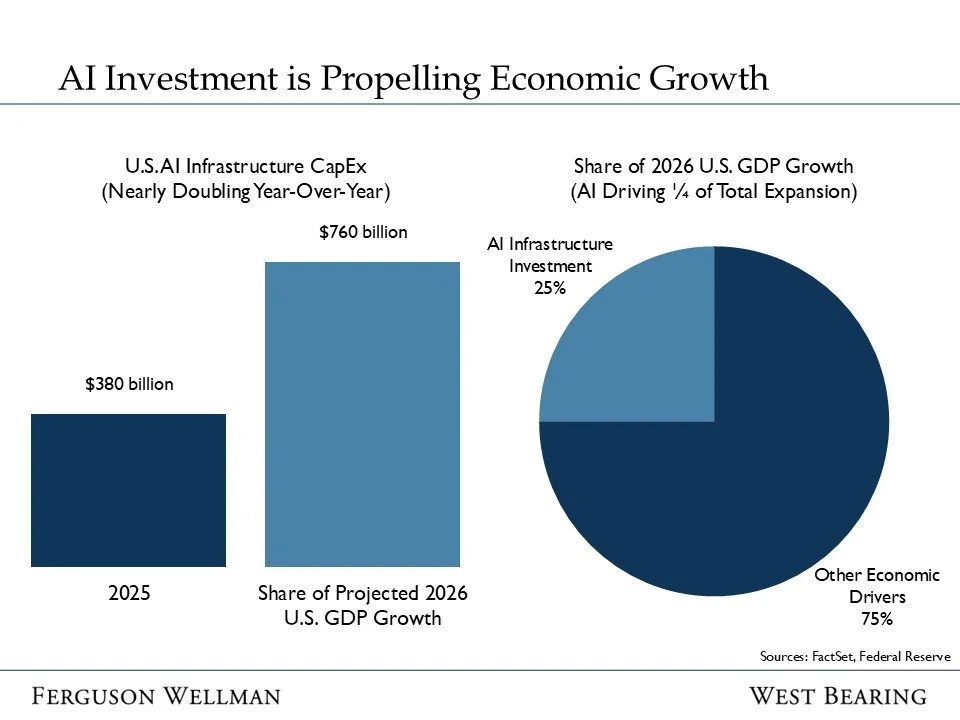
In 2026, analysts expect investment in artificial intelligence (AI) in the U.S. to nearly double. As reported by Goldman Sachs, this will bring AI infrastructure spending to roughly $760 billion, with spending expected to exceed $1.0 trillion next year, eclipsing the total budget for the Defense Department.
Sources: FactSet, Federal Reserve
This rapid increase is a key driver of U.S. economic growth, accounting for a quarter of expected GDP expansion in 2026. To put this in perspective, business spending only makes up 15% of GDP, while consumer spending accounts for 70%.
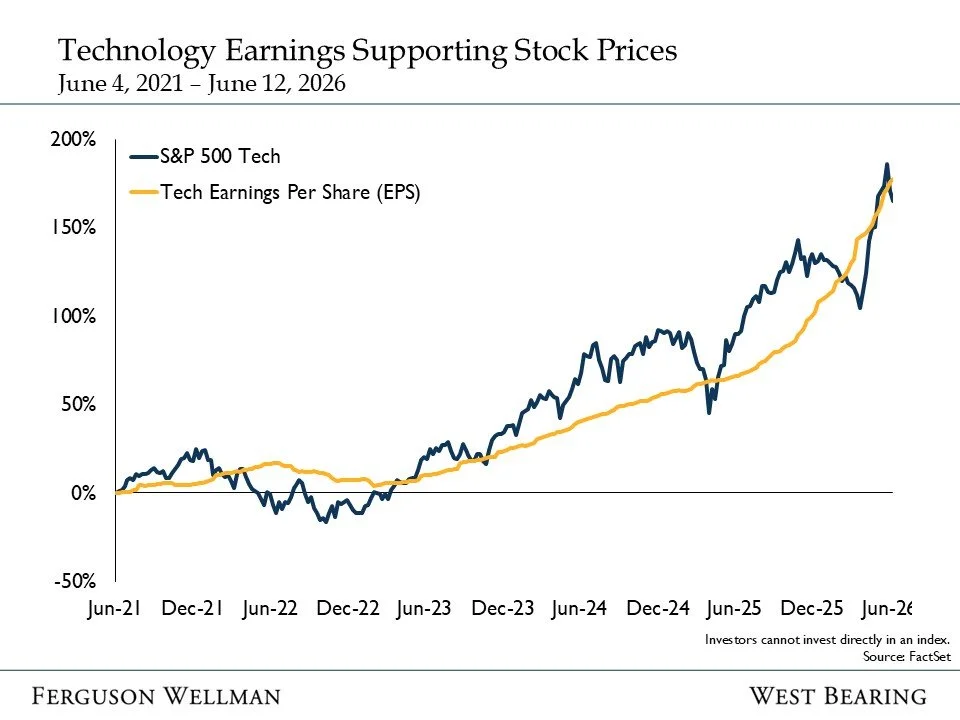
The enthusiasm for AI has driven technology-related stock prices as well. The chart below shows the S&P 500’s Technology sector return since 2020, as well as cumulative earnings growth. Given the performance of technology stocks over the last five years, there have been growing concerns about a possible bubble, as we saw in the late 1990s. What appears to be different today is that earnings have largely supported this growth. Technology stocks are up over 165% in five years, while earnings have risen close to 180%. We do not currently believe this is a bubble.
Source: FactSet
American Ledger: A 250-Year Financial Perspective
With our country reflecting this summer on the Spirit of '76, our team recounts how 2026 economic themes have evolved from our founding days.
In 1776, Scottish philosopher and economist Adam Smith published The Wealth of Nations, permanently changing how the world understood money, trade and human potential. Before Smith, global powers believed wealth meant hoarding gold. Smith turned that idea on its head, proving that a nation’s true wealth flows directly from the productivity of its labor. To prove his point, he famously shared an example of a pin factory, showing how breaking a complex task into specialized steps allowed a small team to manufacture thousands of pins a day instead of just one.
His radical ideas crossed the Atlantic and reshaped history. Adam Smith was a profoundly influential economic authority during the formation of the United States, shaping the debates that built America's financial and political infrastructure. While The Wealth of Nations was published in 1776, the exact same year as the Declaration of Independence, it took a few years to cross the Atlantic. It the 1780s and 1790s, however, it had become widely read by the Founding Fathers, who utilized Smith's ideas to support their competing visions for the new republic. Thomas Jefferson praised it as the best book in existence, while Alexander Hamilton used its blueprint to design the U.S. financial system.
If Smith were here today to witness the rise of AI, we imagine he would not see an economic threat, but rather the ultimate, hyper-evolved tool for cognitive specialization. Just as mechanical looms facilitated manual labor in 1776, AI automates routine mental tasks today, allowing humans to focus on higher-level strategy, creative innovation and complex decision-making.
Far from fearing a jobless future, Smith might argue that AI would lower operational costs, unlock unprecedented wealth and catalyze entirely new industries. History shows that whenever technology makes a service cheaper, society finds new, creative ways to expand. Today, true to his core principles, Smith may simply issue one timeless free-market warning to today's leaders: keep this powerful technology open, competitive and free from monopolistic control.
Takeaways for the Week
Stocks rallied in the latter half of this week on hopes of a deal with Iran, which also resulted in a decline in the price of oil
Inflation data this week was “hot” due to elevated oil and gas prices, however, we believe that these pressures will subside later this year
Disclosure
The views expressed represent the opinion of Ferguson Wellman. The views are subject to change and are not intended as a forecast or guarantee of future results. This material is for informational purposes only. It does not constitute investment advice and is not intended as an endorsement of any specific investment. Statements of future expectations, estimates, projections and other forward-looking statements are based on available information and Ferguson Wellman’s views as of the time of these statements. Past performance may not be indicative of future results. Ferguson Wellman, Octavia Group and West Bearing do not provide tax, legal, insurance or medical advice. This material has been prepared for general educational purposes only and not as a substitute for qualified counsel who can determine how this information applies to you. We believe the information provided is from reliable sources but should not be assumed accurate or complete.
Please see additional disclosures.