
Weekly Market Makers

Liquid Courage

by Jason Norris, CFA Executive Vice President of Research

Volatility increased this past week in most asset classes with oil being in focus. In the last two weeks, crude oil is up roughly 20 percent, its best two-week move in 17 years. While the demand picture has not changed, we have seen U.S. oil and gas companies announce major employment cuts and capital expenditure reductions for 2015. We believe that there has been some “short covering” in the market which has led to recent strength. Our belief is that by year-end, oil prices will be between to $60-$70/barrel, due to reduced supply in the U.S. In the face of this, we do believe we see some opportunity in energy stocks. While earnings continue to come down, we think we can find value in select names with strong balance sheets.

All Over the Road

As mentioned earlier, the energy complex was not the only asset class exhibiting volatility. In the first five weeks of 2015, the S&P 500 has been either up or down more than 1 percent 11 times, which is 44 percent of the trading days. To put it in perspective, last year the S&P 500 moved this much only 15 percent of the time. The chart below highlights the last five years.

Days the S&P 500 Was Up or Down More Than 1 Percent

2011 2012 2013 2014 2015
Number of Days 96 50 38 38 11
Percent of total trading days 38% 20% 15% 15% 44%

Source: FactSet

This year is setting up to be similar to 2011, a year that  saw a lot of uncertainty due to surprisingly poor U.S. GDP growth, a U.S. debt downgrade and the European crisis coming to the forefront. All this uncertainty resulted in a flat market for 2011, but it was a rollercoaster ride. We believe the fundamentals of the U.S. economy and the recent actions of the European Central Bank leave the foundation of the global economy a little firmer. We don’t think the volatility mitigates itself; however, we do believe that equity returns will be better than 2011.

Working for the Weekend

Heading into a wet weekend on the west coast, the monthly jobs report this morning was very strong with the U.S. economy adding 257,000 jobs in January. The unemployment rate ticked up to 5.7 percent due to an increase in people looking for jobs, which is a positive for the economy. This is only a small part of the story. Job gains for December and November were revised higher by 147,000. The third leg of the stool of the January jobs report was an uptick in wages. Wages bounced back after a disappointing December, rising 0.5 percent month-over-month. With a strong labor market and unemployment close to the Fed’s target, we believe this wage growth will persist throughout 2015. This further reinforces our view that 2015 will be a good year for “Main Street.”

Our Takeaways for the Week: 

  • Main Street will fare better than Wall Street in 2015
  • Adding to high quality energy names at this time could pay dividends in 2015

Disclosures

Federal Reserve Bank Basics

by Brad Houle, CFA Executive Vice President

As investors we follow what the Federal Reserve does with a level of geeky interest generally only seen at a Star Trek convention. As a result, the Federal Reserve is a point of interest in our client communications and Outlook presentations. We thought it would be helpful to take a step back and discuss what the Federal Reserve is and what it actually does.

The Federal Reserve is the government’s bank as well as a bank to the bankers. The Federal Reserve has a dual mandate: to provide price stability and full employment. Maintaining price stability is simply not allowing inflation to be too high or too low. Presently, inflation – as measured by the Consumer Price Index (CPI) – is running at about 1.6 percent per year. This is well below the 2 percent target set by the Federal Reserve. The CPI is a basket of goods that includes expenses such as rent, consumer electronics and food. To arrive at the monthly CPI, researchers actually visit stores to price items that go into the calculation that measures inflation.

Too much inflation is a bad thing for an economy because it diminishes the purchasing power of money. Wages often don't adjust upward as quickly as fast-moving inflation, which can cause a decline in standards of living. Hyperinflation occurred in Germany in the early 1920s where the cost of living increased fifteen-fold in six months.

Too little inflation can also be damaging to an economy and ultimately impact the standard of living of consumers. Deflation occurs when prices are dropping which can become a negative feedback loop that triggers economic malaise. As prices drop, consumers delay purchases in hopes of better pricing, which causes the impacted economy's growth to slow. Japan has suffered from deflation for more than a decade. Their central bank is now trying to break the cycle by stimulating Japan's economy in an attempt to resume growth.

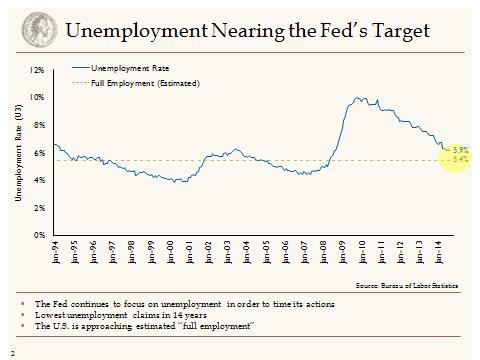
The benefits of providing as much employment as possible are fairly simple. Employed citizens pay taxes and have a tendency to buy things, which drives economic growth. The question then becomes … What is the maximum level of employment? Currently, the Federal Reserve considers 5.4 percent to be full employment. Unemployment will never be zero because there is a segment of the working-age population (from 16 to 65) that is unable to work or unwilling to work. This level of full employment varies among different countries. In some European countries full employment is a high-single-digit number and is often a function of the opportunity cost of not working.

How does the Federal Reserve affect change in the economy to meet its dual mandate? This is where the concept of the Federal Reserve gets fairly abstract. The Federal Reserve can raise or lower short-term interest rates to effectively stimulate the economy if it is growing too slowly or "tap the brakes" if the economy is growing too quickly. This link for a video, although a bit dated, does a good job of explaining the nuance of how the Federal Reserve operates.

http://content.time.com/time/video/player/0,32068,57544286001_1948059,00.html

 Our Takeaways for the Week:

  •  We are early in earnings season for the fourth quarter of 2014 and it has been a mixed bag so far. Multinational companies are starting to show the impact of a strong dollar
  • This is negatively impacting sales in some cases as a stronger dollar makes goods exported from the United States more expense to consumers in other countries

Disclosures

Friends in Low Places

by Ralph Cole, CFA Executive Vice President of Research

In a much anticipated move, the ECB joined the rest of the developed world by announcing a comprehensive quantitative easing package this week. Investors were worried that maybe the plan would not be big enough or long enough to satisfy global capital markets. Bond yields and equity indices gyrated as the official announcement was released but eventually stocks moved higher and European bond yields moved lower. Yields on 10-year bonds around the world remain shockingly low, and it appears they may remain low for some time. Here is a list of global 10-year yields:

U.S. 1.88%
UK 1.51%
Canada 1.42%
France 0.61%
Germany 0.38%
Italy 1.54%
Spain 1.41%
Switzerland -0.20%

Source: Factset

The goal of quantitative easing is to lower longer-term borrowing costs in an attempt to incentivize businesses and individuals to borrow money and invest. Some of the excess liquidity in the system can also flow to equity markets, and drive prices higher. This acts to boost confidence and hopefully trigger investment and spending. This recipe worked well in the U.S. during QE3, and Europe is hoping to follow the same path.

Golden Years

Golden months may be a better term. Somewhat under the radar, gold has turned up in a strong performance in the last three months. It appears that a race to the bottom in currencies is finally starting to resonate with global investors. Gold is up 15 percent from recent lows to nearly $1,300 per ounce. Gold is viewed as a hard currency that can't be debased like fiat currencies. When we held gold in client portfolios several years ago it was for this very reason.

Takeaways for the week

  • Despite a well telegraphed move, the QE announcement by Mario Draghi was celebrated by markets around the world
  • Many developed economies are attempting to deflate their currencies in an effort to boost growth. This has led some investors to purchase gold as a store of value

Disclosures

New Year, New Worries

Shawn-00397_cmykby Shawn Narancich, CFAExecutive Vice President of Research

Deja Vu

Much like January of last year, U.S. stocks are off to a rocky start in the New Year, thanks to a European economy on the verge of stall speed and a plummeting price of oil that’s making investors feel like something other than a small surplus of excess production is afoot. Even after the recent volatility, blue chip stock prices have still tripled since their lows exiting the financial crisis in 2009 and have outperformed international stocks by a whopping 70 percent over the past five years. The question on everyone’s mind is whether a U.S. economy, having now wrapped up what we expect to have been its third consecutive quarter of 3 percent or better growth, can continue to decouple from troubled economies abroad. We still believe that will be the case, as Americans benefit from lower energy prices and a much healthier job market, but positive equity returns in 2015 aren’t likely to come as easily as they did last year.

Banking on Profits?

Our expectation is for U.S. profits to grow by mid-to-high single digit rates in 2015 but, at least for the final quarter of last year, Wall Street expectations are much more subdued. As the fourth quarter earnings season kicks off, investors are expecting earnings to have grown at just a 1 percent clip, reflecting plunging oil prices that will assuredly dent the profits of big oil companies like Chevron and Exxon. What Wall Street may be missing is the positive impact of low oil and natural gas prices on 90 percent of the market’s constituents that are net users of oil and natural gas. While earnings for multi-national companies are likely to be dampened by the stronger U.S. dollar, a clear plurality of publicly traded companies will benefit from lower energy costs that should help boost profit margins.

Regardless of your persuasion, few will argue about the decidedly poor results that banks delivered this week as JP Morgan, Bank of America, Wells Fargo, and Citigroup reported earnings that collectively fell by 12 percent in the period. Unfortunately for investors, the numbers came up short of expectations in all but one case (Wells Fargo), prompting sell-offs in all four names. While lending volumes have picked up in recent quarters, net interest margins are under pressure as deposit costs remain near zero and new loans are underwritten at increasingly low rates. JP Morgan demonstrated that legal costs related to the housing crash remain a meaningful expense item years after the fact, while each of the investment banks reported disappointing results from fixed income, commodities, and currency trading. As reporting season transitions to a broader swath of companies next week, we expect to see more encouraging results.

Off Target

In a move only mildly surprising to those who have followed its travails in Canada, Target announced this week that it will be exiting the country just two years after its first store opening up north. Having never made a penny there, the general merchandiser’s new CEO Brian Cornell has pulled the plug, acknowledging that management couldn’t foresee profits before 2020. The result of Target’s Canadian misadventures? Nearly $6 billion of accumulated losses and write-downs, equivalent to more than the company’s entire profitability for the past two years combined. Yes, this is what gets CEO’s fired, and is a key reason why prior leader Gregg Steinhafel showed himself to the door early last year.

Our Takeaways from the Week

  • Lower stock prices in the New Year reflect worries about flagging growth internationally and dislocations in key foreign currencies
  • Fourth quarter earnings season is off to an inauspicious start thanks to disappointing results at four major banks

Disclosures

The January Effect

by Jason Norris, CFA Executive Vice President of Research

The January Effect

Historically, investors have cited the so-called January indicator in an attempt to forecast future returns. If the S&P 500 is positive in the first five trading days of January, then 75 percent of the time, stocks have enjoyed a positive return for that entire calendar year. With stocks seeking a positive gain the first five days of 2015, we can be hopeful for more of the same come December. With stocks delivering gains two-thirds of the time anyway, this looks to be only modestly significant. While we don't make investment calls based on calendar events and historically superstitions, we at least recognize when the odds are in our favor. As a footnote, the S&P 500 was down the first five days in 2014, and yet we ended the year with positive gains.

Don’t Chase the Hot Dot

Jack Bogle is on cloud nine. The biggest proponent of passive investment management, and founder of The Vanguard Group, saw over $200 billion of inflows from investors in 2014 as frustration increased with active management. In 2014, depending on asset class, 75-90 percent of active equity managers trailed their benchmark. While this lack of alpha is a concern, it is not the most important contribution to an investor’s overall return. The biggest factor is the allocation between stocks and bonds, and then which equities you favor (large cap, small cap, international, ETF, etc.) The U.S. large cap space was the best game in 2014, and the more exposure the better for investors. Finally, there will be periods where passive does better than active; however, over longer periods of time, active is superior. Over the past five years, 50 percent of institutional active managers have outperformed. Over the past 10 years, 75 percent of active managers have outperformed.* The key for investors is patience. Chasing last year’s performance has never been the best policy and taking a long-term view is the best approach.

Our Takeaways for the Week: 

  • 2015 should be a positive year for stocks, though it likely will be volatile
  • Over the long-term, active management beats passive

*Source: Mentor

Disclosures

A Glimpse Into the Continuing Greek Crisis

by Brad Houle, CFA Executive Vice President

Greece, often referred to as “the cradle of democracy,” practices a rather messy form of government by the people. Recently, a presidential election in Greece was considered to be unsuccessful due to a lack of a majority vote in the third round of voting. Due to this failed election, the Greek Parliament needs to be dissolved and general elections need to be held. This matters because the composition of the new government is most likely going to be the Syriza Party (according to the polls). The Syriza Party is considered to be extremely left-wing and is known to be very anti-austerity and anti-European Union.

This government turmoil in Greece has caused the Athens Stock Exchange to decline by over 20 percent in the month of December. Additionally, the Greek government bond market has had a vicious sell-off, much akin to the 2010-2012 European Debt Crisis. The Greek 10-year government bond is yielding 9.3 percent, up from 5.5 percent in early September. By contrast, the Japanese can borrow money for 10 years for .30 percent and the United States 10-year bond is at 2.17 percent.

What is driving down Greek bond prices and spiking yields is the fear that if the Syriza party comes into power, they may try to renegotiate the terms of the recent bailout of the Greek government. If this negotiation does not go their way, it is possible that Greece could leave the European Union. This creates uncertainty of how the bondholders of Greek debt would be treated in this circumstance

The good news about this crisis is that it is contained in Greece. The debt of other European countries such as Italy and Spain have not been impacted. The “do-whatever-it-takes” backstop that was created by Mario Dragi and the European Central Bank has been enough to keep a debt crisis contagion from occurring. General elections in Greece are scheduled for January 25 and even if the Syriza party does come into power, their ability to reverse austerity measures and renegotiate bailout terms is uncertain.

Our Takeaways for the Week:

  • Unfulfilled campaign promises are a universal feature of every form of democracy. It is highly probable that even if the Syriza Party comes into power they won’t be able to make the proposed changes.
  • We wish you and your family a very happy New Year.

Disclosures

You Better Believe It

by Jason Norris, CFA Executive Vice President of Research

You Better Believe It

This holiday week equities continued their historic seasonal trend of strength in December. Driven by positive economic data in the U.S, although many investors had started 2014 with a lot skepticism regarding the durability of the U.S. economy, we are now getting confirmation as to just how healthy it really is. For example, this past Tuesday brought an impressive GDP revision of 1.1 percent to 5 percent. This solid upgrade was driven primarily by consumer spending. This data resulted in a post-winter vortex snap back of 4.8 percent over the last six months. While this may be above expected trend for 2015, it does highlight the underlying stability in the U.S. economy. Wednesday’s unemployment claims confirmed such vitality with only 280,000 people filing for initial jobless benefits (a number under 300,000 is considered healthy). The recovery we have seen in jobs in 2014 is the best we have seen in over a decade. Case in point, through November, the U.S. has added 2.65 million new jobs, which is the best annual job growth since 1999. Lower gas prices and higher consumer confidence provides a tailwind into 2015 which keeps us bullish on the U.S. economy, and more specifically, the U.S. consumer.

Somebody Get Me a Doctor

This most recent data may have put a scare in some of the defensive sectors, specifically healthcare. The sector was hit hard on Tuesday (down over 2 percent) as investors liquidated positions from biotech to pharma. Healthcare has been a popular overweight this year and investors have benefitted with a 25 percent total return year-to-date. However, a shift to more cyclical sectors of the economy (technology, oil and materials, for example) may be a headwind. Investors were also concerned about a recent deal between Express Scripts (a large pharmacy benefits manager) and Abbvie (a pharmaceutical research and development company) regarding their recently-launched Hepatitis C drug. Throughout most of 2014, Gilead Sciences had a virtual monopoly on a Hep C cure; however, the treatment was pretty pricey. Abbvie launched their competitive drug on Friday, December 20, which didn’t bring much fanfare. However, over the weekend they signed a deal with Express Scripts to be the sole regimen for two-thirds of Hep C cases. Speculation is that Abbvie was pretty aggressive on discounting. Investors initially took Gilead to the “woodshed.” However, they followed through with broad selling over concerns of future pricing pressure for all drugs and devices. While Gilead garners close to 50 percent of the revenues from Hep C treatments, Abbvie is estimated to only have 10 percent. Therefore, while it is a great complement to their portfolio, the company has a solid pipeline of novel drugs as well.

Spirit of the Season

Here’s hoping for a bountiful holiday season and if the equity returns stay true to their seasonal trends, we should finish with a strong December and hopefully hold the 18,000 mark on the Dow. Fun fact: since 1987, the month of December has posted the highest monthly returns for the entire year.

Happy Holidays to you and yours from all of us at Ferguson Wellman and West Bearing.

Our Takeaways for the Week: 

  • True to recent market history, December is shaping up to be a good month for equities
  • The U.S. economy is ending the year on solid footing

Disclosures

Here Comes Santa Claus

by Ralph Cole, CFA Executive Vice President of Research

The Federal Reserve delivered some early Christmas cheer with a new policy statement on Wednesday, and by Thursday afternoon the Dow average had advanced 700 points. Please excuse us for being frustrated by the constant attention to the Fed and the parsing of every statement they utter. This tends to happen during any Fed tightening cycle. The chart below shows the average S&P 500 performance around the last five Fed tightening cycles. As you can see, about six months before the Fed starts raising rates the market goes through a correction of 5–7 percent and volatility rises.

Tightening Cycles

The U.S. economy continues to hum along, and there is no lack of positive economic indicators. We believe that the Fed will be raising short-term interest rates in the middle of next year and they are doing their best to signal that move to the markets well in advance. The most recent examples last week were jobless claims, which dropped to a six-week low, consumer comfort climbing to a seven-year high, leading economic indicators rising an additional .6 percent and retail sales increasing by the most they have in eight months. In short, there is plenty of good economic news to go around, and enough momentum for the Fed to justify raising rates next year.

Wind of Change

While oil prices fell modestly this week, energy stocks began to rally. Since the peak in oil prices in June, the S&P energy sector fell 25 percent. This week oil prices are down another 2 percent, but oil stocks in the S&P were up 7 percent. We can’t say that we are surprised. Whenever you get such a dramatic drop in prices, it tends to produce bargains. Financial buyers aren’t necessarily brave enough to step into these situations, but strategic buyers are. This week Repsol, a Spanish oil company, made an offer to buy Talisman Energy for $12.9 billion. Talisman’s share price was as low as $3.96 on December 8, and now trades for just over $9.00 per share. We made the case last week that the sell-off in oil was overdone, and it appears others are coming to the same conclusion.

Our Takeaways from the Week

  • The stock market will continue to experience increased volatility in the coming months as the Fed communicates its tightening plans
  • The sell-off in oil stocks is overdone, and there is value in the sector
  • Our warmest wishes for a happy holiday season!

Disclosures

Black Gold?

Shawn-00397_cmykby Shawn Narancich, CFAExecutive Vice President of Research

Decoupling

With the holiday season in full swing and U.S. investors rejoicing about another year of solid U.S. equity returns, most international investors may be forgiven for feeling like they are getting a lump of coal in their Christmas stocking. In an increasingly decoupled global economy, where China’s growth is slowing and Europe and Japan teeter on the brink of recession, 11 percent returns domestically reflect, in part, the increasingly attractive growth profile of the U.S. economy. What’s surprising is the fact that China’s stock market has risen over 30 percent so far this year, helping buoy emerging market equity returns in a year where stocks have fallen in most foreign markets. Providing better investor access to mainland Chinese equity markets (through linking the Hong Kong and Chinese markets) has helped stimulate investor demand, but the flow of economic data out of the Red Giant remains rather discouraging. Slowing industrial production growth, weaker retail sales, and moribund manufacturing activity all speak to the challenges that Chinese policy makers confront in transitioning the world’s second largest economy from an investment led juggernaut to one better balanced by consumption.

Leading the Way

In contrast, the U.S. economy is moving full speed ahead. The November retail sales growth that came in at the high end of estimates reaffirms our thesis of a healthier U.S. consumer boosted by healthy job gains, rising home prices and the falling price of oil. Healthy retail sales data bely the 11 percent sales decline over the long Thanksgiving Day weekend, indicating that the weak sales numbers were more a function of an earlier start to the holiday selling season. With government spending having apparently bottomed and capital spending on the rise, the error of estimates for Q4 GDP is once again higher.

Crude Thoughts

All of which brings us to the topic that seems to be on everyone’s mind nowadays – oil. Now down 46 percent since June, U.S. black gold is far from it at the moment. Yet we continue to believe that the fundamentals of oil aren’t as bad as the price implies. Developed economy inventories are near five-year averages, global demand continues to grow and, most importantly, because of oil’s correlation with economic growth, GDP globally continues to expand in a world of accommodative monetary policy. Contrast today’s environment with 2008, when oil plummeted over 70 percent in eight months, a washout that coincided with consumer price shocks from $4.40/gallon gas and a global economy on the verge of collapse. The best cure for low oil prices is low oil prices, and at today’s level of around $60/barrel, we expect global petroleum exploration and development spending to fall by 25 percent or more in 2015, sowing the seeds for tighter markets and higher prices.

Indeed, evidence of the supply response to come is already upon us. Lower prices are reducing oil companies’ cash flow, leaving them with less money to reinvest in new wells. We are just beginning to see U.S. shale producers announce their 2015 capital budgets and, so far, the anecdotes support our contention that investment levels will drop dramatically. Indeed, November’s new U.S. well permits number, down 45 percent sequentially, offers investors a taste of the supply response to come. Conoco has announced a 20 percent drop in its capital spending and small independent producer Oasis is cutting its 2015 cap ex budget by 44 percent. Dozens of other independent U.S. producers, those responsible for the domestic energy boom of recent years and which are largely responsible for doubling U.S. production over the past six years, will come to the confessional between now and the end of January.

With less money being expended to replenish reserves from shale wells that deplete up to 50 percent of recoverable reserves in the first two years of production, we expect the oil markets to tighten faster than investors currently believe. We would observe that the incremental U.S. liftings that have driven production growth globally are of much shorter duration than the marginal production of 2008 from the Gulf of Mexico. Deepwater projects can take 5-10 years to produce first oil and, when it finally comes, wells under extreme pressure miles below the seafloor produce at persistently high flow rates for project lives that can last up to 30 years. The point is that supply elasticity is likely to bite much faster this time around and, even with the production backdrop pre-shale, low prices didn’t last for long in 2009. So in this festive season, be thankful for the boost to disposable income that today’s low oil prices provide, but don’t expect them to last.

Our Takeaways from the Week

  • The U.S. continues to demonstrate its global economic leadership as blue chip stocks prepare to close out another good year
  • $60 oil prices provides a meaningful boost to U.S. consumers, but low prices are likely to prove fleeting

Disclosures

A Pleasant Shade of Gray

by Jason Norris, CFA Executive Vice President of Research

Headline sales numbers from Black Friday looked disappointing with revenues falling 11 percent in 2014, which follows a negative year in 2013 as well. However, when we dig into the data, we see that sales have spread out over the entire week. Many stores have been starting their promotions earlier in the Thanksgiving week, meaning Black Friday is not the seminal event it once was. Coupled with an increasing amount of shoppers going online, the post-holiday shopathon is not the signal to the markets it once was.

Data from the entire weekend looked fine with sales rising approximately four percent, with a 15 percent clip coming from online sales. In forecasting the entire holiday season, industry analysts still expect low to mid-single digit growth. In light of gasoline prices down 35 percent from last year, we are comfortable with that growth forecast. In fact, this led us to increase our allocation to the consumer discretionary sector recently.

Quantitative Speaking

With the Fed wrapping up its quantitative easing last month, the European Central Bank has upped their rhetoric. This week, ECB president Mario Drahgi was more adamant that the ECB will be in the markets buying bonds. This put a small bid on the Euro; however, we are still waiting for the ECB to actually make meaningful purchases. Since 2012 when Drahgi stated the bank would do "whatever it takes" to prop up the Euro economy, there has been a lot of speaking, with little actual easing.

The economic data points coming out of Europe have been neutral at best. While the old adage of "don't fight the Fed" may be appropriate for the ECB and European equities, we would rather focus on large cap U.S. stocks due to a strong economy, falling commodity prices and low interest rates. One potential headwind for multinationals is going to be the strength of the U.S. dollar. The dollar has rallied 10 percent the past few months and this will start effecting overseas results this quarter. Due to this, recent portfolio additions have focused on the domestic economy, rather than the global economy.

Our Takeaways for the Week: 

  • Falling gas prices and an improving U.S. economy keeps us bullish on U.S. stocks
  • Continued dollar strengthening will benefit U.S. stocks and bonds, while pressuring commodity prices, thus keeping inflation low

Disclosures

10 Investment Themes to be Thankful For

by Brad Houle, CFA Executive Vice President

This week as we gather with friends and family to celebrate Thanksgiving we thought it appropriate to reflect upon recent investment themes for which we are thankful.

Top 10 Investment themes to be thankful for:

  1. The midterm elections are over. More important than the outcome is the fact that the elections have been decided and the markets have a reprieve from the election cycle until mid-2015. However, like Christmas displays now appearing in stores prior to Halloween, the 2016 election will start to dominate the news far sooner than it needs to.
  2. The Federal Reserve is more open and transparent than it has ever been in its history. As part of the Bernanke Fed, there was an attempt to be more open and transparent relative to communicating interest rate moves to the markets. This transparency has been continued with the Yellen Fed and has been effective in setting the expectations for investors as to the next moves of the Federal Reserve. This openness helps to mitigate the uncurtaining around Fed actions.
  3. Unemployment is at 5.8 percent. At the end of 2009 unemployment was at nearly 10 percent. While the labor market has been painfully slow to heal, the rate jobs are being added each month means we should reach theoretical full employment sometime in 2015. Theoretical full employment is thought to be around 5.4 percent unemployment, as every person of working age cannot be employed in the economy due to a variety of reasons.
  4. Oil prices have declined precipitously this year. While a decline in oil prices has been a headwind for energy stocks, it is great for U.S. consumers. When gas prices decline, it directly puts money into consumers’ pockets and should help consumer discretionary stocks.
  5. The municipal bond market has extraordinarily low default rates. Despite the recent default in Detroit and Puerto Rico's widely publicized troubles, the municipal bond market defaults are exceedingly rare. According to Moody's, the default rate for the entire 43 years in which the data is available is .012 percent.
  6. The Federal Reserve is expected to raise short-term interest rates sometime in 2015. This is good news because if this does indeed happen it demonstrates the strength of the U.S. economy. If the Federal Reserve is compelled to raise rates to keep the economy from overheating, it speaks volumes about the robust economic growth in the U.S.
  7. The United States has a healthy level of inflation in the economy. Inflation as measured by the Consumer Price Index is running at around 1.7 percent annually. Too much inflation in an economy is damaging, such as what was experienced in the United States in the 1970s. Conversely, too little inflation can be toxic to an economy. Deflation is when inflation turns negative and prices grind lower. This can cause a negative feedback look whereby consumers and businesses delay purchases in hope of getting lower prices
  8. The U.S. dollar is strong. It is said that money flows where it is treated best, and, with the robust U.S. economy, our dollar is appreciating against many foreign currencies. This will spur foreign investment in our financial markets.
  9. The current economic cycle shows no signs of overheating. A question we get asked frequently is how much longer does this business cycle have to go? Economic cycles die of overheating, not old age. This has been a painfully slow economic recovery that has been around for approximately 5 years. A slow growing economic expansion with no signs of a bubble in the economy has the potential to last.
  10. Corporate earnings remain strong. According to FactSet Research, of the 487 companies in the S&P 500 that have reported earnings for the third quarter of 2014, 77 percent have reported earnings above the mean estimate and 59 percent have reported sales above the mean estimate. This equated to a blended earnings growth rate of 7.9 percent for the previous year as of the end of the third quarter.

Disclosures

Easy Money

by Ralph Cole, CFA Executive Vice President of Research

The global economic expansion continues to run at very different speeds around the world. However, the common thread among most all developed economies has been easy money. Today, China joined the party by lowering interest rates for the first time since 2012. The reasons for lower rates has been stubbornly slow growth, and as long as inflation remains low, central banks can feel confident in their choice to stimulate their economies.

Markets were also buoyed this week by dovish comments out of the European Central Bank. With most European economies mired in little to no growth, and the ECB has embarked on its own version of quantitative easing (QE). Mario Draghi hinted in a speech yesterday that their asset-buying program could expand if necessary. The lack of economic growth in Europe can at least be partially explained by Draghi’s habit of speaking about, rather than actually enacting, central bank policy. In Texas, they would call this “all hat and no cattle”.

Thrift Shop

This week just about wrapped up earnings season for retail companies. Earnings were basically strong across the board for retailers from Dollar Tree and Target to Foot Locker and Best Buy. We believe retailers and consumers are starting to feel the benefits of lower prices at the gas pump. Lower gas prices often coincide with higher consumer confidence numbers, which in turn leads to increased consumer spending.

What makes the retail industry so interesting is the plethora of stores from which shoppers have to choose. I don’t think any of us would argue that we aren’t over-retailed in the U.S. This abundance is one reason we don’t see much inflation. Despite a zero percent interest rate policy and a massive expansion of the Fed’s balance sheet, inflation is not yet finding its way onto store shelves. Competition for the consumer’s discretionary dollar remains fierce. Case in point: the phenomenon of Black Friday sales moving earlier into our Thanksgiving holiday week.

Our Takeaways from the Week

  • Global markets continue to respond positively to easy money policies around the world
  • Lower gas prices should lead to positive sales for retailers this Holiday season
  • Have a Happy Thanksgiving and travel safely

Disclosures

Notably Accomplished

  Shawn-00397_cmykby Shawn Narancich, CFA Executive Vice President of Research

Onward and Upward

As the sun sets on another round of quarterly earnings that again proved the ability of companies to stay ahead of expectations, investors are left to observe that the “mini-correction” stocks experienced a month ago proved to be a fleeting buying opportunity. With just a small handful of retailers left to report, blue-chip stocks at record levels are in part a reflection of corporate America’s winning scorecard for the quarter, one in which S&P 500 companies produced sales growth of 4 percent that combined with better margins and share buybacks to generate high single-digit earnings gains. Not bad for a quarter where many feared that a suddenly stronger dollar would wreak havoc with so many blue-chip companies doing business overseas.

Puts and Takes

Topping the list of key themes we've observed over the past month’s reporting season is a stronger U.S. economy that companies are seeing juxtaposed against incrementally weaker economic conditions in Europe and slower growth from China. The stronger dollar is a by-product of a globally decoupled economy. But while it creates challenges for multinationals translating earnings from countries using the weaker euro and yen, it has had a silver lining for the American consumer. The comparative strength of the U.S. dollar has coincided with lower commodity prices in general and oil prices in particular. Each one-cent-decline in fuel prices at the pump boosts consumers’ disposable income by $1 billion, providing a major boost to household budgets ahead of the holiday selling season.

Ka-Ching!

Investors got their first glimpse into how this dynamic might play out with Macy’s kicking off the third quarter reporting season for retailers with mixed results. The company delivered earnings above expectations, but on disappointing same-store sales that fell in the period. Despite management lowering earnings expectations, investors bid the stock higher, perhaps acknowledging Macy’s solid track record of expense controls, capital returns and the stock’s undemanding valuation. Whether the twin tailwinds of lower energy prices and a strengthening job market will fuel better holiday sales of the apparel, accessories and footwear that Macy’s sells is open to debate, but our bet is that Americans will spend their newfound income; it might just be that what they’re after turns out to be new gaming consoles, smartphones and SUVs!

Rocket Science

Finally, we would be remiss to deny recognition of Europe’s impressive accomplishment of a space mission this week that, for the first time ever, landed a space probe on a comet. If only a continent with the bright minds required to pull off such a feat could realize and act upon the knowledge that its stagnant economy and accompanying 12 percent unemployment rate aren’t fixable by monetary policy alone. ECB leader Mario Draghi knows that newly enacted European style QE by itself won’t pull Europe out of its funk—only labor market reforms, a more competitive tax system, and lower power prices can pull off that deft landing.

Our Takeaways from the Week

  • With all but the last few retailers yet to report, corporate America has delivered another solid quarter of earnings that have helped push stocks to record highs
  • Tailwinds for the American consumer should result in healthy levels of holiday spending

Disclosures

Putting It All Behind Us

Furgeson Wellman by Brad Houle, CFA Executive Vice President

More than anything, the financial markets dislike uncertainty and the most recent source of angst was the election. With the mid-term elections behind us, the market participants are free to focus on economic data and not political minutia. One of our research partners, Cornerstone Macro, published a great summary of likely legislative change and probable market impact from the change in control of the U.S. Senate.

election chart

The European Central Bank (ECB) met this week and the takeaway from their meeting is the ECB is still poised to take extraordinary measures to keep the Eurozone economy from lapsing into a recession and possible deflation. Mario Draghi, the ECB president, reiterated the ECB's commitment to do whatever it takes to keep Europe's economy staggering forward. He did not go so far as to announce quantitative easing which just ended in the United States. The ECB has been doing some bond buying on a smaller scale and keeping the possibility of a large scale quantitative easing program on the back burner in the event the European economy goes from bad to worse.

The employment data for the month of October was released today. The unemployment rate declined to 5.8 percent and nonfarm payrolls increased 214,000 jobs. In addition, there was a 31,000 revision to the September employment report. While the absolute number of jobs was a bit behind the consensus number, this is a very solid report and continues to demonstrate that the labor market is healing.

Takeaway for the Week

  • The equity markets traded around all-time highs this week as the labor markets continue to improve and the uncertainty of the election is behind us

Disclosures

Exit Stage Left

Jason Norris of Ferguson Wellman by Jason Norris, CFA Executive Vice President of Research

Exit Stage Left Wednesday’s release of The Federal Reserve’s meeting minutes raised more of a hawkish tone. On the surface, the minutes may be viewed as negative; however, due to an improving labor market and an indication of a better growth environment we would welcome an increase in the Federal funds rate next year. As expected, the Fed did formally end its quantitative easing (QE) program with its final active purchase of mortgage-backed securities and government bonds. This is a positive sign for the equity markets and the U.S. economy at large. Coincidentally, U.S. Gross Domestic Product (GDP) data was released this week showing a solid 3.5 percent growth rate, which was better than most expectations. Our forecast has been for the U.S. economy to pick up steam throughout the year, and this data has confirmed that call. This information has supported stocks, yet it has a minimal effect on the bond market with the 10-year treasury yielding 2.3 percent.

Signals Third quarter earnings reports have reinforced our belief of continued economic growth. Seventy percent of the companies in the S&P 500 index have reported earnings to date and the results have shown year-over-year earnings-per-share growth of nine percent and revenue growth of four percent. Healthcare and technology companies have led the way with higher reporting of 11 percent and nine percent top-line growth, respectively. These are two sectors we favor in our equity strategies. These positive earnings reports have enabled stocks to reclaim their footing in this bull market. From the recent all-time high in September, the S&P 500 fell 10 percent over the subsequent four weeks. However, in the last two weeks we have seen a nice snap back with equities sitting just below the record of 2020 set on September 19, 2014. At current valuations (the market is trading 15.5x forward earnings) and with the strong earnings we are witnessing, we continue to favor stocks over bonds.

Different Stages The quarter’s earnings season has not been friendly to the higher growth, momentum stocks. Last week Amazon “cautioned” investors that they are going to reinvest more money into “growth”. Historically, this wouldn’t have been viewed very negatively but it seems investors may be getting impatient for their return on investment as the stock declined by almost 10 percent. Over the last 10 years, Amazon’s profit margins have fallen from six percent to under one percent, while the stock has been a stellar performer. It looks like investors are shortening the leash. Twitter suffered a similar fate this week. Twitter’s growth metrics (advertising, users, etc.) were disappointing, resulting in a 20 percent decline this week. The overall growth of the company is still strong, but investors may be getting anxious when they are paying over 100x future earnings. While many of us are big users of both of these companies’ services that does not make the underlying stock a great investment. Investors need to make sure that the price they are going to pay for future cash flows allows them to earn a competitive return. We just don’t see that in these two names at this time.

Our Takeaways for the Week: 

  • U.S. economic growth is improving which will lead to the Fed raising the funds rate earlier rather than later
  • Third quarter earnings growth is healthy which supports a reasonably valued equity market

Disclosures

CPI: The Underestimation of Inflation?

Furgeson Wellman by Brad Houle, CFA Executive Vice President

Inflation is an obtuse concept to fully comprehend. For the month of September, the Bureau of Labor Statistics indicated that the rate of inflation, as measured by the Consumer Price Index (CPI), was 1.7 percent for the last year. This would hardly be considered a noticeable price increase for most items. As a consumer, it seems that everything other than flat screen televisions is more expensive all the time, particularly if you consume prescription drugs, go to the doctor or pay for any type of tuition.

It is a fairly consistent complaint among the investment community that the CPI understates the rate of inflation. In fact, there are often conspiracy theories around the measure of inflation because the CPI is the basis for cost-of-living increases for Social Security recipients and other government payments to individuals which is consuming an ever greater percentage of the national income.

In looking at the detail of how the CPI is calculated, it is apparent that a great deal of thought went into the methodology while its value in measuring the true rate of inflation is questionable. As for the conspiracy theories around the inflation measure, it is unlikely that a giant bureaucracy is organized enough to pull off anything like that. No doubt well-meaning people work hard to produce these statics.

Too much or too little inflation is a bad thing. Excess inflation, such as was experienced in the late 1970s in the United States, or hyper-inflation that often occurs in developing nations can create an environment where costs spiral out of control. Conversely, negative inflation or deflation is also a troublesome scenario. In deflation, prices continually drop and as a result, consumption also goes down as consumers wait for lower prices. Japan has suffered from this condition to some degree for the last decade and is attempting to climb out deflation via aggressive economic stimulus.

Following aggressive monetary policy action taken by the Federal Reserve following the financial crisis, there was great concern that excess inflation would follow. Thus far, there has been no excess inflation despite the flood of liquidity put into the financial system to stimulate the economy. In fact, inflation is below where the Fed would like to see it. The Fed's preferred measure of inflation called the PCE Deflator which last month has a yearly increase of 1.5 percent and generally is lower than the CPI. The primary difference between the two measures of inflation is the PCE Deflator allows for the substitution of goods by consumers. The Fed would like to see the PCE Deflator closer to 2 percent.

Unemployment_10_24_14The attempt to control and measure inflation produces more questions than answers. Inflation is very difficult to quantify and measure. There is no such thing as an average consumer and people are going to experience inflation very differently depending upon their stage in life and level of income. We believe that inflation is muted due to the long, slow recovery we’ve experienced since the financial crisis. The slack in the labor market and broader economy is just now beginning to get wrung out.

Our Takeaways for the Week

The equity markets were strong this week, up around 3 percent as we move through third quarter earnings season. According to data compiled by Bloomberg, about 79 percent of S&P 500 companies that have posted quarterly earnings this season have topped analysts’ estimates for profit, while 60 percent beat sales projections. In addition, the hysteria around Ebola now being called “Fearbola” has hopefully subsided.

Disclosures

Turbulence

by Shawn Narancich, CFA Executive Vice President of Research

Up, Down & All Around

Hello, Volatility. After having very little of it for nearly two years, stocks and bonds rode a roller coaster this week on trading volumes that exploded to the upside. Investors were forced to come to grips with how much could have really changed in such a short period of time. In our view, not nearly as much as the markets would imply. But whatever your persuasion on the topic, what we witnessed this week is exceptional. Blue chip stock gains for the year evaporated Wednesday on nearly 12 billion shares traded and benchmark 10-year Treasuries surged on decade high volumes, all in a remarkable flight to quality bid driven by concerns about a weaker Europe teetering on the edge of recession, plummeting oil prices, and concerns about Ebola. That markets promptly reversed themselves mid-week and stocks moved back into positive territory for the year is a testament to what we believe are still solid fundamentals for the U.S. economy. Healthy levels of job growth, slowing inflation aided by lower energy prices, and newly diminished interest rates that should help extend gains in housing activity all argue for domestic economic growth of 3 percent or better in the second half of this year.

Black Gold?

Unusual markets sometimes elicit misleading interpretations, and no shortages of would-be pundits have attempted to explain a 25 percent free-fall in oil prices since the summer solstice. The Wall Street Journal, as much as we read and respect this quality newspaper, did readers a disservice by proclaiming on Wednesday’s front page banner: Global Oil Glut Sends Prices Plunging. What we observe is that developed market inventories of the black stuff now stand below five-year average levels and, despite the International Energy Agency’s recent minor 200,000 barrel/day reduction in expected global demand for this year, the world is still using more oil than it ever has.

Yes, Chinese demand growth has slowed, the U.S. energy boom has added new production to a global oil market, and OPEC member Libya’s exports have risen by about 500,000 barrels/day recently, but all the hub-bub about swing producers Saudi Arabia, Iran, and Iraq (combined export volumes = 15.5 million barrels/day) cutting official selling prices is nothing more than these countries acceding to recently lower prices on stable sales volume. Although oil demand is unquestionably tied to economic growth, which recent developments have called into question, we still see growing demand for oil tied to what we believe will be record levels of economic output globally. The lack of any smoking gun supply surge and evidence that hedge funds have been exceptionally active in trading oil contracts leads us to conclude that the downside in oil has been more about speculation than physical supply and demand. As seasonal refinery maintenance concludes and crude demand rises into winter, we expect oil prices to climb out of their hole in the low $80’s.

And They’re Off. . .!

Third quarter earnings season has begun and results from the 50 or so companies that have reported to date have been relatively encouraging. Banks like JP Morgan and Citigroup are beginning to benefit from rising loan volumes and higher trading volumes in fixed income, currencies, and commodities, while benchmark industrials like GE and Honeywell are demonstrating the ability to navigate a stronger dollar environment without reporting excessive hits to the bottom line. In part because of the industrials’ foreign currency exposure, investor expectations for earnings in this group were muted into earnings season, so decent results are being met with enthusiasm. Next week the floodgates will open wide, as hundreds of additional companies across industries come to the earnings confessional.

Our Takeaways from the Week

  • Modest losses in the stock market belie what was one of the most volatile and actively traded weeks in recent times
  • Third quarter earnings season is underway, and results so far are encouraging

Disclosures

Slowdown?

Jason Norris of Ferguson Wellman by Jason Norris, CFA Executive Vice President of Research

The first couple weeks of trading in October have been volatile, primarily on the downside. While the U.S. economy continues to print positive data points, most other regions around the globe seem to be experiencing some headwinds. We continue to see deteriorating economic data coming out of the Eurozone. Germany had been stronger; however, recent data is pointing to the country possibly entering into recession. Industrial production and manufacturing orders came in weak, and this concern has pushed the yield on the 10-year German Bund to 0.84 percent.

China is a wildcard as well. Growth has been slowing moderately; however, Thursday evening technology investors were greeted with bad news from a key component supplier. Microchip Semiconductor, a supplier of chips that go into a broad array of consumer, household and industrial products, issued a warning citing weakness in China. The company believes this is a short-term issue, but demand just three months ago was strong. This resulted in a drubbing of the Philadelphia Semiconductor index and caused the industry to be down over 5 percent on Friday. Even though there may be some general hiccups in demand, we continue to play the semiconductor space through specific technologies and applications, primarily in the wireless space.

We don’t anticipate a slowdown here in the states. The U.S. economy should continue to exhibit solid growth and decouple itself from the rest of the globe. The most recent positive development has been the decline in energy prices over the last couple weeks, which will result in a nice increase of discretionary income for U.S. consumers.

When Doves Cry

The Fed released its meeting minutes earlier this week and the capital markets were pleasantly surprised. There had been some concern that the Fed may become more hawkish and looking to tighten. However, contents of the minutes showed the Fed to be focused on the data. They highlighted benign inflation, a strengthening U.S. dollar (which is positive for low inflation) as well as increased risks of a global slowdown due to Europe’s stalling growth. We still believe that the Fed will be looking to raise the funds rate in the second quarter of 2015. Even though inflation remains low, U.S. economic growth will support the beginning of a rate hike cycle.

European Central Bank President Mario Draghi also signaled his dovish intentions for the ECB earlier this week. At a speaking engagement in Washington D.C., he stated that the bank was willing and able to alter its current bond buying program which may eventually move from just asset-backed securities to actual sovereign debt. We believe the ECB will be active in the market and will attempt to push growth higher to fight any possibility of deflation.

Our Takeaways for the Week: 

  • While the Eurozone looks to be slowing, U.S. economic growth remains healthy which is positive for both the U.S. dollar and equities
  • The Fed will remain data dependent when determining when to increase rates, which probably won’t happen for another 6-9 months

Disclosures

Growing Pains

RalphCole_032_web_ by Ralph Cole, CFA Executive Vice President of Research

Outside of the United States, global growth is challenged. Stagnant economies in Europe, Japan as well as slowing growth in China have led to concerns that the U.S. economy will have a difficult time moving forward on its own. Economic numbers this week were on the slower side here at home.

On the first Friday of each month the jobs report is released and today’s number was quite strong with the economy generating 248,000 new jobs in September. Wages continue to rise slowly and aggregate work hours are expanding to improve as well.

This slow-and-steady growth should enable the stock market to grind higher in the coming months. Worries about slowing global growth and the end of quantitative easing have led investors to take some profit in the past several weeks. These pullbacks were anticipated with the imminent Fed rate hikes in the second quarter of next year.

It’s All About the Money, Money, Money

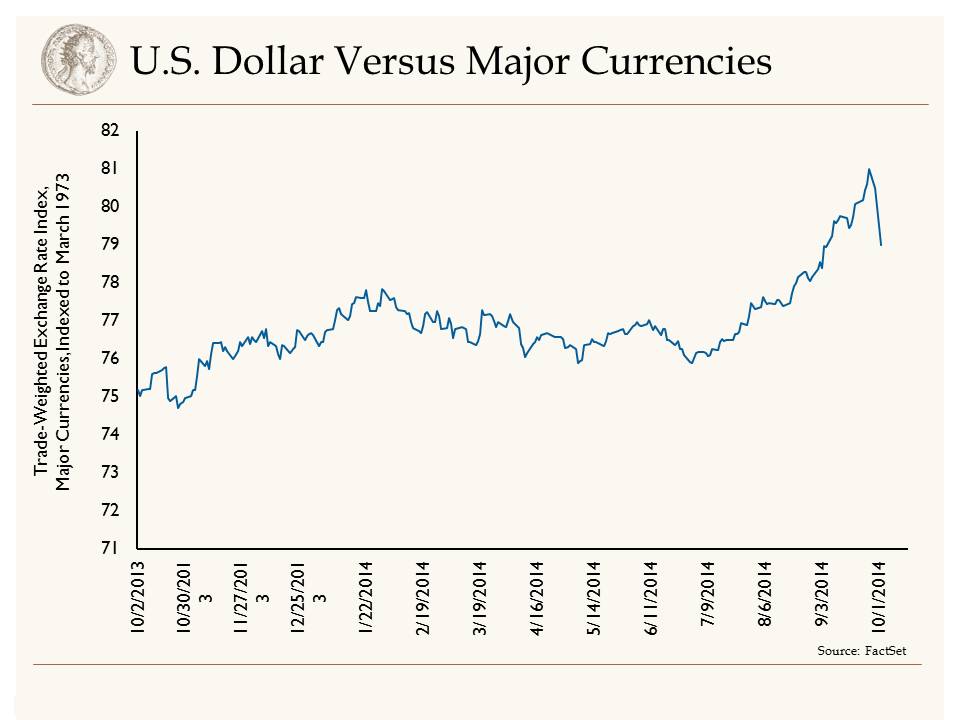
Or should we say it is all about the currency? With U.S. growth outpacing all other developed markets around the world, with the exception of the United Kingdom, it has caused the dollar to rally relative to other currencies. This strength has several ramifications. Trade Weighted Dollar Vs Major Currencies

First, it makes our assets more appealing to the rest of the world. With rising interest rates and higher government bond yields than other developed economies, capital is starting to flow to the U.S. This has led to a drop in interest rates and further strengthening of the dollar. Think of this as a virtuous cycle.

Second, this could act as a headwind for third-quarter earnings for multinational corporations. U.S.-based companies that sell overseas will take a hit on earnings that occur in other countries, depending on how much the dollar has strengthened relative to the currency of the country where the revenue was generated.

Finally, it is very good on the inflation front because a strong dollar allows U.S. consumers to purchase goods brought in from other countries at a lower price, especially commodities. On the margin, this should help keep a lid on inflation.

Our Takeaways from the Week

  • Job growth continues at a steady pace. This a big positive for the economy and will eventually lead to Fed tightening next year
  • Growth fears in the U.S. and around the world have led to increased volatility in recent weeks

Disclosures

Seasons

Jason Norris of Ferguson Wellman by Jason Norris, CFA Executive Vice President of Research

Seasons

The more things change, the more they stay the same. Five months ago, we rebuked the old Wall Street adage of “sell in May and go away” which, through the end of August, was a good call. From May 1st to Aug 31st, the S&P 500 was up just over 7 percent. However, just like clockwork, the month of September looks to be producing the same results it historically has. Since 1928, September is the only month out of the twelve that has an average negative return. With only a couple of trading days left, it looks like that trend will not be “bucked” this year. Even though there is still time to pull even, the end of the month is usually the weakest (see below).

SP 500 Seasonality

Source: Renaissance Macro Research

Send for the Man

While this has been a bad week for stocks, it was also not a good week for healthcare mergers and acquisitions. On Monday afternoon, U.S. Treasury Secretary Jack Lew issued some administrative rules making it harder for U.S. companies to start inversion mergers. This type of merger allows a U.S. company to buy a smaller foreign company and relocate offshore to lower tax jurisdictions (see an earlier post for details). Most of these deals are centered in the healthcare space and while these changes will not stop potential inversions, they are designed to make them more difficult. For example, Medtronic is currently in talks to purchase Covidian (based in Ireland) and would use a meaningful amount of offshore cash to finance the deal. With these new rules, Medtronic would not have access to that cash without paying U.S. taxes. Therefore, they will have to look for other financing means, most likely debt, thus slightly increasing the cost. We still believe the deal will be completed, but it does show that the U.S. Treasury is adamant about changing this part of the U.S. tax code. AbbVie and Shire may also be affected; however, the tax benefits are not as meaningful and the gains from the Shire pipeline are significant enough to proceed.

Lesson Learned

Last week was not a good week for Apple. After announcing a record weekend of sales for the iPhone6 and iPhone6+ with over 10 million handsets sold (and this without shipping any to China), any good financial news was eclipsed by issues with the iPhone6+ bending and a botched iOS update. Investors didn’t have patience for the stock during the last few days. We believe that despite these hiccups, this iPhone launch will net over 60 million units this month, and based on pricing and component costs, should be accretive to gross margins.

What we know

  • The trend of September probably won’t be broken and stocks will give back some of their summer gains
  • Both buy and sell side analysts have been on the phone with their tax attorneys due to Secretary Jack Lew’s administrative order regarding inversions

Disclosures