

Weekly Market Makers

Should I Stay or Should I Go?

Jason Norris of Ferguson Wellman by Jason Norris, CFA Executive Vice President of Research

Should I Stay or Should I Go

This question seems to more prevalent these days as equity markets muddle along and bonds continue to rally. The yield on the 10-year Treasury fell below 2.5 percent this week as investors attempted to seek safety and income. Economic data hasn’t been great, but it hasn’t been bad and we still believe that the “Spring Thaw” will come to fruition and stocks will outperform bonds in 2014.

Best of Both Worlds

As investors increase their exposure to bonds, driving the yield on the 10-year Treasury below 2.5 percent, it leaves us curious as to what is driving this behavior. One culprit may be that U.S. yields are relatively high on a global basis. Global fixed income investors have a lot of markets to consider, but it seems the U.S. continues to be very attractive. Yields in Germany on 10-year government debt are as low as 1.3 percent, where France isn’t much higher at 1.8 percent. There is relatively no income in Japan, with yields under 0.6 percent. Therefore, the U.S. is competing more with Norway (2.6 percent) and even Spain and Italy (both around 3 percent). It is no wonder with global rates so low, that investors are flocking to the U.S. to boost their coupon.

Gettin’ Better?

We received mixed data on the consumer this week. Retail sales came in with a disappointing 0.1 percent monthly gain, with autos being a drag. Walmart disappointed investors as higher gas prices and lower government assistance programs were a drag on spending. Nordstrom, however, exhibited strong growth in their market segments. Jobless claims hit a seven year low on Thursday with initial applications for benefits dropping 24,000 last week to 297,000 this week. Meanwhile, small business sentiment hit a six year high. We believe the U.S. economy is improving after a poor first quarter, primarily due to weather, and we remain bullish on increasing domestic growth. Cisco Systems reiterated this view on their most recent earnings call citing a “very good month [of April]” with the U.S. leading the way in growth.

A New High in Lows

Global hedge fund data was released and for the first time on record (data inception 2003), hedge funds have lost money for three consecutive months while equity markets rose. It seems that a lot of hedge funds have been long on small cap growth and as we’ve seen that trade unwind (rather quickly), they have been slow to follow. Time will tell if this is a short term phenomenon, or a longer term trend. There have been parts of that market that moved into “bubble” territory. Our small cap exposure tilts toward quality and we still believe this area of the market is attractive due to its exposure to the U.S. economy.

Our Takeaways from the Week:

  • Investors remain skittish and are seeking safety over risk, but this will be a short-term occurrence
  • We believe the U.S. economy will continue to grind higher and will be a stand out for the developed world

 Disclosures

Motion Simulating Progress

RalphCole_032_web_ by Ralph Cole, CFA Executive Vice President of Research

Talk, Talk, Talk

It seems that every time you turn around, the Fed is trying to communicate information to the capital markets or to Congress. This week, Janet Yellen made a trip to Congress to speak to the Joint Economic Committee where she gave a very balanced view of the economy and of possible future Fed actions.

Chairwoman Yellen said that the U.S. economy paused in the first quarter, but appeared to be gaining steam in the current quarter. This view dovetails perfectly with our own views at Ferguson Wellman. The questions from Congressional members centered on job growth, unemployment and the labor participation rate. As we watch testimony of this type, it is interesting to observe the new Fed Chair sidestep the clearly partisan questions and get to the heart of what the Fed is tasked to do and what duties are tasked to Congress. This inculcation occurs every time the Fed Chair is invited to give testimony. The Fed has a dual mandate ― maximum employment and stable prices. This slower than usual recovery has placed an increased focus on employment, and what the definition of “full” employment actually is. Congress and the markets want to identify the exact unemployment rate at which the Fed will begin raising rates, which we think is foolhardy. The Fed Chairwoman explained the importance of not reading too much into any one data series, and any one data point. Rather, it will depend on a number of factors.

Here in our office we are turning our focus toward wage-related inflation. Increasing wages are often a precursor to overall inflation for the economy, and just like the Fed, we will be looking for acceleration at the margin for a number of indicators, not any one indicator.

What’s Going On

What has surprised us has been the movement of rates going lower in the face of better growth. Many explanations have been floating around and we suspect it is a combination of slower growth in the first quarter of the year and low rates around the world, making the yield on the 10-Year U.S. Treasury look appealing. We continue to believe that an improving labor market and positive GDP growth will move rates higher in the coming months.

Our Takeaways from the Week

  • While Chairwoman Yellen is adept at dealing with Congress, we hope that the Fed can reduce their commentary in the future which we believe will reduce overall volatility in the fixed income markets
  • Strong first quarter earnings for the S&P 500 continue to support higher stock prices in the future

Disclosures

Spring is Finally Here

by Shawn Narancich, CFA Executive Vice President of Research

Spring is Finally Here  

True to our outlook for the quarter and in-line with anecdotes from the mass of companies reporting first quarter earnings, the U.S. economy appears to be gaining speed after a weather-induced slowdown earlier in the year. While investors were disappointed to learn that first quarter GDP barely budged in the U.S., their disappointment was short-lived, as the blue-chip Dow Jones Industrial Average traded to new highs this week, with the benchmark S&P 500 not far off its best-ever levels. Merger and acquisition deal flow has picked up markedly, signaling greater confidence in corporate America to deploy near-record levels of idle cash. To our surprise, benchmark 10-year Treasury bonds remain remarkably well bid, with yields that held stable after a bullish jobs report likely reflecting continued geopolitical risk in Eastern Europe.

Green Shoots

Investors were encouraged to see that the U.S. jobs market kicked into a higher gear, producing substantially better than expected growth of 288,000 net new jobs in April. Previously reported jobs numbers were revised higher and the unemployment rate fell to a 5-and-one-half-year low of 6.3 percent. Bears will argue that a drop in the labor force participation rate to 36-year lows was responsible for the falling jobless rate, as discouraged workers gave up the hunt for jobs. We would argue that an accelerating economy will produce more job opportunities for disaffected workers, pulling them off the sidelines and tempering the decrease in unemployment. Average hourly earnings remain subdued, rising at the slowest pace of the year, and likely heartening the Fed, which earlier in the week left its QE3 tapering on course for conclusion by year-end. In addition to healthier labor markets, equities are responding favorably to further strengthening of the U.S. Purchasing Managers Index, a benchmark gauge of manufacturing health; it rose for the fourth consecutive month in April and dovetails with the rising levels of manufacturing and construction employment seen in the payroll report. U.S. auto production in March rising at the fastest pace since 2007 is another data point confirming for us the renaissance in domestic manufacturing. Finally, we were encouraged to see March consumption spending increase by nearly 1 percent sequentially, indicating that shoppers are beginning to spend at healthier rates following a brutal winter.

The Urge to Merge

All of a sudden, deal-making abounds: the planned combination of orthopedic device makers Zimmer and Biomet, Comcast’s proposed acquisition of Time Warner Cable, GE’s bid for Europe’s Alstom, Exelon’s planned acquisition of fellow utility Pepco Holdings, and Pfizer’s $106 billion bid for British drug maker AstraZeneca. This sample of proposed combinations highlights companies attempting to grow their bottom lines through sales and cost synergies at a point later in the economic cycle, when organic growth is harder to come by.

Only time will tell whether these deals actually get consummated as antitrust issues and nationalistic sentiment could foil at least a couple of them. For investors, the bidding activity shines a positive light on the economy and corporate valuations that we believe will continue to expand.

Late Innings of Earnings Season

Nearly 75 percent of the S&P 500 Index has now reported first quarter earnings. With forecasts that initially called for a decline in earnings now morphing into the reality of low single-digit growth, we observe that corporate America is once again proving its ability to under-promise and over-deliver.

Our Takeaways from the Week

  •  Evidence of an accelerating economy continues to mount as weather-induced weakness fades
  •  Heightened deal activity and better-than-expected corporate earnings leave stocks well bid, trading at near-record highs

Disclosures

Will Unemployment Be the Rat in My Kitchen?

Furgeson Wellman by Brad Houle, CFA Executive Vice President

The British reggae band, UB40, was formed in 1978 and, according to Wikipedia, went on to have more than 50 singles on the UK Singles Chart and achieved considerable international success, selling over 70 million records. During the late 1970s and early 1980s, the economy in the UK was depressed with high unemployment and the band's name reflected the economic environment of the time. UB40 is a reference to a document to obtain unemployment benefits from the UK government. The designation UB40 stood for Unemployment Benefit, Form 40. As investors, we have been very focused on unemployment in this country, which is measured by two different measures, U-3 and U-6.

The most widely quoted measure of unemployment is collected by the Bureau of Labor Statics and is called U-3. This gauge of joblessness simply assesses the percentage of the labor force not employed. Total labor force is defined as the number of employed plus unemployed. Presently, the U-3 is 6.7 percent and has been as high as 10 percent following the Great Recession.

U-6 is a measure of underemployment that is presently 12.7 percent and was as high as 17 percent in the time following the financial crisis. U-6 determines the unemployed as well as those that are working part-time but desire full-time work. It includes workers that are overqualified for their current position based on education or experience level as well as those that are considered to be marginally attached to the workforce. Marginally attached workers are persons that have not looked for work in the past 12 months yet indicate that they are open to being employed.

Currently, full employment, as based upon the U-3 number, is considered to be between 4 and 5 percent. Full employment is an evaluation of unemployment whereby the vast majority of employable people are employed. Unemployment never drops to zero because there is a segment of the population that is unemployable.

Unemployment Chart

Despite the continued slack in the labor market, we view the economy as still growing. The unemployment rate as measured by U-6 or U-3 continues to go down, just at a rate that is slower than most investors would like to see.  We continue to expect stronger economic growth for the rest of the year as we get past the weather impacted data from the winter months.

Takeaways for the Week:

  • Companies are in the midst of reporting first quarter earnings. Of the S&P 500 companies that have already reported their earnings, more than half the companies beat sales expectations and 75 percent have beat earnings expectations
  • Apple had stronger than expected earnings and raised the dividend and increased their share repurchase

Disclosures

Time of the Season

Jason Norris of Ferguson Wellman by Jason Norris, CFA Executive Vice President of Research

Here Comes the Sun

The polar vortex of 2014 seems to have finally thawed and we believe this change in the weather will bring some warmth to the U.S. economy. Economic growth hit a speed bump in the first quarter as much of the U.S. experienced severe winter conditions. This resulted in lower-than-expected economic activity, which in turn led investors to reduce risk in their portfolios and bid up bonds, leading to a decline in interest rates. We believe the “soft patch” is a short-term phenomenon and we have already started to see a pick-up in retail sales and industrial production, as seen in the Purchasing Managers Index (PMI).

While stock market volatility hasn’t hurt consumer confidence, the price of gas may do so in the near future. We have seen a 10 percent increase in gas prices over the last two months. Commodity prices can be volatile, but if this is a persistent trend higher, it will present an impediment to our bullish view of the U.S. consumer.

Send Me Your Money

April 15 has come and gone, bringing increased revenues to the Treasury. 2013 showed high single digit “revenue” growth for the Treasury. On the expenditure side of the ledger we are seeing lower-than-anticipated spending on healthcare and defense. Both of these instances should lead to lower deficits. While the U.S. is still spending more than it takes in, we are pleased that difference is declining. For those tax payers who have a big heart and want to make a difference, the IRS includes a box on tax forms for filers to check if they want to make a donation to the Treasury. Remember that tax rates are just a minimum requirement – you may always pay more. Over the last 15 years the average annual donation has been around $2 million; however, 2014 has already eclipsed this amount with $2.7 million in donations. Considering the strength in equity markets the last few years, will there be more “giving” to the U.S. government… or will increased capital gains taxes eat into this potential philanthropy?

Back in Business

April kicks off the first quarter earnings season for 2014 and this week we saw two bellwether semiconductor companies report, Intel and Linear Technology. The results were mixed, with Intel citing a pick-up in the P.C. space and Linear seeing strength in automobile and industrial markets. Both companies showed average revenue growth but profit margins continue to remain high.

Overall, expectations for the first quarter are for an earnings growth of three percent (year-over-year). This is down from expectations of 10 percent growth three months ago. We believe this negative revision is a result of the inclement weather in the first quarter. We expect second quarter growth to reaccelerate to nine percent. That may prove to be somewhat optimistic, but we believe we will see greater than five percent growth in the second quarter.

Our Takeaways from the Week:

  • As we move into spring, we would expect U.S. economic growth to continue to pick up
  • We would use the recent strength in the bond market as an indication to reduce exposure and move those funds to U.S. equities

 Disclosures

Growth, Gas and Golf

by Shawn Narancich, CFA Executive Vice President of Research

Suspended Animation

 Despite an improving job market and a spring thaw that appears to be lifting the economy out of its winter doldrums, U.S. equity investors felt the chill of a sell-off that left benchmark stock indices underwater for the year. Confronted by the dawning reality that the Fed’s ultra-accommodative monetary policy is going away and, by implication, that projected inflation premiums are rising, high-flying tech stocks like Facebook, Twitter, and Amazon have been particularly hard hit. In contrast, amid a bond market rally that few foresaw at the start of the year, interest-sensitive stocks within the utility sector and REIT space have performed quite well. In general, value stocks are outperforming growth and, from out of the blue, emerging market stocks have begun to excel. Despite the distinct possibility that tighter monetary policy in countries like Brazil, South Africa and India could push these economies into recession, the markets of these BRICS constituents have rallied recently. For our part, we expect waning fiscal headwinds and a renewal of fortunes in the energy and manufacturing sectors to produce faster U.S. economic growth as the year progresses.

Shoulder Season

With the dawn of April, U.S. natural gas markets have officially transitioned from heating season to what is known as “injection season.” Commonly, the clean burning commodity falls in price this time of year as cold weather wanes and heating demand disappears (often referred to as “shoulder season”), allowing natural gas producers to start injecting gas into underground storage caverns in preparation for next winter. Front-month gas prices are down from the $6.00/Mcf level reached in February, but prices have been notably firm around the $4.50 level recently, and are much higher than the $2.00 lows reached in 2012. Prices have risen because of demand growth from utilities using more gas to generate electricity, but more immediately because of an unusually cold winter that has depleted storage inventories to 10-year lows. Surprisingly, a more than doubling of gas prices has happened without a lot of fanfare, as gas bears beat the drum of supply response from “gas behind pipes.”

Gas Bulls

The key question now is whether a domestic energy industry more focused on drilling for shale oil will be able to replenish gas supplies in time for the next heating season. At current prices, count us as skeptics. Natural gas directed drilling is at the lowest level since 1992, and while associated gas from oil directed drilling has provided a key source of supply, we doubt it will be enough to adequately refill depleted storage caverns. The reality is that curtailed gas flow doesn’t exist on any meaningful scale, and with the typical shale oil project still much more profitable for producers, we don’t expect adequate gas drilling to materialize until futures prices reach the $5.00-to-$5.50 level. Because of the substantial lead times necessary to transport drilling rigs and hydraulic fracturing equipment from oil to gas basins, combined with the time it takes to actually drill and complete new gas wells, the industry will not be able to turn on a dime. As a result, price spikes could occur until adequate new supplies materialize.

A Tradition Unlike Any Other

As the world’s best tee it up at Augusta National this week, money managers are gearing up for a pursuit of their own, less affectionately known as earnings season. Aluminum producer Alcoa kicked things off in acceptable fashion earlier this week and, following early reports from Wells Fargo and JP Morgan, reporting starts to kick into a higher gear next week.

Our Takeaways from the Week

  •  Stocks have retreated from recent highs despite generally improving economic data
  • Depleted supplies and healthy demand growth appear to have ended the bear market in natural gas

Disclosures

Be Careful What You Say

Furgeson Wellman by Brad Houle, CFA Executive Vice President

Flash Boys

High-frequency trading” (HFT) was a huge media topic this week due to author Michael Lewis’ appearance on last weekend’s “60 Minutes” as part of his promotion of his latest book titled Flash Boys. What captured media attention was his claim that the stock market was a "rigged game." This statement was based upon his research for Flash Boys that detailed the impact of high-frequency trading on the stock market. HFT is a very complex trading strategy that relies on computers to trade at lightning speed to make a small amount of money on a huge volume of trades. In fact, it is theorized that 30 to 50 percent of the current stock exchange volume is HFT.

High-frequency trading is an extremely complex issue that simply can't be summarized by declaring the stock market a "rigged game."  In most forms, HFT is not illegal. It falls into a grey area of trading. If certain investors have a speed advantage, is that unethical? It is hard to say and supporters of HFT maintain that it adds liquidity to the market and facilitates trading. However, the aspect of HFT that is not defensible is that it also allows these trading firms the ability to know what other investors are doing and trade ahead of them. This practice is called "front running" which is certainly unethical and illegal.

The issue is so broad and complex, it is very difficult to determine who is doing what, and how that is impactful to the stock market as a whole. This is not a new issue for regulators who have been looking at HFT for some time now. We think the good news is that the recent attention on the topic will result in appropriate market reforms which will benefit investors. Financial markets operate on the confidence of the participants, and anything that enhances transparency and confidence benefits all investors.

While Mr. Lewis is a great writer and entertaining storyteller, his comments are unnecessarily inflammatory and might be intended to sell books and maximize the value of a possible film adaptation.

Employment Numbers March On

Turning to the capital markets, today the March employment numbers were released with a 192,000 increase in nonfarm jobs and a slight uptick in the unemployment rate to 6.7 percent. The consensus among economists was for a 200,000 increase in jobs. Due to the late-December expiration of long-term unemployment benefits, there was an expectation that the employment numbers would be even stronger than anticipated.

Historically, when long-term unemployment benefits run out, there is a significant pickup in employment. The “whisper number” was for a gain of 250,000 or more jobs. Defined as the number economists secretly hope will be the outcome, the “whisper number” usually is not reached by consensus and therefore is rarely published as an estimate. The bottom-line is that markets perceived the March job creation as a mild disappointment which resulted in some weakness in the equity markets.

Takeaways for the Week

  • We view the current employment data to be moving in the right direction
  • We are not overly concerned with the monthly volatility of the labor statistics

Disclosures

Spring Break Movies

by Tim Carkin, CAIA, CMT Senior Vice President

Divergent

This week the market is showing some interesting divergence. The S&P 500 performance is paltry, nearly flat on the year. Technology, biotech and consumer discretionary sectors, which are more heavily weighted in the NASDAQ, started selling off heavily last week leaving the NASDAQ down more than seven percent year to date. This week small cap stocks, which had been performing admirably, sold off more than four percent and are now negative on the year. Citigroup, Morgan Stanley and other large financials also sold off heavily after the Fed’s latest stress test results. On the plus side, emerging market stocks rallied significantly this week in hopes of new Chinese stimulus.

Need for Speed

A few good economic readings came out this week. Last month’s Q4 GDP number was revised up to an annualized 2.6 percent from 2.4 percent. This came as consumer spending in February rose by the most in three years and jobless claims declined last week to the lowest level in four months. Personal consumption expenditures (PCE), a favorite economic indicator of past Fed Chairman Bernanke ticked up 0.1 percent in February. Lower jobless claims and a low inflation rate give the Fed a little cushion to work with when considering stimulus and rate increases.

Rise of an Empire?

The constant media attention of developments in the standoff between Ukraine and Russian is weighing on the market. We did get good news on that front in an announcement from the IMF of $14-18 billion in aid. In addition, our Senate approved $1 billion in loan guarantees and the EU promised more than 10 billion euros in the next few years. On the other hand, Yulia Tymoshenko, former Prime Minister of Ukraine, announced her candidacy for president. This ensures the standoff will remain in the news through the Ukrainian elections on May 25th.

Takeaways for the Week

  • Geopolitics is a major overhang to the momentum in the U.S. economy

From Healthcare to Hoops

Jason Norris of Ferguson Wellman by Jason Norris, CFA Executive Vice President of Research

I Want a New Drug

We have seen a major resurgence in the healthcare space with regard to R&D and stock performance. In 2013, with the broad market up over 30 percent, the healthcare sector returned close to 45 percent and was the second best-performing sector. This year, in a flat, sideways-trending market, healthcare has been the best performing sector. We believe the sector gives investors a great mix of growth as well as stability and income. The worst of the drug patent cliff and generic substitution is behind us. We saw this transition peak in 2011 and 2012 with the likes of Lipitor, Plavix, Viagra and Singular coming “off patent.” This total was roughly $90 billion of revenue for big pharma companies. With this event sunseting, big pharma has cut costs, spun off divisions and made acquisitions to “right size” their lines of business. We anticipate the emerging pipelines from big pharma to more-than-offset the loss of revenue that will occur in 2016 and 2017. This reemergence is driven by diabetes, oncology and anti-clotting drugs.

Another space displaying strong R&D performance is biotech. In 2013, Biogen Idec launched its revolutionary multiple sclerosis drug and this year we have seen Gilead’s hepatitis C treatment (Sovaldi) come to market. The growth opportunities for this type of drug are great. For example, six months ago, Gilead was estimated to sale $2 billion of Sovaldi in 2014. Now expectations have risen around $7 to $10 billion. The R&D efforts in drug development around the world continue to break new ground.

Cover Me

The end of March will mark the conclusion of the first open-enrollment season of the Affordable Care Act (ACA). While the rollout was far from perfect, there is still quite a bit of uncertainty of its effects on the healthcare sector. We believe, relative to investing, most of the uncertainty has been diminished. The taxes that were implemented on the drug makers and medical device manufacturers have already taken effect. It is anticipated that the remaining uncertainties will affect hospital and insurance markets. As we have seen some adverse selection in the enrollment, the overall costs to the plans may see steep increases. While there is a clause in the ACA to reimburse insurance providers for their losses, we have heard “rumblings” from Congress to repeal this provision. While that is highly unlikely, it still creates uncertainty.

Finish What You Started

On Wednesday, the Federal Reserve continued to reduce their monthly bond purchases and gave all indications that they want this program to wrap up by year end. The Fed did state, however, that they will continue to remain “accommodative” while the economy muddles along. The major change was the removal to the 6.5 percent unemployment-rate threshold. We anticipated this because of the issues around labor participation can distort the rate. We do believe that the Fed funds rate will be anchored at 0.25 percent well into 2015.

Come Monday

On Monday, April 7, the NCAA will crown a men’s college basketball champion. For those lucky enough to still have a viable bracket, you are moving closer to winning $1 billion from Warren Buffet, providing you continue to have the perfect picks. The odds of this are 1-in-9 quintillion (yes that’s 19 zeros).  Let’s hope that in the last couple days, worker productivity did not fall too much as fans tried to follow all the games.

Our Takeaways for the Week

  • We remain bullish on the healthcare sector and believe it will outperform the broad market
  • Even though interest rates have fallen year-to-date, as the Fed unwinds its bond buyer and the economy picks up, the 10-year Treasury will end the year above 3 percent


Underneath it All

RalphCole_032_web_ by Ralph Cole, CFA Executive Vice President of Research

Workin’ for a Livin’

The U.S. jobs report has become the most watched economic indicator in the world. The jobs report comes out on the first Friday of the month and includes the unemployment rate and number of new jobs created the prior month. Both January and February reports were underwhelming due to weather, but we think employment will strengthen more than people think in the coming months.

Dan Clifton of Strategas alerted us this week to some underlying trends that will be playing out in the labor market in the coming months. Extended unemployment ran out at the end of December. The Senate voted this week to retroactively extend those benefits through May of this year, which may or may not become law. The fact is that long-term unemployment benefits ran out for a significant number of people in December. History tells us that many of these folks will go out and find jobs, bringing down the unemployment rate faster than people expect.

We have a real-life example in North Carolina. North Carolina’s emergency benefits ran out six months ago. Since that time, the state’s unemployment rate dropped 2 percent!  During that same time period, employment in North Carolina increased 1.3 percent versus the national average of just .5 percent.

The Gambler

Vladimir Putin continues his quest to win over Crimea. He has been admonished by every major country in the world, but will not give in until after Crimea’s secession referendum on Sunday. The U.S. and other major powers have stated that this is an illegal vote that is contrary to the Ukrainian constitution. How this plays out in the near term is important, but the more interesting part of the story is the long-term implications of Russia’s aggression.

We’ve written at great length about the energy revolution here in the U.S. and the benefits that will accrue over time because of it. Much of Europe’s natural gas comes from Russia, with more pipelines in the works. This partnership is being questioned in light of Russia’s latest activities, resulting in our European allies turning their attention to “the Saudi Arabia of natural gas” (i.e., the United States). While the U.S. won’t be able to assist in the near term, we think recent tensions will cause additional pipelines and liquid natural gas terminals to be approved in the coming months.

Our Takeaways from the Week

  • The labor market is stronger than people believe and will lead to rising interest rates in the coming months
  • Vladimir Putin has overplayed his hand. While he may win the Crimea vote on Sunday, he just offended his country’s largest customer
  • Uncertainty in China and Russia led to a sell-off in the S&P 500 of 1.7 percent for the week

    Disclosures

"Putin" Russia Behind Us

by Shawn Narancich, CFA Executive Vice President of Research

Good Friday, Great Week

Shaking off another bout of Russian adventurism in the former Soviet Union, stocks moved further into record territory this week on the heels of a better than expected jobs report domestically and encouraging manufacturing reports both here and abroad. Investors have witnessed a slow but steady reversal of the early 2014 risk-off trade, with benchmark U.S. Treasuries retracing approximately half of their earlier year gains and the S&P 500 now up 7 percent from its early February lows. Despite cold and snowy weather that has put a damper on retail sales this winter, we continue to foresee a stronger U.S. economy this year, supported by a rejuvenated energy sector that is in turn producing a renaissance in U.S. manufacturing.

Decoupling

A monthly jobs report signaling net non-farm payroll gains of 175,000 is not ordinarily a reason to celebrate, but viewed against the cold and snowy weather of one of the nation’s worst ever winters, the fact that February employment gains approached the average levels achieved last year is notable. We are encouraged to observe that local and state employment, after being such a material drag for so long, posted gains during the month, but even more important is the continued employment gains reported in construction and manufacturing. Dovetailing with the detail of today’s jobs number was the purchasing managers report for February out earlier this week, which showed manufacturing expanding at a faster pace domestically. Given the encouraging economic data, we foresee the Federal Reserve continuing to pare its purchase of Treasuries and mortgage backed securities, as likely to be detailed at its next FOMC meeting March 19th.

This week, investors witnessed Russia’s ruble tumble in response to the country’s Crimea incursion, forcing the central bank to boost short-term interest rates in support of the currency, but also adding to the risk that Russia falls into recession.  With emerging market currencies under pressure and in turn creating inflationary problems beyond US and European shores, we see developed economies that have increasingly decoupled from their emerging market counterparts. Supporting our outlook for the world’s developed economies to outperform in 2014, Europe reported its best retail sales numbers in thirteen years and coupled that with surprisingly strong manufacturing growth.

Tales of the Cash Register

Over the past couple weeks, U.S. retailers book-ended a fourth quarter earnings season that once again produced a clear plurality of better than expected results. For the retailers, hits and misses were as numerous as in any quarter we can recall. On the plus side of the ledger, investors were pleasantly surprised by strong sales at department store operator Macy’s and by the home improvement retailers Lowe’s and Home Depot, which both reported strong finishes to fiscal years advantaged by the rebound in housing. Meanwhile, investors in Radio Shack and Staples were left to lick their wounds, as both these companies continue to suffer from sales lost to the digital economy in general and Amazon.com in particular. Both undershot investor expectations and are in the process of closing hundreds of stores to right-size their disadvantaged business models.

Our Takeaways from the Week

  • Stocks forged new highs despite geopolitical tensions in Eastern Europe
  • Despite bad weather, the U.S. economy continues to make encouraging progress

Disclosures

Puerto Rico Debt Crisis

Furgeson Wellman by Brad Houle, CFA Executive Vice President

As of late, Puerto Rico has been in the news due to financial problems that stem from too much debt, a shrinking population and weak economic growth. Consequently, Puerto Rico's debt has now been downgraded to below investment-grade status. Puerto Rico is a territory of the United States and as a result is able to issue municipal debt that is federal and state tax-free to investors in every state. Puerto Rico has roughly $70 billion in outstanding debt that is widely owned by municipal bond investors in high-tax states with limited municipal bond supply due to Puerto Rico’s favorable tax treatment and ample supply.

The government of Puerto Rico has been taking steps to stabilize their economy. Governor Alejandro Garcia Padilla has enacted drastic pension reform and economic growth has improved recently. However, Puerto Rico needs to access the bond market next month with a planned $3 billion dollar bond sale. In order to attract investors, Puerto Rico will have to pay a high single-digit rate of interest in order to compensate investors for the default risk. We believe that Puerto Rico will be able to successfully issue this debt which should shore up the finances as well as lessen the news flow. Additional liquidity coupled with less financial media attention should allow for a rebound in the prices of the debt.

While the situation in Puerto Rico appears to have stabilized, the territory is not yet out of the woods. There are still high levels of unemployment and violent crime and a business climate that is considered to be unfriendly. If the financial situation gets worse, there is some question whether the U.S. Government would step in to provide assistance. This is a complicated situation in that Puerto Rico is a territory and not a state. Detroit was allowed to go bankrupt and received no state or Federal assistance. In addition, there is not a clear mechanism for an orderly bankruptcy due to the territory status.

If the situation in Puerto Rico becomes more serious, some are concerned that it would become a systemic crisis across the municipal bond market. In past municipal bond market corrections, we have used the dislocation to buy bonds at attractive valuations for our clients. Overall, municipal bonds have been a very safe investment, specifically according to Moody's for the last 40+ years, only .012 percent of municipal bonds have defaulted. Said differently, Strategas Research has calculated that of the greater than 1 million municipal bond issues outstanding only 71 have defaulted between the years of 1970 and 2011.

Our takeaways for the week:

  • We have not actively purchased Puerto Rico debt for our clients in the past and are not buyers at this time. We view Puerto Rico debt as a “hold” for investors that do own the debt. Presently, the situation is characterized by more smoke than fire. Following a successful bond offering and as news flow abates, there will probably better opportunities to exit positions in Puerto Rico debt if individual risk preferences warrant doing so.
  • This week we saw the S&P 500 hit new all-time highs.

Disclosures

Money Talks

Jason Norris of Ferguson Wellman by Jason Norris, CFA Executive Vice President of Research

Money Talks

Earlier this week, Facebook anted up close to $20 billion (with a capital B) to purchase WhatsApp, a mobile texting company. The company is estimated to gross $300 million in revenues this year and $500 million in 2015 by charging $0.99 per year to allow users to by-pass texting fees from their wireless provider. One can argue if the price will be “worth it” for Facebook, but we do know that WhatsApp’s 50 employees are pleased.

This deal is just one of the several major merger and acquisition (M&A) deals we have seen this year. On top of the Facebook deal, over the last week we saw a major take-out for Forest Labs, talk of Safeway going private, and Comcast bidding for Time Warner Cable. Corporate America is flush with cash and, as we forecasted, is putting it to work. Industry analysts have yet to declare that we are off to the races for M&A, but confidence is improving.

Modern Day Cowboy

Move over Henry Ford, here comes Elon Musk, the CEO and Chief Product Architect for Tesla Motors. The high-end electric car maker continues to push the limits on manufacturing and innovation.  While global demand is picking up and Tesla has been ramping up production to meet these needs, profitability and valuation are key determinants of a good stock, on top of a good company. One can get caught up in the hype of the revolutionary envelope Tesla pushes on a manufacturing basis (check out this video for a demonstration). Is a good company necessarily a good stock?  When you look at the value investors are giving Tesla, it is $817k per vehicle sold. The auto average is $13k. One could argue that Tesla should command a premium, but the current premium may be a little too rich for our taste.

Baby, It’s Cold Outside

The recent polar vortex that has affected most of the U.S. the last few weeks has impacted several economic indicators (as highlighted last week by Ralph Cole) as well as commodity prices, specifically natural gas. Natural gas prices in mid-January hovered around $4.00/btu. Since then, gas has spiked to over $6.00/btu. While this may have a short-term impact on the cost of energy, we do not foresee much more upside pressure to gas prices. At these levels, we are likely to see some shift in exploration and production from oil to gas since the cash flows at these prices can be very attractive. Therefore, as demand slows with warmer weather and more supply comes online, we would expect gas prices to trend lower.

This phenomenon in the U.S. has led to an energy/manufacturing renaissance. Low energy prices have allowed manufacturers to “on shore” their production because the costs have become more attractive. Especially those industries where natural gas is a major feedstock:  chemicals, fertilizer, etc. There are plans for 10 new ethane facilities (or crackers) in the U.S. due to the increased supply of energy and natural gas. This will result in a major increase in polyethylene supply, which is a major input for plastic, thus, lowering the cost for thousands of consumer and commercial products, while increasing jobs in the U.S.

Takeaways for the Week

  • M&A deals are starting to pick up and companies are paying premiums for growth
  • Low commodity prices and technological innovation is a boom for the U.S. economy, thus benefitting the U.S. consumer

Sympathy for the Weatherman

RalphCole_032_web_ by Ralph Cole, CFA Executive Vice President of Research

Sweater Weather

As economic and market forecasters, we have a great deal in common with meteorologists. We know forecasting daily moves in the stock market is a fools game, but that over longer  time horizons, our forecasting accuracy improves greatly. Weathermen face the difficult task during snow storms of forecasting snowfalls and temperatures minute-to-minute, and hour-to-hour – to which we say... “No thanks!”

The East Coast has been battered by several snow storms over the past month, and this has had a negative impact on high frequency economic data. The reason that this has such a large effect on government data is because the Northeast megalopolis that spans from Washington D.C. to Boston is responsible for 20 percent of the nation's GDP. Largely due to poor weather conditions, retail sales in the month of January were down .4 percent. Similarly, industrial production also came in weak for the month of January, down 1.4 percent.

We believe the current slight weakness in economic data is a blip on the Doppler radar, and economic growth should accelerate as, literally, the snow thaws.

Welcome to the Jungle

One of Janet Yellen’s first duties as Federal Reserve Chairwoman was the semi-annual report to Congress. Timing of the report was helpful to both Congress and the markets because both senate and house leaders are trying to determine and understand the likely pace of tapering to expect in 2014. More specifically, what indicators will the Fed be relying upon, and are there any hard and fast rules governing the pace of tapering? As any good Fed Chairwoman would do, Janet left answers to all of those questions up in the air. Yes, she would like to continue tapering at this pace, but she is not tied to a $10 billion monthly reduction. Yes the Fed will be monitoring the unemployment rate, but it is not the only indicator they will be considering.

Despite the lack of specifics in her answers, the Fed Chairwoman’s performance was received very positively by the markets and as of this posting the S&P 500 was up 2.4 percent for the week.

Takeaways for the Week

  • Despite several weak near-term economic statistics, the economy continues to expand at a reasonable pace
  • The new Fed Chairwoman assured Congress and the markets that she will be a steady hand at the helm of the Fed

Disclosures

Synchronized Global Expansion?... Far From It

by Shawn Narancich, CFA Executive Vice President of Research

Dawn of a New Era

Amid heightened turbulence in the global economy and capital markets, Janet Yellen was sworn into service as the Federal Reserve’s first chairwoman this week. Although she has a dovish reputation as an economist focused on the labor market implications of monetary policy, she ascends to a position requiring the optimization of full employment and low inflation. In this spirit, and acknowledging the faster pace of U.S. economic expansion at present, we do not expect this morning’s surprisingly weak payroll report to throw the Yellen Fed off its course of continuing to taper QE3. The headline number of 113,000 net new jobs created in January is anemic but, like December’s similarly weak number, unusually severe winter weather could be at play. More importantly, the underlying detail is encouraging – more private sector hiring and less competition from the government, which continues to shed jobs. After retreating nearly 6 percent year to date, blue chip U.S. equities shook off the weak payroll headlines and rallied back into positive territory for the week.

Decoupling

While retailers cut back following a choppy Christmas selling season, construction and factory jobs surged in January, providing more anecdotal evidence of a renaissance in U.S. manufacturing. Combine that with the surge in U.S. energy production and low inflation, and what we see is a relatively healthy domestic economy that appears able to withstand an increasingly uneven outlook internationally. The global purchasing manager surveys out this week demonstrate that economic activity globally is far from the synchronized global expansion that some would claim. Consider China, where the manufacturing sector is teetering on the edge of contraction, and contrast it with Europe, where despite 12 percent unemployment, factory output is growing at a faster clip. While China is still growing, its rate of expansion has slowed, taking the punch out of commodity prices and serving to help developed nations worldwide, whose lower bills for gasoline and agricultural commodities are helping boost consumers’ disposable personal income.

Emerging Market Contagion?

With the sun beginning to set on another reasonably constructive earnings season, we observe corporate earnings for the fourth quarter of 2013 that in the aggregate appear to have risen by about 8 percent. But with emerging equities already down as much as 11 percent year to date, investors are concerned that the relatively modest pullback U.S. stocks have already experienced could turn into something more sinister. So far, the interest rate hikes in nations like India, South Africa, and Turkey that are being used to help stem currency weakness and capital outflows appear localized to such economies disadvantaged by current account deficits that are driving up inflation. In contrast to the late 1990’s when currency devaluations in countries like Thailand were exacerbated by foreign currency debt obligations (making those obligations more expensive to repay), emerging market challenges today center around the more common but less pernicious problem of stagflation, a combination of slowing economic growth and rising inflation. As emerging market countries adjust to higher interest rates, we expect their growth to slow and in turn, dampen the level of global economic growth. But just as it did against a strong domestic backdrop amid the Asian Financial Crisis, we expect the U.S. economy and capital markets will weather the storm. Acknowledging the near-term challenges presented by emerging markets, we recently reduced our allocation to this equity style.

Our Takeaways from the Week

  • Janet Yellen became the Fed’s first Chairwoman, amid an increasingly turbulent global economy
  • Stocks bounced back, defying disappointing headlines on the jobs front and mixed manufacturing data

Disclosures

Are You Ready For Some Football?

Jason Norris of Ferguson Wellman by Jason Norris, CFA Executive Vice President of Research

Super Bowl Shuffle

With Super Bowl XLVIII due to kick off this Sunday, the results have historically had an impact on investors’ portfolio for that calendar year. This match up, for me, is a classic. Growing up in Boise, Idaho, most likely you were either a Seahawks fan or a Denver Broncos fan. From the late 1970s through the 1990s, both teams played in the AFC West and were archrivals. My allegiance always went to the Seahawks with great players like Steve Largent, Kurt Warner, Dave Krieg and David Hughes. And with Super Bowl XLVIII, my allegiance has not altered, and this would be beneficial for equity markets. Even though correlation does not lead to causation, historically, if a team from the NFC wins the big game, the S&P 500 is positive 80 percent of the time. Now that the Seahawks have made the move to the NFC, a win “may” portend a positive gain for equities.

While we are not big fans of seasonal and/or cyclical indicators, we do pay attention to them. With the S&P 500 down more than 3 percent for the month of January, history does not look good for the remainder of 2014. The returns in January usually predict what the returns will be for the entire year. Since 1950, this “January Barometer” has a completion percentage of 80 percent. While not perfect, it is an interesting factoid. Therefore, we should be cheering for the Seahawks to offset this calendar trend…

One final note on the subject: the Seattle Seahawks have been a great investment for owner and former Microsoft co-founder, Paul Allen. He bought the team in 1997 out of “civic duty,” and since then it has increased in value six-fold, while his Microsoft stake has merely doubled.

Down in a Hole

Global markets continue to be disheartened with events in emerging markets. Currency devaluations and higher interest rates are resulting in a “risk-off” trade for global investors. This sell-off has not been limited to just emerging markets. As we have seen here in the U.S., global developed markets felt the effects as well. The global markets (as measured by the MSCI All-World Index) are down five percent for the month of January. These risk-off trades have resulted in developed market interest rates declining meaningfully. The 10-year U.S. Treasury yield started 2014 at 3.00 percent; it is now trading at 2.65 percent. Yields in Germany and the UK have dropped by similar levels.

Due to this uncertainty, we are looking to reduce our emerging market exposure and allocate those funds into the UK, focusing on the consumer.

It’s Alright

While the January sell off is disappointing, we are still constructive on equities, especially developed market equities. This week we saw strong economic data in the U.S. regarding GDP and consumer spending even though consumer sentiment continues languish. Earnings for U.S. companies have been relatively healthy with 72 percent of companies having reported beating expectations. While we have seen some uncertainty in some parts of the earnings reports, specifically enterprise technology, we are still like the overall market. Specifically we increased our exposure to U.S. healthcare this week as we see the sector as offering great defensive/growth opportunities.

Takeaways for the Week

  • Even though we believe interest rates are going to trend higher, holding bonds in portfolio is still warranted
  • Developed market economies continue to improve, and while we are experiencing some volatility, we are still positive on U.S. equities

Why the Price of Tea in China Matters

Furgeson Wellman by Brad Houle, CFA Executive Vice President

One of the risk factors we highlight in our 2014 Capital Market Outlook is China's growth, which is slowing more than expected.  This week China's Purchasing Managers Index (PMI) was released.  A Purchasing Managers Index is an indicator of economic health.  PMI data is collected from various industries all over the world. PMI data is collected by analyzing five major indicators: new orders, inventory levels, production, supplier deliveries and the employment environment.1 The point of PMI is to indicate if an economy is accelerating or decelerating.  A number above 50 suggests improvement and a number below 50 suggests deceleration.  The latest PMI for China was 49.6 down .9 from the three month average of 50.3.  This is the fourth month in a row the Chinese PMI has declined.

Even with a decelerating economy China is expected to have Gross Domestic Product (GDP) growth between 6-7 percent.  China has been able to engineer a soft landing, managing GDP growth from 11 percent to the 6-7 percent level.  A soft landing is an expression for a decelerating economy that slows down without going into recession.  However, Chinese economic data is looked upon with some skepticism by market participants. Chinese GDP is reported in a way that is not consistent with how GDP data is reported in all the world's developed economies.  There is very little transparency in the numbers not to mention an unusual stability that might suggest certain components of the data are not completely factual.  In China there is a large underground cash economy that would be difficult to measure.

The China PMI news put a downdraft in the U.S. markets and caused some minor selling in other developed markets.  Other emerging markets also had a difficult week.  Argentina's peso declined the most in 12 years due to the cumulative effect of years of the Kirchner government’s economic mismanagement. Argentina has been challenged with uncontrolled inflation and a currency black market that has undermined the government’s efforts to regulate capital flows.  In addition, Turkey has been struggling with a political crisis that has undermined confidence and led to a large drop in the Turkish lira.

Earnings season is underway and according to FactSet Research, of the 53 companies of the S&P 500 that have reported fourth quarter 2013 earnings, 57 percent have reported earnings above the mean estimate.  The blended growth rate has been 5.9 percent with financials having the best growth rate and the energy sector having the lowest growth rate.

Our Takeaways for the Week:

  • The strength of the Chinese economy is top of mind for investors and will continue to be impactful to developed and emerging markets

1Source: Investopedia

Disclosures

Off to the Races

by Shawn Narancich, CFA
Executive Vice President of Research

 Ohhh, the Weather Outside Is Frightful

Rubber hit the road this week for investors as traders and money managers returned to work after what for many turned out to be a nice two week break. Stocks appear to be consolidating gains realized over Christmas and New Year’s, with a plurality of economic data pointing to faster U.S. growth in 2014. A fly in the ointment was this morning’s December employment report which showed the economy producing just 74,000 jobs - albeit in a month where bad weather seems to have had a disproportionately negative impact on the headline number. Nevertheless, if one excludes construction job losses and cases where people were counted as unemployed because they couldn’t get to work, the job numbers still fell short of estimates. And while the unemployment rate dropped to 6.7 percent, it fell primarily because more of the jobless gave up hunting for work. Indeed, as we look back to year-end, the labor force participation rate has fallen to a new cyclical low of 62.8 percent - that is the percentage of “employable” people either with a job or looking for work.

Gaining Momentum

Will one month of relatively poor employment data dissuade the Fed from its planned tapering of QE? We doubt it. Q4 retail sales picked up, the renaissance of U.S. manufacturing and energy is going full steam ahead, and capital spending by companies flush with cash appears on the verge of inflecting upward. In related fashion, this week’s monthly trade data was bullish. The November report showed U.S. imports exceeding exports by a four-year low of $34 billion. Increasingly positive trade flows are being driven by two key trends: rapidly falling oil imports resulting from new domestic production and surging exports of gasoline and diesel being refined from the crude. As a result of these encouraging trends, GDP growth estimates for the fourth quarter are being revised upward, and for the first time in recent memory, the U.S. economy may have grown in excess of 3 percent for two consecutive quarters. With fiscal headwinds waning, 2014 is shaping up to be a year of faster economic growth domestically.

The Dawn of Another Earnings Season

Alcoa unofficially kicked off the fourth quarter reporting season by reporting weaker than expected profits that left investors disappointed and shareholders with lighter pockets. Other early reports from seed and herbicide producer Monsanto, US beverage producer Constellation Brands and chipmaker Micron were more encouraging, and each of these cases resulted in nice stock price gains afterward. Overall, investors are expecting blue chip earnings growth of 6 percent for Q4, on flat revenues. These estimates could prove conservative if fourth quarter GDP growth was as strong as the 3 percent rate we expect. Next week, several big banks including JP Morgan and Citigroup will come to the earnings confessional, as well as industrial conglomerate General Electric. Let the fun begin!

Our Takeaways from the Week

  • Stocks are taking a breather, consolidating some of their heady 2013 gains
  • Despite a hiccup in the monthly employment report, the U.S. economy appears to be gaining steam

Disclosures

Reeling in the New Year

Jason Norris of Ferguson Wellman by Jason Norris, CFA Senior Vice President of Research

With 2013 coming to a close, one of the most frequent questions we have received is, “What’s the encore?”  The S&P 500 rose over 32 percent, the best return since 1997. Will 2014 result in profit taking or will there be continued follow through as investors deploy their cash?

A year ago, investors were looking at a lot of uncertainty with the pending government sequestration, increasing taxes (as you recall, the payroll tax was increased to 6.2 percent), as well as international questions with Europe and a possible slowdown in China. Those fears, at least by market perception, were put to bed as the Federal Reserve continued to hold interest rates down with their bond buying program. As the U.S. economy showed steady gains and the Fed signaled the end to quantitative easing, investors chased stocks higher and exited bond positions. In the last six months of 2013, over $175 billion left bond mutual funds but only $75 billion found its way into equity funds. We believe there is still a lot of cash to be deployed in 2014.

Against the Wind

2014 will be the advent of the Janet Yellen tenure at the Fed, a mid-term election, as well as the conclusion of QE3. We continue see slow improvement in economic data for the U.S. economy. Unemployment claims are trending lower (after a volatile month due to the holidays). Manufacturing data remains healthy, as reflected by this week’s PMI reading of 57 (a score of 50 or above signals strength). The U.S. consumer remained engaged into the end of the year as retail sales rose over four percent (primarily driven by double digit on line sales growth). Finally, the housing market is improving with prices rising and inventories falling.

What could derail the expansion? Rising rates. As the Fed unwinds its bond buying, we believe rates will continue to trend higher. Will these higher rates be a meaningful headwind to growth and equity returns? We don’t believe so. However, we will be monitoring closely.

Back for More

This brings us back to the first question: what does 2014 have in store after such a strong 2013? Looking at historic returns, equities revert to their averages. Since 1928, there have been 17 periods when stocks returned over 30 percent. The following year, equities averaged an 11 percent return and were positive two-thirds of the time (in line with historic annual returns). Therefore, this year, equity returns are going to be contingent on corporate profit growth and market valuation, which we believe are both constructive.

We hope you all have a healthy and prosperous 2014 and we look forward to seeing our clients and friends at one of our many Investment Outlook presentations over the next six weeks.

Our Takeaways for the Week:

  • The retail investor remains skeptical of equities
  • The U.S. economy continues to show steady improvement

Christmas Comes Early … and Late

RalphCole_032_web_ by Ralph Cole, CFA Executive Vice President of Research

Melt with You

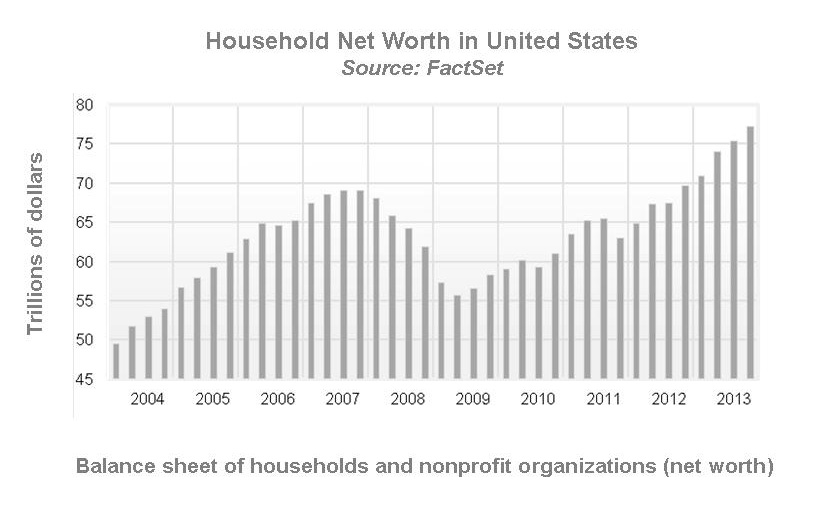
It feels like the market is melting up these days as stocks continued their year-long rise during the shortened holiday week. Investors continue to be heartened by positive economic data signaling stronger growth as we enter 2014. Durable goods orders were up 3.5 percent in November with automobiles, airplanes and refrigerators helping drive end demand. Also, new home sales remain robust with record-setting sale prices. Both of these data points hit on some important topics for our 2014 Investment Outlook.  Specifically, we think demand for capital equipment will finally accelerate in 2014 due to underinvestment and substantial cash balances on corporate and consumer balance sheets. Furthermore, consumers are increasing their spending as a result of the “wealth effect” that has been fueled by increased home and stock prices.

Household_NW

Crosstown Traffic

Our investment team has been writing for some time about the shift to online shopping and this trend came to a head this week for Amazon and UPS.  For those of us who like to start shopping closer to Christmas, Amazon Prime© seems like the perfect solution.  For an annual fee of $79.00, Amazon provides two-day free shipping on most merchandise. We don’t think anyone is surprised to learn that we live in an era of procrastinating techno-geeks who wait until the last minute to ship gifts. This time, the sheer volume of orders overwhelmed both Amazon and UPS. Though UPS has not stated how many packages were affected, the number seems to be in the hundreds of thousands. While both Amazon and UPS are doing what they can to satisfy customers, the real story is the volume shift to cyberspace. Amazon signed up over 1 million additional Prime© customers in the third week of Christmas alone. This is a nice development for Amazon because these shoppers tend to spend twice as much in a given year as those who don’t have Amazon Prime©.

Our Takeaways for the Week

  • Christmas week was just another reason for investors to keep bidding up stock prices
  • Interest rates continue to move slowly higher on Fed taper talk

Disclosures