

Weekly Market Makers

Summertime Blues

Jason Norris of Ferguson Wellman

by Jason Norris, CFA
Senior Vice President of Research

As we move into the dog days of August, both equity and bond markets have experienced some seasonal weakness due to Fed taper fears and some weaker-than-expected earnings reports. Historically, August and September are relatively poor months for equities and with concerns about the Fed taking its foot off of the liquidity gas, equities may take a breather. That said, we believe there is a 50/50 chance the Fed will begin to taper their bond buying at the September meeting, but this will be contingent on economic data for the next month.

Superunknown

Retailers delivered mixed results this week with disappointing reports from Macys and Wal-Mart. In both instances the retailers were able to maintain pricing, but volumes were weak. In short, consumers are going to the stores, but they are being more selective in their purchases.  Macy’s did state that August back-to-school shopping showed a nice pick up. We have seen some positive recent data with weekly jobless claims continuing to make post-recession lows and consumer confidence has been in an upward trend since mid-April. While these data points are positive, we realize that they are modest and may stagnate. Though the U.S. economy is improving and we are seeing improvements in northern Europe; however, as Cisco CEO John Chambers stated earlier this week, the recovery is “inconsistent.”

Highway Star

With consumers purchasing less, we are seeing a deleveraging of their personal balance sheets. Mortgage debt declined meaningfully as consumers refinanced at lower rates. Credit card debt remained stable, but auto loans saw a nice increase. While mortgage and credit card debt are meaningfully below their pre-recession peaks, auto loan is back to peak levels. We believe that with relatively low interest rates and an aged auto fleet, consumers will continue to upgrade their auto purchases. The average car in the U.S. is now 11.2 years old while in 1995 it was 8.4 years old. For the time being, rising interest rates won’t have a negative effect on auto loans since these loans are based on Prime, and until the Fed begins to raise the funds rate, prime will remain low.

Schools Out

Unfortunately, the deleveraging theme is not occurring for young college graduates as student loan debt reached the $1.0 trillion mark and shows no signs of declining. While one can debate if the loans are “worth it,” the load of debt post-graduation will impair spending. We are already seeing red flags in this market with delinquency rates meaningfully above historic levels. Over 30 percent of student loan borrowers are at least 90-days delinquent compared to 10 years ago when less than 20 percent were. There are now concerns that recent graduates may be less likely to start a small business due to their debt burden. Unlike the mortgage and credit crises of 2007 and 2008 which had a devastating effect on the banking sector, the Federal government (or U.S. taxpayer) back the student loans.

Our Takeaways from the Week:

  • Though equities are in the midst of a pullback, we believe stocks will be higher by year-end
  • Economic data continues to show improvement, but the pace remains tepid

Motor City Meltdown

Furgeson Wellman by Brad Houle, CFA Senior Vice President

On June 6, the city of Detroit declared Chapter 9 bankruptcy, which is the largest municipal bankruptcy in U.S. history. Detroit has an estimated $18 to $20 billion in debt and over 100,000 creditors. The city has suffered a long, slow decline over the past few decades as the U.S. auto industry has withered. According to the U.S. Census 2010 findings, the population base in Detroit has declined 60 percent from 1960 to 2010. Moody’s Corporation has reported that Detroit’s general fund revenues have declined 25 percent since 2007  As the population has declined the city has struggled to provide city services due to their shrinking tax base.

Municipal bond investors are among the creditors who have effectively loaned money to the city of Detroit for operating expenses as well as capital improvements. How bondholders are treated in this bankruptcy is being carefully monitored by municipal bond investors. Part of Detroit’s debt is general obligation municipal bonds that are theoretically backed by the city’s taxing authority. In question is the value to be recovered by these bondholders who theoretically bought bonds with the assumption that they were backed by the city’s full taxing authority. In addition to debt holders, there are pension recipients that are also in the mix of creditors. Detroit also has an unfunded pension liability that is between $3 and $3.5 billion, depending upon the assumptions used in the calculations.

Unfortunately, it looks as if the bankruptcy process is going to pit the bondholders against the pension recipients and the taxpayers to see who will bear the burden. How the remaining value is going to be divided is an open question at this point. Federal bankruptcy law treats each creditor equally while Michigan has strong protections in place for public employee pensions in the event of a bankruptcy.

Detroit is an extreme example of a municipality in financial distress. While there are other cities that are facing financial challenges, such as Chicago, the probability of default is fairly low. Chicago still has a dynamic economy, a recovering real estate market and a more stable population. Detroit had no other options other than bankruptcy due to an extraordinary drop in population impacted by a revolutionary change in the auto industry. This population decline coupled with corresponding erosion in the economic base created a downward spiral that Detroit could not reverse, which may impact bondholder’s recovery potential.

While the Detroit bankruptcy has made headlines and has caused bond investors to reconsider how cities with similar problems are evaluated; historically, municipal bonds have been a safe investment. According to Moody’s, the default rate on rated bonds has been .012 percent for the 40-plus years of data available. Looking at it differently, of the greater than 1 million municipal bond issues outstanding, only 71 have defaulted since 1970.

Moody's Rated Municipal Issuer   Defaults 1970-2011
Type of Bond Defaults Percentage
Housing 29 40.80%
Hospitals 22 31.00%
Education 3 4.20%
Infrastructure 4 5.60%
Utilities 2 2.80%
Cities 2 2.80%
Counties 1 1.40%
Special Districts 1 1.40%
Water & Sewer 1 1.40%
State Governments 1 1.40%
Non-General Obligation 66 93.00%
General Obligation 5 7.00%
Total 71

Our Takeaways from the Week:

  • The situation in Detroit is an extreme example of a city in financial distress.
  • Municipal bonds historically had very low default rates and are an important component of many investors’ portfolios.

Source: Moody's Corporation

Disclosures

Amid Dry Holes, Positive Change at the Margin

by Shawn Narancich, CFA Senior Vice President of Research

Revisionist History

Amid hundreds of quarterly earnings reports daily, investors were challenged to stay on top of a slew of important economic data hitting the tape this week. While always old data by the time the report sees daylight, GDP for the U.S. economy remains an important benchmark for investors and the Fed, and the 1.7 percent growth rate came in substantially above where we thought it would for Q2. Underlying detail reveals that consumer spending continues to support growth, with housing construction and a reduced drag from government spending also helping boost numbers. That U.S. businesses had sufficient confidence to build inventories in the quarter (thus also adding to reported GDP growth) is a good sign. Comprehensive revisions from the Commerce Department, dating back to 1929, showed that GDP growth was better than expected last year at 2.8 percent, with the Great Recession also being less severe than previously advertised.

Bullish confirmation came from another number that isn’t subject to ex post facto revisions – the survey of U.S. purchasing managers. That number skyrocketed to 55.4 in July, meaningfully above the growth/contraction dividing line of 50, and the strongest reading for U.S. manufacturing in nearly two years. Coupled with better than expected manufacturing indicators in China, the news helped to confirm stocks’ recent gains and was a catalyst to push both the Dow Industrials and benchmark S&P 500 Index above the 1700 level. With blue chip U.S. stocks up about 20 percent for the year, the question now is whether the economy can attain the higher rate of growth investors increasingly expect in the back half of 2013.

Help Wanted?

Friday’s monthly payroll report completed the week’s troika of important economic indicators, and the fact that a net jobs gain of 162,000 disappointed expectations met with a yawn by investors. After all, what’s sustaining the Fed’s quantitative easing program and well contained labor costs is a jobs market that remains slow to expand, keeping pressure off employers to raise wages and pushing corporate profit margins to record levels. Second quarter earnings reports have confirmed the bottom line benefits which, when combined with share buybacks and acquisitions, promise to deliver 6-8 percent profit gains for the full year.

Dry Holes

This week, it was Big Oil’s turn at the earnings confessional, and unfortunately for them, the congregation of investors was in no mood for penance. One after the next – first British Petroleum, then Royal Dutch Shell and Exxon Mobil, and finally Chevron – delivered what we judge to be Big Oil’s worst collective set of numbers in recent memory. In Royal Dutch’s case, this Netherlands-based integrated oil company continues to be confounded by pipeline sabotage in Nigeria, a production mix weighted toward natural gas, and failure to gain traction in the booming U.S. shale plays. The stock rightfully got hammered, off almost 6 percent on the discouraging report. Aside from company-specific issues with Royal Dutch, the common denominator for the four Super-Majors was poor refining results. Contraction in refining margins was most pronounced domestically, where the rising cost of benchmark West Texas Intermediate (WTI) crude pinched margins relative to the price of gasoline, diesel, and jet fuel production. As takeaway capacity has increased from key producing basins in North Dakota, West Texas, and Canada, the anomalous discount of WTI to Brent has disappeared, and with it, the outsized profits that mid-continent refiners once enjoyed. Remarkably, all four companies missed consensus earnings forecasts and all four experienced downdrafts in their stock prices afterward.

Our Takeaways from the Week

  • An important week of economic news flow was encouraging overall, and stocks responded by trading to new highs
  • Big Oil was an exception to what has generally been a decent second quarter earnings season

Disclosures

It's Earnings Season: Industrials and Tech Gain Traction

by Shawn Narancich, CFA Senior Vice President of Research

Earnings Central

Economic news was light this week, and what there was took a back seat to earnings. As we approach the midway point of second quarter earnings season, investors who were late to the equity party and were looking for cheaper admission remain confounded by a market characterized by a strong underlying bid. On balance, second quarter earnings have been positive so far, with most companies avoiding disastrous misses and again eking out profit gains through good cost control, share buybacks and modest underlying growth. That the U.S. stock market has become a consensus favorite despite sub-2 percent economic growth for the past three quarters is a testament to highly accommodative monetary policy and themes like the renaissance of U.S. energy production and the rebound in housing, both of which promise to deliver better GDP numbers in the second half of this year.

Shock and Awe

What strikes us most about the numbers so far are the trends by sector. While about two-thirds of companies are delivering earnings above estimates and half of those are generating better than expected revenue, the industrial and technology sectors are reporting the best numbers relative to expectations. That blue chips industrials like General Electric, Honeywell and United Technology are clearing the earnings bar is less surprising than the numbers delivered by defense companies, which Wall Street had widely expected to be weakened by the early innings of federally sequestered spending cuts. Much to our surprise, defense primes Lockheed Martin, Northrop Grumman, and Raytheon reported clean sweeps, exceeding top and bottom line expectations for the second quarter while also raising guidance. Multiple factors explain this paradox, including the fact that Pentagon cutbacks are still in their early days. More notably, the defense contractors represent “Exhibit A” in the manual on how to manufacture earnings growth—cut costs, repurchase shares and, if you are an old-line industrial with roots in the defined benefit pension era, recognize the earnings benefit that rising interest rates have on projected benefit obligations. Remarkably, the stocks of all three of these companies have outperformed the S&P 500 year-to-date.

Hall Pass Anyone?

In technology, it’s hard to emphasize the upside without highlighting Facebook, which blew away expectations for both revenues and earnings. Revenue growth accelerated to 53 percent in the quarter, defying skeptics who claimed that they would be unable to monetize an avowed shift to mobile advertising. As investors took notice of a remarkable 75 percent sequential surge in mobile ad sales, bears ran for cover and prompted a huge short squeeze in the stock. Facebook’s stock was an overnight success, surging 30 percent on immense trading volume that brought shares to within shouting distance of the company’s ill-priced IPO. While Facebook profits surged, Amazon.com disappointed investors by reporting a quarterly loss on slightly lower than expected revenue growth.  Nevertheless, Wall Street again looked the other way, seeing eventual riches behind the bounty of sales this web giant continues to amass. Despite management telling investors to expect another loss in the third quarter on lower than expected sales, shares rose 3 percent.

Green Shoots

Earnings remain front and center, but we would be remiss not to mention the change at the margin that we perceive in Europe. While the Continent has been plagued by recession for two years now, increasingly easy monetary policy and reduced emphasis on fiscal austerity appear to be germinating some green shoots. A broad mid-month survey of manufacturing activity there rose above 50 this week (the dividing line between contraction and growth), consumer confidence is up, and a handful of companies are reporting that their European business isn’t quite as bad as it was. In a world of 12 percent unemployment and weak export markets, it wouldn’t take much of a spark to move Europe’s GDP needle back into positive territory.

More Where That Came From

Next week brings another huge wave of corporate earnings reports, including bellwether reports from ExxonMobil and Chevron in the energy sector. In addition, the economics calendar ramps up, with the July employment report Friday preceded by what will be investors’ first look at second quarter GDP here in the U.S. on Wednesday. Finally, investors will scour reports from the Fed, which will meet again on Tuesday and Wednesday to review monetary policy and perhaps give additional clues about its plan to reduce the size of QE.

Our Takeaways from the Week

  • Equities finished a busy week of earnings largely flat, with industrials and tech companies providing the most encouraging results
  •  Europe’s recession appears to be waning

 Disclosures

A Dovish Bernanke Soothes the Market

by Shawn Narancich, CFA Senior Vice President of Research

Bend it Like Bernanke

Concerned about the steep rise in 10 year U.S. Treasury interest rates that help set the price of mortgages, our fearless Fed Chairman went before Congress to give his semi-annual testimony to Congress this week. While he disclosed little to lawmakers that was new, one key takeaway was his emphasis on the idea that tapering the Fed’s program of buying U.S. mortgage backed securities (QE) has no pre-set schedule. Stocks, bonds, gold, and the dollar responded predictably (rally, rally, rally, decline) to the notion that the Fed will be slower to pull back the punchbowl of stimulus than traders first thought when it fired its first volley of commentary about “tapering" last month. At a time when the Fed’s forecast for 3-4 percent economic growth next year appears increasingly optimistic when juxtaposed against sub-2 percent GDP growth currently, investors are left to hope that a good old fashioned earnings season can sustain and perhaps enhance the heady returns US stocks have delivered so far this year.

Earnings Season Shifts into High Gear

On this topic, investors have now parsed their first full week of Q2 numbers. With over 15 percent of the S&P 500 having now reported, two-thirds of companies are beating earnings expectations, but only about 40 percent are exceeding the top-line forecasts promulgated by Wall Street. In broad brushstrokes then, not much has changed since last quarter, but as always, what makes this business so interesting is the detail beneath the averages.

Money in the Bank

Delving into sectors, we observe that banks have generally reported encouraging numbers, helped by higher levels of capital markets activity (IPO’s driving growth in investment banking, rising fees on managed assets, better trading revenues, etc) that have boosted earnings at the likes of Goldman Sachs, Morgan Stanley, and JP Morgan. Also at work for the financials is better credit quality, which has allowed key regional lenders like Wells Fargo and PNC to reduce their credit provisioning for bad loans. Looking ahead, higher levels of interest rates, if sustained, should help banks increase core earnings power on both their portfolios of marketable debt securities (maturities reinvesting at higher rates) and, more importantly, on new loans benchmarked to market rates. Anecdotally, several management teams have noted stabilization of net interest margins and the potential for rising net interest income if rate gains hold.

Like Falling off a Log

In tech land, no one can be too surprised by the weak numbers out of Intel and Microsoft, given the continued double-digit losses in sales of the PC, still their core market. And while Yahoo’s earnings beat expectations, this aging Internet player once again missed on the top line as its display ad business declined at double-digit rates despite the fact that the Internet continues to take ad share overall. Notwithstanding erosion in Yahoo’s core business under the leadership of new CEO Marissa Mayer, earnings expectations post-quarter actually increased because of Alibaba. This Chinese e-commerce giant reported 71 percent revenue growth and margin expansion as well, resulting in an earnings boost for Yahoo because of its 24 percent ownership interest. So as Wall Street begins to assess the effectiveness of Ms. Mayer’s leadership one year in, she has Alibaba to thank for a stock price that rocketed 10 percent higher post-earnings and now stands at nearly twice the level it was when she arrived last summer.

Next week, investors can look forward to an even heavier slate of second quarter earnings, with more consumer, industrial and energy names entering the fray.

Our Takeaways from the Week

  • Stocks, bonds, and gold melted up this week against the backdrop of further dovish jawboning by the Fed
  • Earnings season is off to the races, with puts and takes

Disclosures

Somebody’s Watching Me

by Ralph Cole, CFA Senior Vice President of Research

“Fed-watching” is a time-honored tradition among industry insiders who parse every word that the Fed Chairman and his committee utter. While it is entertaining for many, it is also the cause of unnecessary volatility in the bond and stock markets. In his efforts to be as communicative as possible, Fed Chair Ben Bernanke has probably come to realize that people are going to interpret things he says differently, or ways that he might not intend … despite every attempt to be as clear as possible!

Although market action that has been to the contrary, we think the Fed chairman has been very clear in his messaging, which simply has been: If the economy continues to improve, the Fed will likely begin tapering in September. If the economy fails to improve in the coming months, the Fed will continue with QE3. The chairman has bent over backwards to make it clear that he is more afraid of deflation than inflation, and the Fed stands ready to support the economy.

What indicators are we watching? Late last year, the Fed indicated that it was monitoring the unemployment rate and by this measure, 6.5 percent would be the level by which the economy would be considered on sound footing. Currently the unemployment rates stands at 7.6 percent, a good deal away from Bernanke’s threshold.

Where Do We Go from Here?

Our attention turns in the coming weeks to second quarter earnings reports. Estimates are for 4 percent profit growth from the S&P 500. More important than reported earnings, the key to earnings season will likely be company guidance for future quarters.

In particular, we will be listening to companies’ insight on growth in Europe (is it bottoming?), growth in China (is it falling off a cliff?), and U.S. (does the second half look better than the first?). Company projections will go a long way in determining if the S&P 500 can hold recent gains and extend to new all-time highs.

Takeaways for the Week

  • Don’t overanalyze Fed commentary; rather, watch employment numbers the first Friday of every month
  • Fed commentary has led the market to new highs. It is now up to corporate earnings to take the market to another level

Disclosures

The Sport of Protesting for Brazil

Furgeson Wellman by Brad Houle, CFA Senior Vice President

The Sport of Protesting for Brazil

Brazil has been in the news recently with images of large protests filling public squares that have turned violent in some instances. There is no one issue that is sparking the protests other than what can be described as a general dissatisfaction by the public. Issues from a rise in bus fares, lowering of fuel taxes and a call for improved government services have caused the citizens to take to the streets.

Until recently, Brazil has been considered a model emerging market economy with its burgeoning middle class and abundant natural resources. Also, next year is Brazil’s big “debutante ball” to the world as it is hosting the 2014 FIFA World Cup and the 2016 Summer Olympics. Despite spending on infrastructure as well as the government’s efforts to stimulate the economy, Brazil is struggling. The Brazilian stock market is down over 20 percent this year and the Real, Brazil’s currency, has depreciated versus the dollar. There are broader structural economic issues which are causing the slowdown in the economy and have filtered down to create social unrest.

Brazil is a large exporter of commodities with exports accounting for 14 percent of GDP, compared to 6 percent of GDP in the 1990s. Brazil exports agricultural products and metals, with China being a large trading partner of Brazil. With the Chinese slowdown and a general slump in commodity prices, pressure has been placed on Brazilian incomes. According to the World Bank, the per capita GDP is around $12,000, which has grown nicely in the last few years. However, this number also suggests that despite recent progress of income gains and standard of living, much of the population still lives in abject poverty.

Also hampering the Brazilian economy is an explosion of debt that accompanied the strong economic growth that was fueled by the commodity boom. With the private sector saddled with debt, the ability to invest and grow businesses is hampered by high current debt service requirements. As we have recently witnessed in developed economies, deleveraging is a long and painful process that crushes growth opportunities.

Despite the efforts to “dress up” Brazil for the World Cup and Olympics, there are global economic headwinds which are making it difficult for the country to pull out of the current economic malaise. Brazil is a reminder that conditions can change rapidly and dramatically in emerging markets. It also reinforces the growing interdependence of economies around the globe.

Disclosures

First Half 2013 . . . A Tale of Two Asset Classes

by Shawn Narancich, CFA Senior Vice President of Research

Ready, Fire, Aim

The fact that financial markets are closing the first half of 2013 on such a volatile note is not so surprising given the concern investors have about the timing of the Federal Reserve’s contemplated exit from quantitative easing. The Fed has been instrumental in manufacturing a rebound in housing that is adding not only to the investment accounts of the GDP equation, but also indirectly to consumer spending through the wealth effect of higher home prices and 401(k) values. Against this backdrop, several Fed governors and regional bank presidents hit the lecture circuit this week to clarify for investors that the Fed is not imminently planning to reduce monetary accommodation. Stocks responded in predictable fashion, and are now set to post the best first half gains since 1999, with returns of about 14 percent. We continue to believe that the Fed will remain accommodative for some time to come, helping support further expansion in a U.S. economy that many Americans still think is in recession.

 Bonds . . . Et Tu Brute?

In the bond market, it’s another story entirely. Although benchmark 10-year Treasuries stabilized this week, bond indices are littered with small losses for the first half of the year. The good news is that bond investors who put money to work today are realizing real rates of return for the first time since early 2011. For example, a benchmark Treasury purchased today yields a nominal 2.5 percent which, when a 1.4 percent rate of inflation is subtracted, results in a real rate of return equaling 1.1 percent.

Bonds 101

With the recent spike in interest rates, we encourage clients to recognize the power of time and reinvestment to heal bond market wounds. In addition, we would note that recent bond market “losses” will only be realized if investors sell their paper below par. To that end, we plan to continue owning our clients’ bonds into maturity and look forward to reinvesting those funds at higher rates of interest. Furthermore, fixed income investors can reduce interest rate risk by structuring bond portfolios with shorter term maturities, thus reducing the duration of their investments and hastening the maturity of lower coupon bonds. On the other hand, investors in bond funds confront a harsher reality. In a rising interest rate environment, the net asset value of these funds drops with bond prices, but unlike a portfolio of individual bonds, there is no assurance that their initial purchase price will be recouped because they share ownership of that fund with other investors. Indeed, what we are beginning to see now is an accelerated rate of bond fund redemptions by investors who don’t want to wait for bonds to mature. In this case, losses may be realized by fund managers forced to sell, with proceeds used to redeem the bond fund shares being liquidated.

As the second quarter of 2013 comes to a close, we wish our Ferguson Wellman friends and clients a happy and safe Fourth of July holiday. Investors should rest up, because second quarter earnings reports are right around the corner!

Our Takeaway from the Week

  • Stock and bond markets stabilized following reassuring comments from Fed officials and generally upbeat economic data

Disclosures

Taper Tantrum

Furgeson Wellman by Brad Houle, CFA Senior Vice President

The sell-off in virtually all financial markets and asset classes preceding and following the Federal Reserve meeting and press conference this week has been dubbed the “Taper Tantrum” in the press. Investors and the media parsed and analyzed every syllable uttered by Federal Reserve Chairman Ben Bernanke during Wednesday’s meeting.

While nothing really changed in the message that the Federal Reserve Chairman delivered … the markets took it as an opportunity to overreact. The passing of time has merely brought us closer to the Federal Reserve’s previously announced subtle change in strategy as the economy has improved. The good news about “The Taper” is that it is clearly and acknowledgement that the economy is actually recovering. We do not believe that conditions exist for interest rates to move up sharply. Both the current rate of inflation and the projected future rate of inflation remains contained. Further, the tepid current economic growth does not seem poised to increase so rapidly that would cause the Federal Reserve to be forced to raise rates.

Fear of sharply rising interest rates and a bear market in bonds seem overblown. Interest rates are artificially low based upon the Fed’s bond purchase, however; if the purchases are curtailed, rates should seek a higher equilibrium but are unlikely to explode higher. If rates move slowly higher over the next two-to-three years, investors will have disappointing bond returns. The silver lining is the opportunity to reinvest at higher rates. Time is a bond investor’s friend in a rising rate environment. Also, it is advantageous for investors to own individual bonds and use active management in this type of environment. Many investors will welcome the end of the “tax on savers” that has been a consequence of zero interest rate policy. 

Equities that are viewed as interest rate sensitive have sold off the most during this correction. REITs and utilities have been notable underperformers. It is important to remember that most equity indexes are up nearly 12 percent for 2013. The equity markets probably got a bit ahead of themselves and were due for a normal correction. We still view the economy as being stronger in the second half of 2013 and equity markets should find a firmer footing when this myopic view of the “The Taper” has passed.

Our Takeaways for the Week

  • Nothing has really changed relative to the Federal Reserve announcement this week and the financial markets seem to be overreacting to the situation

Disclosures

Synchronicity out the Window

by Ralph Cole, CFA
Senior Vice President of Research

Synchronicity out the Window

The first four months of the year were typified by all global markets moving higher in unison. That market action began to change in May as rates started to rise and markets around the world moved toward disconnecting. This was evident Wednesday when the Nikkei dropped 6.5 percent. In a world where all equity asset classes seemingly move together, we would have expected the U.S. markets to rollover on Wednesday as well – but the S&P 500 was only down .8 percent on the day.

This has been the case with several equity asset classes in recent months. While the U.S., Europe and the UK have held up relatively well, Japan, emerging markets and REITs have all sold off rather sharply … for many different reasons. We are not surprised by the pullback in Japan after a 70 percent run up in six months. While we continue to believe in the long-term growth story of emerging markets, they have not been as aggressive on the policy front as their developed brethren. Until we see some accelerating growth in these countries, we would expect them to lag their more developed peers. For REITs,  fundamentals remain positive, but they are susceptible to higher interest rates.

Bump and Grind

It is clear that the stock market and interest rates are struggling for direction. The best analogy that we have heard is that “we are riding in a car with a manual transmission driven by a 16-year-old.” Much like trying to find the next gear in an old VW Bug, the U.S. economy is trying to “find its next gear” in the expansion. If we do indeed accomplish finding this next gear and “breakaway speed” for the economy, the Fed will be able to begin to withdraw QE3. This is known as tapering.

This withdrawal of liquidity will have a dampening effect on the markets in the near term. Earnings and economic fundamentals will have to drive the market higher from current levels. 

Our Takeaways from the Week

  • Stocks around the world continue to disconnect, with the U.S. showing some of the best strength
  • Until the U.S. economy shows that it is clearly on its feet, fears of Fed tapering too early will continue to dominate the headlines


Disclosures

Key Jobs Report Turns the Market's Tide

by Shawn Narancich, CFA Senior Vice President of Research

Jobs Turn the Tide

While always a key data point anticipated by investors, the jobs number reported Friday was one of the most eagerly anticipated data points in recent memory owing to the recent cacophony of banter about when the Federal Reserve will begin to reduce its unprecedented levels of monetary stimulus. With the near consensus jobs number delivered, investors breathed a sigh of relief that the Fed is probably no closer to tapering its program of quantitative easing (QE). Expanding employment at May’s pace of 175,000 jobs is arguably too slow to reduce the unemployment rate to levels the Fed would like to see, and in this case, was accompanied by a rise in the unemployment rate that signaled a higher rate of labor force participation. Apparently all the talk about job gains and Fed “tapering” brought would-be laborers off the sidelines, producing the juxtaposition in data. While US stocks posted gains on the week, the sell-off in bonds continued, pushing the yield on benchmark 10-year Treasuries up to 2.17 percent.

Slower for Longer

For our part, we believe Fed interest rate policy will remain highly accommodative for the foreseeable future, and that reductions to QE are probably farther off than the consensus believes. Fed Chairman Bernanke is a student of the Depression, and is well aware of the adverse consequences of prematurely tightening monetary policy. Furthermore, he has witnessed firsthand the deflationary malaise of Japan, which is only now beginning to respond to unconventional monetary stimulus. We would argue that when the Fed ultimately begins to remove the punch bowl of monetary stimulus, it will be for the right reasons – multiple months of 200,000+ job gains and an unemployment rate materially below today’s 7.6 percent rate. A rebound in housing and higher stock prices have induced a wealth effect that is supporting growth in consumer spending, and higher US energy production is improving the US trade picture. But these positives are being tempered by higher income and payroll taxes that, combined with reduced government spending, have created fiscal headwinds dampening the pace of job creation.

Making Numbers

In a week of light news flow from corporate America, AT&T’s announcement of better than expected wireless subscriber additions in the second quarter-to-date highlights some interesting undertones. What normally would be viewed as good news might end up being so for AT&T shareholders, just not right away. In today’s environment of promotions and subsidy-driven smart phone plans, adding more subscribers typically dings near-term earnings, with payoff happening over the course of the wireless customer’s contract. Predictably, many analysts on Wall Street reduced AT&T’s second quarter earnings estimate because of this news, but AT&T management continues to guide full year 2013 financial results in line with previous expectations. Why the disconnect? AT&T plans to use its prodigious cash flow to repurchase stock. So while reported net income in 2013 may actually undershoot original forecasts, per share earnings should meet expectations on fewer shares outstanding. This example is noteworthy only inasmuch as it highlights the increasingly common practice of major US companies “manufacturing” EPS numbers to overcome challenges posed by a slow growth economy. Against this backdrop, AT&T shares underperformed, falling 1 percent on Friday.

Our Takeaways from the Week

  • Stocks recouped early week losses as a “Goldilocks” jobs number rejuvenated investor spirits
  • The debate goes on about when and how fast the Fed will taper its QE program

Disclosures

Abenomics in Action

Furgeson Wellman by Brad Houle, CFA Senior Vice President

The Japanese economy has been stagnant for the last 20 years following the real estate bubble burst at the end of the 1990s. In addition, Japan has a rapidly aging workforce, low birthrate and very restrictive policies regarding immigration. Japan has been caught in a cycle of deflation whereby prices decline and consumers delay purchases as they believe prices will continue to decline. This negative feedback loop has been very damaging to economic growth. 

Japan’s Prime Minister Shinzo Abe is undertaking a bold experiment in an attempt to pull Japan out of this economic malaise. Dubbed “Abenomics” by the press, the plan is using three-pronged approach: aggressive monetary easing, structural reforms to make Japan more competitive and fiscal stimulus. The plan is essentially similar to the quantitative easing presently being used in the U.S. but on steroids. The Japanese government has a stated goal to drive the inflation rate to 2 percent and reinvigorate the economy. Thus far, the program has been successful in the short-term. The Japanese stock market is up more than 30 percent, consumer confidence is higher and the yen has depreciated against many currencies. Tiffany, the high-end jeweler, reported that sales in Japan were up 20 percent last quarter attributed to the government’s attempt to stimulate the economy. The depreciation of the yen is welcome in that it makes Japanese exports more affordable to the rest of the world.

Bold economic experiments are never a riskless endeavor. Japan has a serious debt problem which raises the jeopardy of Abenomics. According to IMF Data, Japan’s debt-to-GDP ratio is projected to be 238 percent for 2013. The United States, although not a sterling example of fiscal discipline, is projected to have a debt- to-GDP ratio of 105 percent this year. Japan has been able to finance most of its debt internally. Savings is a cultural norm in Japan and its citizens have been financing Japans debt at very low levels. According to Pavilion Global Markets data, the weighted average cost of all Japan’s debt is less than 1 percent. Since the announcement of Abenomics, the interest rate on the Japanese 10-year bond has moved from below .5 percent to nearly 1 percent. This reaction is largely due to increased inflation expectation, which is the point of Abenomics. The peril of the situation is that Japan is borrowing mostly short-term to finance long-term liabilities, which can be problematic. This type of risk is called “roll-over risk” because as short-term bonds come due, they might have to be refinanced at higher interest rates. This is fine to a point; however, at some point if interest costs rise too far—the situation could become unstable. If current bondholders lose confidence or Japan has to seek substantial capital from outside countries, Japan could have a serious financial crisis. While we are not predicting an eminent financial crisis, we do feel it is important to have an awareness of the high stakes involved with the present Japanese economic policies. 

Our Takeaways from the Week

  • Fears of Japanese bond prices and the long-term effectiveness of Abenomics have created skepticism and concern, taking down Japanese markets for the past two weeks
  • Despite the Dow dropping 200 points on Friday, it ended higher for the sixth straight month. The S&P 500 and NASDAQ also fell today but gained for the seventh straight month

Disclosures

Turbulent Stocks and Tales of the Cash Register

by Shawn Narancich, CFA Vice President of Research

Stocks Hit Turbulence

Investors became disabused of the goldilocks notion that U.S. equities will benefit from both good economic news and bad (the latter being ascribed to what’s known as the Bernanke put), with stock prices succumbing to congressional probing of the Fed Chairman’s testimony this week. Bernanke indicated that the U.S. central bank could begin dialing back its open-ended quantitative easing (QE) program if incoming jobs data evinces sustainably better employment trends. Nothing earth shattering here, but in light of the near uninterrupted 15 percent-plus gains that stocks have experienced so far this year, traders don’t need much of an excuse to take profits. Ultimately, a less accommodating Fed presumes the type of economic improvement and employment gains the Fed wants to see (i.e., good news), an environment supporting corporate profits. With 1.1 percent inflation and 7.5 percent unemployment still materially distant from the Fed’s goals, much work remains to be done. That said, we may be embarking on one of those periods in which the receipt of typically encouraging economic reports are met with skepticism by traders fearful that the Fed will withdraw the proverbial punch bowl of monetary stimulus sooner than expected. Against this backdrop, Treasuries have fallen in value, with the benchmark 10-year security now yielding in excess of 2 percent.

Tales of the Cash Register

Major retailers bookended what was an otherwise uninspiring first quarter earnings season, reporting characteristically disparate results. In the “hit” column, Home Depot confirmed its spot as the nation’s top home improvement retailer, reporting healthy sales gains despite a much cooler spring that delayed lawn and garden spending. The key drivers for Big Orange are continuing gains in new home sales and higher home prices that are making existing homeowners more prone to spend on an appreciating asset. Unlike Home Depot, competitor Lowe’s missed earnings expectations on disappointing same-store sales that fell in the period. As such, Home Depot’s market share gains accelerated and management raised earnings guidance, rewarding shareholders with further gains in a stock that is now up 28 percent year-to-date and 114 percent in the past two years.

Things weren’t so rosy for Target in its fiscal first quarter, as cheap chic retailer reported a disappointing drop in same-store sales and missed earnings expectations. While a cool spring hurt temperature-sensitive apparel sales, management reports that better weather recently has same-store sales back in the “plus” column. The stock was hit by 4 percent on the earnings news, but we remain optimistic that Target will gain its fair share of U.S. retail sales while benefitting from a recent expansion into Canada, where customers have enthusiastically greeted Target’s new stores. As the business gains scale, we believe that Canada will turn profitable later this year and drive attractive earnings accretion in 2014 and beyond.

Our Takeaways from the Week

  •  Stocks stumbled this week as investor focus turned to Fed policy amid increasing speculation about the timing of tighter monetary policy
  • Retailers reported mixed first quarter earnings that marked the unofficial end of reporting season

Disclosures

The Wealth Effect Rearing Its Head

Jason Norris of Ferguson Wellman by Jason Norris, CFA Senior Vice President of Research

 The Wealth Effect Rearing Its Head

Shrugging off higher taxes and politics in Washington, consumer sentiment reached levels not seen since 2007. The gains, however, were focused primarily among the higher income earners. The broad University of Michigan Index gained seven points from last month, however, those families earning over $75,000 posted a gain of over 17 points, while those making less rose only two points. Higher home prices and a strong stock market has a significant wealth effect on higher earners, thus instilling higher confidence.

This strength in data fueled Friday’s equity markets to record highs. Specifically, the S&P 500 is up over 17 percent for the first five-and-a-half months of 2013. Robust economic growth has not been the catalyst. While the U.S. economy should continue to grow in the 2 to 3 percent range and corporate earnings are expected to show growth of around 7 percent, a 17 percent move in equities may seem a little frothy. We believe that equities still offer a better risk/reward relative to bonds. With the price-to-earnings multiple on stocks is currently at 15 times the earnings in 2013, this is still below multiples seen in 2007 when the equity markets were last at these levels. Also, with interest rates remaining below 2 percent on the 10-year Treasury, we would not be surprised if price-to-earnings multiples continue to expand into the upper-teens.

Japan Joins the Printing Party

That leads us to that elusive question of when will interest rates start rising in a meaningful way. Central banks around the world continue to flood their economies will currency in order to stimulate growth. The four major central banks (U.S., EU, UK and Japan) have increased their balance sheets by over $5.0 trillion to $9.1 trillion since 2008. Japan has been the most recent country to aggressively purchase securities to increase its money supply. This has resulted in a meaningful depreciation of the Japanese Yen relative to the U.S. dollar. However, the ECB has been shrinking its balance sheet and the Federal Reserve has been giving signals that it may be closer to unwinding its QE program. San Francisco Federal Reserve President John Williams stated earlier this week that the pace of securities purchases could slow as soon as this summer. This will have to be balancing act so rates do not spike. Commenting on how the Fed might end the monthly purchase of $85 billion in fixed income securities, this week the Dallas Fed President stated that, “I don’t want to go from wild turkey to cold turkey,” and “I think we ought to dial it back.” We believe the end game will be the Fed eventually stopping all purchases. However, they will not actively sell bonds to the open market, but rather just let them mature.

Has Gold Lost it Luster?

Collectively, the aforementioned events have resulted in relative strength in the U.S. dollar, which in turn, has led to a major sell off in gold. Friday’s close of $1,364 for an ounce of gold is the lowest level since early 2011. With inflation benign and the dollar holding firm, there may be more downside to gold in 2013.

Our Takeaway from the Week

  •  Even with stocks at historic highs, valuations are still reasonable

Disclosures

Focus on Municipalities and Pension Reform

Diedrefinal_033_web_ by Deidra Krys-Rusoff Portfolio Manager

Ask any municipal bond expert what keeps them awake at nights and I guarantee that concerns over the escalating costs of pensions and post-retirement benefits for municipalities is on their top 10 list. The pension landscape is changing; as costs increase, the balance between fiscal, ethical and moral responsibility becomes more precarious. Analysts worry about how the costs will be funded and whether the costs will impact or interrupt debt repayment. 

I was afforded the opportunity to moderate an expert panel on pension reform at the National Federation of Municipal Analysts annual conference last week and came away believing that while the problems are large, they are not insurmountable. Here are the key takeaways from the experts.

Politicians tend to think about the next two to four years, which is a not productive for pension reform which is an obligation for the next 30 to 60 years (think “kick the can” mentality). As Robert North, chief actuary for the New York City Retirement Systems said, “I have yet to find anyone who would rather not spend the money on other things.” He noted that public pension financing is asymmetric: the more assets and better funded the pension plan is, the more money politicians are willing spend on enhancing plan benefits. Less assets and lower funded pension plans will result in increased employer contributions and less money in the budget for other services. Most politicians do not want to spend today’s money on a future liability. This leads to some government employers not funding their pension plans at sustainable levels. 

Steve Kriesberg, director of collective bargaining and healthcare policy for the American Federation of State, County and Municipal Employees, noted that retiree health spending is projected to rise, but that it is still a relatively modest share of governmental budgets. He also stated that some government reforms that decrease healthcare for government employees may push the costs onto the taxpayer in other ways; such as through state programs for underinsured patients. The labor opinion is that distressed pension situations are relatively few and easy to identify and that bankruptcy is not an effective way to solve the problems. 

Perhaps the most encouraging speaker was Steve Toole, head of North Carolina’s Retirement Systems. He noted that pension reform is underway in many states and local government agencies and that the underfunding can be solved with political will and creative planning. Progressive pension plans are changing their amortization periods from a rolling 30-year cycle to six to 12 years (this increases annual required contributions now, but will stabilize funding in the future). Other reform measures include removing annual cost of living adjustment provisions, decreasing discount rates and extending plan vesting periods. Toole noted that we should expect to see upward pressure on plan contribution rates for the short term, but that the improving stock market may reduce that pressure within the next five to 10 years. 

We believe that increasing pension and pos-retirement healthcare obligations will continue to have an impact on municipality balance sheets, but that this won’t immediately impact their ability to make bond interest payments. Reform is slowly becoming more palatable to politicians as taxpayers are paying closer attention to benefit costs, which should ease some of the pressure. We will continue to pay close attention to this issue and monitor our client's municipal bond holdings. 

Disclosures

Sell in May? Not on this Day

by Shawn Narancich, CFA Vice President of Research

 Sell in May? Not on this Day

 Defensive sectors like telecom, utilities, and healthcare don’t typically lead stocks to new bull market highs, but through the first four months of this year, that is exactly the odd circumstance investors have observed. A recent string of softer economic reports (both domestically and overseas), stubbornly low Treasury yields and weak trading volumes have fed investor skepticism about the underlying strength of a stock market that once again set a new high on the S&P 500 this week. Only time will tell if a late-week rally in cyclicals will reverse a trend of year-to-date underperformance, but count us as pleased to see a market led higher by elements signaling better economic health. In that regard, the Labor Department’s latest read on jobs was surprisingly upbeat, as net non-farm payrolls expanded at a faster rate in April. Net new job creation of 165,000 certainly isn’t a barn-burning number, but when combined with the upward revisions made to both February and March figures, the jobs picture all of a sudden doesn’t look so bad. Once again, the unemployment rate dropped, this time to 7.5 percent. Surprisingly weak construction spending and lower levels of manufacturing activity reported domestically and in China remind investors that a global economy facing European and U.S. fiscal austerity continues to encounter substantial headwinds.

Discretion the Better Part of Valor

While austerity remains official mantra in Europe, we have noticed a not-so-subtle shift in the Continent’s view of it. With Spain struggling to overcome 27 percent unemployment, key European leaders have agreed to relax the timetable for it to achieve the Eurozone’s holy grail of reducing deficits to a rate of 3 percent of GDP or less. Of course we have to question how long it will be before other economically depressed countries on the southern periphery ask for similar treatment and, if granted, whether the hard-fought reduction of borrowing costs in southern Europe could reverse course. One key player who remains unswayed by calls to relax austerity is ECB President Mario Draghi who, in announcing another rate cut this week, implored European countries to stick to their fiscal diets. Judging by the dramatic fall of interest rates in Spain, Italy and Portugal, the sovereign debt crisis has been extinguished, at least for now. 

Distinctly Mediocre

With about 80 percent of the S&P 500 having now reported first quarter earnings, about two-thirds of companies have delivered better than expected bottom line numbers and modest levels of EPS growth, while at the same time missing top line expectations in the majority of cases.  In other words, a near repeat of what we saw at the end of 2012. The feel right now is late cycle, with companies that are offering updated financial guidance more often than not reducing their projections. A notable exception is the insurers. Aetna and Cigna both reported surprisingly good numbers and raised estimates for the year. A big question that continues to loom large is whether the HMOs will prosper under the expanded system of health insurance coverage mandated by the Affordable Care Act, which becomes law next year. Only time will tell whether the volume gains associated with additional insured lives will more than offset the potential margin headwinds of covering the previously uninsured. 

 Our Takeaways from the Week

  •  The sun is beginning to set on a partly cloudy earnings season
  • Stocks continue to set new highs as global central banks remain committed to unprecedented levels of monetary stimulus

Disclosures

"Twittermonium"

Furgeson Wellman by Brad Houle, CFA Senior Vice President

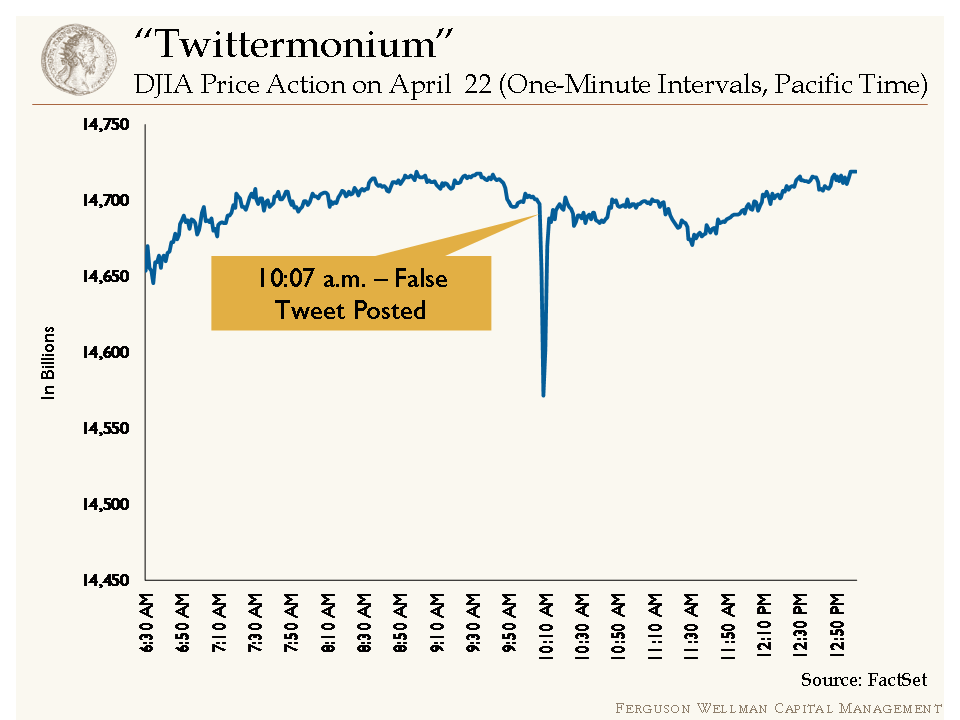
In the not-so-distant past, Twitter was solely known as a bullhorn for celebrities, such as Paris Hilton, who would extol their wisdom – 140 characters at a time – to tens of millions of followers. Global events over the past year have catapulted Twitter into an unprecedented aspect of mainstream media – both as a lifesaving resource and a weapon for destructive pranks and rumors.

Dow Jones Industrial AverageLast year, Twitter was part of electronic communication that facilitated the Arab Spring and just last week, it was used by police to inform Boston-area citizens of public safety issues following the marathon bombings. In addition, federal securities regulators have allowed the use of Twitter and Facebook as a means to disseminate potentially market-making news. On Tuesday, equity markets plunged 1 percent in three minutes due to an erroneous Associated Press tweet indicating that there were two explosions at the White House, causing injury to President Obama. The Associated Press quickly announced that their Twitter account had been hacked and the markets quickly recovered from its pandemonium. This incident exposes the razor’s edge that financial markets are on relative to news dissemination. Algorithmic and high-speed trading quickly takes over without any real evaluation of changing conditions.

This incident is reminiscent of the flash crash that occurred nearly three years ago on May 6, 2010, when the Dow Jones Industrial Average (DJIA) fell almost 1,000 points intra-day and recovered most of its loss before the close. This “crash” was the result of selling pressure from quantitative investors, as well as high-frequency trading that fed on itself. Having only begun to recoup the losses of 2008, investor confidence in the markets was rattled by this volatility as there was a growing suspicion among investors that the “game was rigged.”

Investors_EquitiesThis lack of confidence in the equity markets can be observed in the difference between fund flows into both equity and fixed income mutual funds. From the market bottom in March of 2009 to the end of the first quarter of 2013, investors have plowed greater than $1 trillion into bond funds and withdrawn more than $500 million from equity funds. In the first quarter this year fund flows into equity funds have turned modestly positive. While market indexes flirt with all-time highs, retail investors are largely on the sidelines in bonds or cash. 

In other market-maker news, it was a busy week for earnings releases. With the earnings season nearly half over, the largest takeaway is that results are mixed at best. Earnings have generally exceeded expectations and revenue growth that has been largely disappointing.

Our Takeaways from the Week

  • This is in an environment with low expectations where company guidance was cautious coming into the quarter
  • Guidance for next quarter and the remainder of the year has also been weak

 Disclosures

Win, Place or Show

by Shawn Narancich, CFA Vice President of Research

Dr. Copper?

What might have seemed to some like a rounding error for China’s first quarter economic growth metastasized into something worse, after news Monday that the Red Giant’s GDP grew 7.7 percent instead of the 8 percent investors expected. A typical lack of detail accompanying the release, as well as ongoing questions about its accuracy, were of little concern to commodity and stock investors who booked profits and headed for greener pastures. A rally in Treasuries has signaled the recent weaker tone of economic data globally, and this week was no exception, with the benchmark 10-year security rising again. Gold’s shellacking Monday amounted to 9 percent, its worst one day decline in 30 years, amid a free-fall that fed on itself as futures owners were hit with margin calls. Copper, long known for its ability to predict economic cycles, joined gold in a bear market that has some wondering whether this week’s 2 percent pullback in stocks could get worse. What’s clear to us is that stocks were due for a pullback after an almost uninterrupted march upward since last fall.

Big Blues

Investors received key inputs from corporate America this week, as 20 percent of the S&P 500 reported first quarter earnings. Blue chips were in the spotlight, and the results were decidedly mixed. A tally of key company earnings reports reveals that while most have delivered earnings above expectations, revenues have come up short in more cases than not. Tech companies Yahoo and eBay are good examples of companies whose earnings outperformance failed to be confirmed by top line numbers, and both stocks suffered as a result. Within technology overall, these companies have so far failed to deliver compelling enough results to refute the sector’s year-to-date underperformance.  IBM laid an egg across nearly every facet of its business in reporting numbers that missed both top and bottom line expectations. The Dow component plunged 8 percent after citing order delays in mainframes as well as weakness in software, storage, and services.

Winning the Race

In contrast to technology, the one sector earning its keep so far this earnings season is consumer staples, and in this case, the preponderance of evidence supports its status as a market leader year-to-date. Beverage and salty snack powerhouses Coca-Cola and Pepsi both reported surprisingly strong results, despite a continued weak soft drink market domestically. International markets drove Coke’s beverage volume growth, up a surprisingly strong 4 percent in the quarter, while Pepsi’s Frito Lay unit delivered superior results once again. Revenues at both companies exceeded expectations, confirming the bottom line beats and sending the stocks to nice gains in a week of market declines.  Global personal care titan Kimberly-Clark also delivered the goods, reporting superior top and bottom line results that boosted its stock by nearly 5 percent Friday. Philip Morris International, purveyor of cigarettes outside the U.S., was a notable exception, and a key reason for its earnings miss was currency. The stronger dollar that dented its earnings will undoubtedly have done the same for countless other multi-national companies that have yet to report.

Next week is the heaviest of the first quarter reporting season, when investors will see earnings results from 169 members of the S&P 500.  As well, investors will glimpse the Commerce Department’s preliminary estimate of first quarter GDP, which most now expect to tilt the scales at somewhere near 3 percent growth.

Our Takeaway from the Week

  • Stocks and commodities succumbed to weaker economic data internationally, as first quarter earnings reports failed to turn the tide

Disclosures

Bull Markets, Bear Markets, and a Tradition Unlike Any Other

by Shawn Narancich, CFA Vice President of Research

There’s Always a Bear Market Somewhere

As good as things have been lately for stock investors, who witnessed blue chip averages reach new highs again this week, gold bugs are licking their wounds from recent selling pressure that has plunged the yellow metal into a bear market. Behind this selloff, several key factors appear to be at work:  1) a plunging yen is driving the Japanese to scour their attics for gold to sell, gold that is priced in dollars and converted at ever higher rates into a weak yen, 2) a stronger dollar, which tends to correlate negatively with the price of gold, and 3) at least one major brokerage firm downgrading its price outlook. What’s unique about gold and what makes it particularly challenging to price, is that very little of its demand is tied to cash flow generating activities. Unlike industrial metals, energy, and grain commodities, whose prices are determined by the economics of a business cycle, most of the demand for gold comes from its primary uses in jewelry and as a store of value. Paradoxically, the determination of an increasing number of global central banks to do whatever it takes to stimulate economic activity has led to decreased demand for gold.  Instead, investors increasingly see the merits of investing in cash flow generating investments advantaged by expansionary monetary policy. Nothing like a good bull market in stocks to make gold bugs wonder why they own so much of the stuff.

Spring Swoon?

In the real economy, surprisingly poor retail sales in March confirmed for investors that last week’s lackluster employment report was more substance than exception. Sales declines at department stores and general merchandisers underpinned a 0.4 percent decline in overall retail sales compared to February. While colder than average weather probably explains some of the drop, the data dovetail with the tepid rate of retail job creation in March. Confirming the recent softness of economic data was a bigger than expected drop in the producer price index last month. Fishing even further upstream, one can observe a recent softening in bank loan surveys confirmed by weaker mortgage loan production reported at both Wells Fargo and JP Morgan, the first banks to report Q1 earnings earlier today. While the wealth effect from higher housing and stock prices remains a key support for the U.S. economic expansion, economists appear to be correct in forecasting a slowdown in GDP growth from the 3 percent rate forecast for Q1.  Amidst a weaker tenor of economic data, Treasuries have caught a meaningful bid, and in less than one month, the yield on the benchmark 10-year security has fallen from over 2 percent to 1.73 percent today.

I Had a Laptop Once

While investors have become used to hearing bad news about the PC market, this week’s data from industry observer IDC was attention grabbing. Increasing adoption of tablets and smart phones is putting a tighter squeeze on personal computers and laptops, demand for which fell a staggering 14 percent in the March quarter. Put into perspective, these are the poorest numbers to see the light of day since IDC began collecting the data in 1994. Much to the chagrin of the old WinTel juggernaut, Microsoft’s latest operating system Windows 8 appears to be hitting the market with a thud. Not only are consumers shunning the new software, but enterprises appear to be running the other way as well, loathe to make the cost and time commitments necessary to train workers on a new touch-screen interface.

A Tradition Unlike Any Other

As golf fans revel in the magic of Augusta, investors among us are gearing up for the first full week of Q1 earnings season next week. They will be looking for management commentary on the current state of business and what that may portend for the remaining three quarters of the year. Next week will bring key earnings reports from a range of blue chip stalwarts like General Electric, Kimberly Clark, McDonalds and Verizon.

Our Takeaways from the Week

  • As stocks continue to soar, gold has entered a bear market
  • Economic data has softened, putting a meaningful bid back into Treasuries

Disclosures

Increased Stimulus, Decreased Jobs and Fast-Approaching Earnings Season

by Shawn Narancich, CFA Vice President of Research


Land of the Rising Stimulus


Nervous investors inclined to book profits got several excuses to do so this week, and despite blue-chip U.S. stocks ascending to new highs early on, equities in most major markets lost ground. Across the Pacific, few would have wagered on a 23 percent increase in 2013, let alone in just the first few months, but that’s where Japanese stocks (measured by the Nikkei 225 Index) stand at this point. Behind the rush of optimism is a new prime minister and central bank chief who have taken a page out of our Fed’s unconventional playbook, vowing to do whatever is necessary to end Japan’s miserable 15-year stint of deflation. Ben Bernanke’s newly installed counterpart Haruhiko Kuroda fleshed out the central bank’s policy bone, vowing to double Japan’s monetary base by boosting the country’s quantitative easing program, to the tune of 1 percent of GDP monthly. Long-term Japanese government bonds, real estate investment trusts, and even exchange-traded funds will be purchased in a show of force roughly twice as large as the Fed’s current program, when measured relative to economic output. Reactions were predictable. The yen plummeted, Japanese stocks surged, and most of the world’s economic observers applauded. Improvement in Japan’s leading economic indicators and anecdotal evidence of better sales activity appear to confirm an intended uptick in economic activity year-to-date. However, it’s still too early to tell how successful Japan’s aggressively expansionary monetary policy will be in stimulating loan demand and, ultimately, the country’s output.


Trouble in Paradise?


Stateside, a slowdown in manufacturing activity and a much weaker-than-expected March jobs report put a chill into our stock market. After several consecutive years of the economy experiencing a summer slowdown, the question in the back of investors’ minds is whether we could be in for another air pocket of economic activity following the highly documented tax increases and mandated government spending cuts instituted earlier this year. A net jobs gain of 88,000 for March was certainly underwhelming, and while optimists will point out that the previous two months’ jobs data were upwardly revised, the fact remains that average job creation in the first quarter fell below fourth quarter 2012 levels by more than 15 percent. Colder-than-normal weather could have impacted the jobs tally, but when combined with the Purchasing Managers’ Index of manufacturing activity also retracting more than expected in March, investors are less likely to presume that an economy growing more quickly in the first quarter can sustain such 2.5 to 3.0 percent growth momentum for the rest of the year. Diminished reconstruction activity following Hurricane Sandy last fall, reduced levels of inventory investment, and fiscal headwinds are likely to cause the economy’s growth rate to normalize at a lower level for the remainder of 2013. In the meantime, resurgent housing and the wealth effect from higher asset prices are likely to remain key supports preventing a more sinister outcome.


It’s About that Time Again


Ready or not, Alcoa ushers in first quarter earnings season next week when it delivers results after the close of trading Monday. Investors aren’t expecting much from corporate America this time around, with consensus expectations calling for 3 percent growth in earnings for the S&P 500. While public companies have become masterful at managing down expectations into the print, sprinting ahead of estimates this time around may prove more difficult given a stronger dollar that created first quarter headwinds for multinational companies’ international earnings.


Our Takeaways from the Week


  • Aggressive monetary policy easing in Japan has resurrected the country’s stock market


  •  Investors are mulling less bullish economic data domestically, as first quarter earnings season looms


Disclosures