

by Alex Harding, CFA
Senior Vice President
Equity Research and Portfolio Management
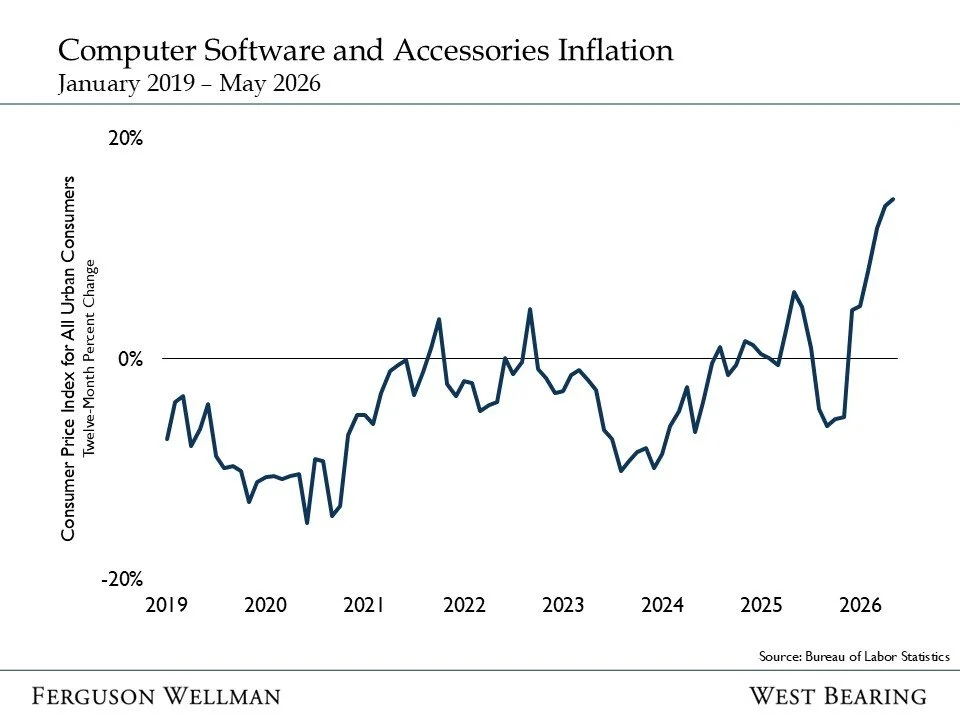
Summer motorists might soon be enjoying lower gas prices at the pump now that crude oil has slipped below the $73-per-barrel mark seen just before the Middle East conflict broke out earlier this year. However, consumers are facing a very different reality at the electronics store. Apple recently initiated uncommon mid-cycle price increases on Mac and iPad lines by up to 25% or $100-$300, depending on the product’s previous selling price. Management pointed to the skyrocketing cost of digital storage and memory components as the unavoidable driver, hinting that iPhone and Apple Watch prices will soon follow suit.
This tech-sector inflation is a direct byproduct of the artificial intelligence supercycle. Staggering demand from massive data centers has caused prices of working memory (DRAM) and storage (NAND) chips to quadruple over the last year. Major hyperscalers like Amazon, Alphabet, Microsoft and Meta are showing no signs of price sensitivity with plans to deploy roughly $640 billion in capital expenditures this year, representing a massive 88% year-over-year surge to build out their capabilities. Because these advanced server farms consume the same foundational memory materials used in everyday laptops, phones and tablets, hardware manufacturers are left with little choice but to pass these structural cost constraints on to the end consumer.
Source: Bureau of Labor Statistics
Nowhere was this pricing power more evident than in Micron’s earnings update on Wednesday afternoon. The memory chipmaker delivered blowout numbers well ahead of analysts’ expectations, with quarterly revenue growing 345% year-over-year from $9.3 billion to $41.5 billion and quarterly profits skyrocketing ~1,200% from a year ago. The most telling indicator of their tremendous pricing power is that their operating margins expanded from 27% to 81% over the past year! Wall Street responded with enthusiasm, driving the stock up 15% on Thursday to a new all-time high. Critical to the stock’s forward prospects, executives dismissed any notion that this is a fleeting trend, emphasizing that intense AI-fueled demand paired with complex manufacturing bottlenecks will keep supply exceedingly tight well beyond calendar 2027.
Ultimately, Micron’s quarterly results and forward guidance illustrate a fundamental evolution for the memory industry. Previously tethered to the boom-and-bust cycle of auto, personal computing and smartphone sales, chipmakers are now riding a durable wave of data center expansion. To insulate their AI pipelines from ongoing shortages, major purchasers have locked in 16 long-term strategic customer agreements (SCAs) with Micron. These binding contracts legally guarantee a minimum of roughly $100 billion in sales over their lifespans. By securing these multiyear commitments, component producers have effectively swapped cyclical volatility for structural pricing power—proving that the AI buildout is re-engineering both physical infrastructure and capital market dynamics.
American Ledger: A 250-Year Financial Perspective
With our country reflecting this summer on the Spirit of '76, our team recounts how 2026 economic themes have evolved from our founding days.
The capital currently being allocated to artificial intelligence infrastructure shares an interesting parallel with Alexander Hamilton’s 1791 Report on the Subject of Manufactures.
Following the Revolutionary War, the United States remained heavily dependent on imported goods. Hamilton argued that achieving economic independence required a focused financial commitment to domestic manufacturing. He recognized that the nation would need to take on substantial upfront costs to establish essential mills, forges and supply chains. To Hamilton, these weren't just steep financial burdens; they were the necessary groundwork required to build a self-sufficient economy.
Today’s digital landscape reflects a similar dynamic. Major tech companies are absorbing near-term costs to secure long-term technological positioning. Specifically, hyperscalers like Amazon, Alphabet, Microsoft and Meta plan to deploy roughly $640 billion in capital expenditures this year to build out their capabilities. Just as Hamilton encouraged strategic investments to overcome the young nation's industrial bottlenecks, today’s leading technology executives are allocating significant capital to building the foundation of the AI economy.
Whether it is 18th-century ironworks or 2026 data networks, the underlying lesson is the same: shifting to a new economic era requires substantial and structural capital investment.
Takeaways for the Week
Micron earnings results highlight both the tremendous current pricing power of the memory chip makers and the price insensitivity of the hyperscalers in the ongoing AI arms race
In response to the soaring memory prices, Apple raised the cost of Mac and iPad prices by as much as 25% this week
While fragile, the Memorandum of Understanding between the United States and Iran has led to oil dipping below the pre-conflict price of $73 a barrel
Disclosure
The views expressed represent the opinion of Ferguson Wellman. The views are subject to change and are not intended as a forecast or guarantee of future results. This material is for informational purposes only. It does not constitute investment advice and is not intended as an endorsement of any specific investment. Statements of future expectations, estimates, projections and other forward-looking statements are based on available information and Ferguson Wellman’s views as of the time of these statements. Past performance may not be indicative of future results. Ferguson Wellman, Octavia Group and West Bearing do not provide tax, legal, insurance or medical advice. This material has been prepared for general educational purposes only and not as a substitute for qualified counsel who can determine how this information applies to you. We believe the information provided is from reliable sources but should not be assumed accurate or complete.
Please see additional disclosures.