Brad Houle Article in Portland Business Journal

Furgeson Wellman Brad Houle, CFA, executive vice president of research, recently authored a by-line article that was included in the Portland Business Journal’s 2014 Wealth Management and Financial Services Guide. This publication is sponsored annually by the CFA Society of Portland.

In the article, Houle states, “While bonds do not offer a compelling value at this point, they are a necessary component of many portfolios for both individual and institutional investors.” Houle is a member of Ferguson Wellman’s fixed income team and manages the firm’s REIT investment strategy.

Click here to read “A yield austerity; how not to get burned in the bond market.”

Disclosures


Full Speed Ahead

by Shawn Narancich, CFA Executive Vice President of Research

 Unexpected Returns

Despite serious turmoil in the Middle East and ongoing conflict in eastern Ukraine, blue-chip stocks have pushed to new record highs amid upbeat quarterly earnings and encouraging economic data. As Wall Street frets about why interest rates are so low, investors are also enjoying what has turned into a nice coupon-plus return environment for bonds this year, one that could continue to confound those expecting higher rates. Indeed, the CPI report out this week provides evidence that a 2.1 percent inflation rate may trend lower over the next few months if commodity prices continue to moderate.

Gasoline prices accounted for two-thirds of the June index increase, and with pump prices now on their way back down, consumers should expect to get a break at the pump and investors a break on headline inflation. Just as important, natural gas prices have fallen precipitously in the past month due to better-than-expected storage refills and grain prices falling under the expectation of record harvests this fall. With wage gains remaining muted and investment-grade bond yields at surprisingly low levels in Europe, bond investors expecting materially higher rates could be surprised by a rate environment that stays lower for longer. We see an environment of muted inflation and accelerating U.S. economic gains creating a profitable backdrop for equity investors.

A Jobs Renaissance?

Supporting the notion of improving economic fundamentals was this week’s jobless claims number, which breached the psychologically important 300,000 level to the downside. U.S. claims trickled in at a rate of just 284,000 in the past week, a level investors haven’t witnessed in over eight years. This bullish claims number and the downward trending four-week moving average lend credence to the strong payroll numbers reported in June, while increasing our confidence that July’s report will be another good one.

Holy Chipotle!

As more people find work, consumption spending should increase, but as the results from McDonalds and its former subsidiary Chipotle Mexican Grill showed this week, where consumers choose to spend their new-found incomes can be as different as, well, burgers and burritos. McDonalds disappointed by reporting falling same-store sales, but Chipotle announced a 17.3 percent surge, the likes of which it hasn’t seen since 2006. Store traffic at the Golden Arches has lagged and McDonald’s contends with a lower income demographic for which pricing is always an issue. In contrast, Chipotle’s higher income constituents are more likely to accept occasional menu price hikes as they did in the second quarter, without chasing away customers. Indeed, Chipotle benefitted from a trifecta of good fortune – higher prices, better mix, and more store traffic that collectively produced 24 percent earnings growth. On much better-than-expected sales and earnings, Chipotle’s stock surged 12 percent while McDonalds’ shares fell 1 percent.

With about half of the S&P 500 having reported second quarter results, approximately 75 percent of companies are delivering better-than-expected earnings, and 65 percent are also besting top-line estimates. As a result, earnings projections for the benchmark index that a month ago predicted 4 percent growth for the quarter now stand at 6 percent.

Our Takeaways from the Week

  • Despite stiff geopolitical headwinds, U.S. stocks continue to forge new highs
  • A majority of companies reporting so far are delivering better than expected second quarter sales and earnings

Disclosures

Jason Norris Discusses Microsoft Restructuring on KGW

Jason Norris, CFA, spoke with KGW’s Joe Smith to share his thoughts on the impact of Microsoft’s restructuring from an investor’s perspective.  Please click here to see the video.

Take Me to the Top

Jason Norris of Ferguson Wellman by Jason Norris, CFA Executive Vice President of Research

Take Me to the Top

The most common question we have been getting as of late is when is the market pullback going to occur? Stocks are up over to 200 percent from the March 2009 bottom and 75 percent from the most recent market correction (of 15 percent) in October 2011. While it has been almost three years since a major correction, history has shown this trend can continue for quite a bit longer. To that point, Cornerstone Macro Research gathered some data on previous market pullbacks which are highlighted in the chart below.

Chart

History shows that there have been numerous periods of much longer durations when stocks have climbed without a major pullback. If you simply look at the fundamentals of the stock market, an argument can be made that the S&P 500 can continue to move higher without a meaningful pullback. First, U.S. economic growth is improving and global GDP should continue to trend in the mid-single digits, resulting in continued earnings growth. Second, with low inflation and low interest rates, the valuation of the equity market is still attractive and the Price-to-Earnings multiple of the S&P 500 still has room for upside from 15.6x at present. While there will always be unforeseen shocks, the risks in the system are not as predominate as we saw in 2011 (Europe debt crisis, U.S. debt downgrade, Fiscal austerity) or 2000 (stretched valuation, falling consumer sentiment, manufacturing data weakening). However, risks that investors should be cognizant of are a spike in oil prices due to Middle East tensions, China’s economic growth slowing meaningfully, and an adverse reaction to Federal interest rate hikes in 2015.

What Do You Do For Money?

Earnings kicked off this week with mixed results from large cap technology. Specifically, there was divergence within the internet ad space, with Google growing and Yahoo stagnant. One wonders how long the Yahoo board will give CEO Marissa Mayer to achieve the turnaround. Intel delivered a strong quarter due to PC upgrades primarily from businesses as Microsoft sunsets its client support for Windows XP. This strength is allowing the company to return cash to shareholders through an announced $20 billion repurchase plan. While Intel stock reacted very favorably to the announcement, it was disconcerting that their mobile business continues to underachieve. This division lost over $1 billion while grossing a mere $51 million in revenue (down from $292 million a year ago). Intel’s move into this area looks to have been a failure which leads us to speculate where they will have to make an acquisition in order to penetrate the market.

Takeaways for the Week

  • The start of the earnings season has resulted in no major market moving results
  • Tensions in the Middle East and Ukraine may have a minor effect on U.S. markets, and unless we see a spike in oil, they should not hinder economic growth

 Disclosures

Investment Outlook Video: Third Quarter 2014

We are pleased to present our Investment Outlook: Third Quarter 2014 video titled, "Back on Track." This quarter, Chief Investment Officer George Hosfield, CFA, discusses how despite starting the year with a winter-induced swoon, the equity markets have nearly realized the “average annual return” that we predicted in January for the entire year. That said, we believe that an improving labor market, a strengthening economy, rising earnings, low interest rates and reasonable multiples provide a backdrop for further equity gains.

To view our Investment Outlook video, please click here or click on the image below.

jpeg of Q3 2014 Outlook video for email hyperlink

Sovereign Debt Risk in Europe Takes a Holiday

Furgeson Wellman by Brad Houle, CFA Executive Vice President

We have illustrated below the details of the convergence of government bond yields between the stronger credits of Germany and the United States versus the weaker credits of Italy and Spain. Germany and the United States are arguably two of the strongest sovereign bond insurers in the world. While not perfect, both Germany and the United States have dynamic economies with reasonable levels of inflation versus economic growth. Also, both countries have excellent ability to pay their debts and are viewed as "safe haven" credits by bond investors.

Low Global Rates Suppress Domestic Interest Rates


Italy and Spain are a different matter. While we do believe that these countries are starting to recover from the European debt crisis, there are still many structural economic issues that need to be addressed. For example, Italy has a 12 percent unemployment compared to the six percent unemployment in the United States. However, Italy's unemployment looks very favorable compared to the 25 percent unemployment currently in Spain. In addition, both of these countries have severe demographic issues with aging populations and strict labor market regulations that make the labor force less flexible.

What changed to cause interest rates to drop from around the seven percent for a 10-year bond for Spain and Italy in 2021 to the less than three percent rate of interest they now pay were the actions by the European Central Bank or ECB. Essentially, the ECB, which is akin to the Federal Reserve for Europe, announced they would do whatever it takes to backstop these countries. These words gave bond investors the confidence that Italy and Spain will have the ability to honor their debt obligations. Financial markets run on confidence, and this was enough to cut the borrowing costs of these countries by half.

Countries compete for capital from investors. Investors strive to get the best return for the risk that they are taking. Given this set of facts, buying United States treasury bonds versus European country debt seems like a much better investment from a risk versus reward standpoint. While the words of the ECB do merit more investor confidence, there is still underlying credit risk that does not seem to be properly priced into European government debt.

This week there was an event in Portugal that highlighted this risk. During the European debt crisis, Portugal was in a similar position to Italy and Spain. Portugal had a heavily indebted economy with structural economic issues and a high cost of borrowing based on perceived credit risk. Portugal fell under the ECB umbrella and their borrowing costs have declined in a similar fashion to Spain and Italy. However, this week Portugal's Banco Espirito Santo announced that they were having issues meeting debt payments on some short-term borrowing the bank had done to fund operations. This news was enough to cause a one day .30 percent increase in the yield of the Portuguese 10-year bond and a broader decline in European stock markets. While relatively minor, this incident demonstrates the market confidence in European sovereign debt markets is on the razor's edge and credit risk is probably not properly reflected in the possible risk of this debt.

Our Takeaways for the Week

  • U.S. Treasury debt is more attractive than European sovereign debt
  • While we do believe interest rates will rise in the U.S. as economic growth continues, there is a cap on how high interest rates will climb. Investors will favor U.S. Treasury bonds over European bonds which will help keep rising rates in check

Disclosures

2014 Q2 Market Letter

Please click here to find our Market Letter Second Quarter 2014. We hope you find our economic insights interesting and informative.  

Living in America

RalphCole_032_web_ by Ralph Cole, CFA Executive Vice President of Research

Over When It’s Over

It has been quite a week here in the U.S. on a number of fronts. First, the U.S. men’s soccer team brought society to a halt on Tuesday afternoon with a heartbreak loss to Belgium in the second round of the World Cup. While the game showed just how far we have to go to catch up to the rest of the world, the team made all their supporters very proud. It will be interesting to see if the current soccer enthusiasm will have the “legs” to build on this momentum in the U.S. beyond the conclusion of the World Cup.

What’s Going On

As for the markets, they did not take the holiday-shortened week off as the Labor Department announced May payrolls a day early in observance of the Fourth of July. The numbers were unabashedly strong with a whopping 288,000 jobs added across the nation in May. This strong reading moved the five-month average up to 248,000 which is roughly 60,000 more than we averaged in all of 2013. Perhaps most impressive is the fact that this was during one of the worst winters on record.

Contrary to just two months ago, all signs now point to an improving economy, but headline GDP numbers have been surprisingly weak. Mark Twain once said, “There are lies, damn lies and statistics.” As investors, we can’t rely on any one statistic to determine the direction of either the economy or the capital markets. Rather, we rely on a mosaic of information that is force-fed to us each day through our computer screens. What that information is telling us today is that we have moved from a tentative expansion to one that appears sustainable. While some may lament the speed of the recovery and robustness of economy, we would point to a lack of excess in any given area.

While consumer spending hasn’t been overly strong, it does appear to be durable because unlike recent economic expansions, this has been not driven by borrowing. While job growth has been somewhat sluggish, it also hasn’t reached inflationary levels. While housing has improved, it is far from the bubble levels experienced in 2005 and 2006 and while the stock market is at record highs, so too are earnings.

So sit back and enjoy it this Fourth of July holiday weekend. Next week we can get back to worrying about an Iraq oil shock, inflation and stock market valuations.

Our Takeaways for the Week

  • Strong job growth led the Dow to break 17,000 for the first time
  • While the U.S. and the UK are leading this recovery, neither remain in contention for the World Cup

Disclosures

Financial Times Ranks Ferguson Wellman Capital Management on Top Registered Investment Advisers List

PORTLAND, Ore. – July 1, 2014 – Ferguson Wellman Capital Management was recently informed that the firm was named by Financial Times to their inaugural “300 Top Registered Investment Advisers List”. The Financial Times compiled the list of RIA firms by soliciting applications from more than 2,000 independent RIA firms who had $300 million or more in assets. They judged the firms on six categories which resulted in a numeric score for each adviser. The areas they took into consideration included assets under management, growth of assets under management, number of years the firm has been in existence, the number and depth of industry certifications of staff, the SEC compliance record of the firm and accessibility of the firm online. According to Financial Times, only independent and elite firms were considered for this designation and the average firm listed on the 300 list manages more than $2.5 billion in assets under management and serves over 3,000+ clients.

“Everyone at Ferguson Wellman is very gratified by our recent acknowledgement in the Financial Times. We appreciate being mentioned alongside our peers, but quite frankly what means the most to us is the trusting relationship that we continually earn with each client we serve,” said James H. Rudd, principal and chief executive officer.

Founded in 1975, Ferguson Wellman Capital Management is a privately owned registered investment adviser that serves over 650 clients with assets starting at $3 million. The firm works with individuals and institutions in 35 states with a concentration of those clients in the West. Ferguson Wellman manages $3.9 billion that comprises union and corporate retirement plans; endowments and foundations; and separately managed accounts for individuals and families. In 2013, West Bearing Investments was established, a division of Ferguson Wellman, that serves clients with assets starting at $750,000. All company information listed above reflects 3/31/14 data.

###

Methodology and Disclosure: The 2014 Financial Times Top 300 Registered Investment Advisors is an independent listing produced by the Financial Times (June, 2014). The Financial Times 300 is based on data gathered from RIA firms, regulatory disclosures, and the FT’s research. As identified by the Financial Times, the listing reflected each practice’s performance in six primary areas, including assets under management, asset growth, compliance record, years in existence, credentials and accessibility. Neither the RIA firms nor their employees pay a fee to The Financial Times in exchange for inclusion in the Financial Times 300.

Don't Stop Believin'

by Shawn Narancich, CFA Executive Vice President of Research

Don’t Look Back!

As investors question the underlying strength of the U.S. economy, stocks are consolidating gains and bonds are defying Wall Street expectations for yields to rise. Like drivers gawking at a car wreck as they drive past, market participants once again revisited the surprisingly poor economic start to a 2014 that most thought would bring faster economic growth instead of the worst quarterly performance since the depths of the Great Recession. Reasons for the 2.9 percent contraction in first quarter U.S. GDP have been widely discussed, but the cold, inclement weather and late Easter don’t negate the math of such a poor start to the year, and its impact on full year estimates that economists are now scrambling to reduce.

Back on Track

Relatively healthy payroll growth, rising retail sales, and healthy manufacturing indicators bely the wreckage of first quarter GDP, but this week’s surprisingly poor May personal consumption numbers prolong the debate about how strong the economy really is. Few indicators are as simple as they first seem and this number is no exception, being dampened by accounting for the Affordable Care Act that economists first thought would boost healthcare spending. As it turns out, this component of consumer spending actually fell in May, and with the Fed’s preferred inflation measure ratcheting up to 1.8 percent year-over-year, real consumption spending used to compute the GDP number actually dropped sequentially. So what’s an investor to believe?  Notwithstanding the disappointing May number, we expect Q2 consumption spending to increase at a faster pace and look for better capital spending and housing investment to produce GDP growth somewhere in the 3-4 percent range. If achieved, this level of growth will be the best in a couple years and should go a ways toward allaying concerns about the pace of economic expansion. In this environment, we expect bond yields to rise.

Clear as Condensate?

The U.S. energy industry was jolted this week by surprise news that the Commerce Department has granted approval for two energy companies to begin exporting very light crude oil known as condensate. The U.S. energy renaissance has boosted domestic oil production by over 70 percent since the lows of 2008 and, owing to the nature of unconventional development, an increasing amount of the liftings are of the clear variety. The challenge for U.S. refiners has been to revamp their capital intensive facilities to accommodate this light production after years of gearing up for heavier Mexican and South American imports. The reaction on Wall Street was dramatic, as stocks of oil producers rallied and refining stocks tanked. If the first government approvals this week turn out to be a harbinger of additional exports to come, benchmark WTI oil prices should increase relative to the global benchmark Brent. Accordingly, the producers would realize higher prices at the expense of the refiners, which have benefited greatly from the discount at which they buy U.S. light crude. Only time will tell whether additional export approvals are granted, but the risk for refining investors is not only that their feedstock costs increase, but that investments made in recent years to process lighter grade crudes fail to pay off.

Our Takeaways from the Week

  • Q2 comes to a close, with stocks hovering near all-time highs as investors assimilate disappointing headline economic news into full year estimates
  • Energy stocks are in focus following initial government approval for light crude oil exports

Disclosures

InvestmentNews Magazine Names Ferguson Wellman to Largest RIA and Biggest Gainers Lists

PORTLAND, Ore. – June 24, 2014 – Ferguson Wellman Capital Management is pleased to announce that the firm has been named to the Largest Fee-Only RIAs list and the Biggest Gainers list in the recent RIA Rundown 2014 issue in the June issue of InvestmentNews magazine. Ferguson Wellman is ranked 38th and 22nd, respectively. For the Largest Fee-Only RIA list, InvestmentNews qualified the list of RIA firms based on the data the firms provided in Form ADV to the Securities and Exchange Commission in 2014. Many criteria were considered for the listing, among them the total of assets under management must be at least $100 million, firms must provide financial planning services and neither the firm nor its representatives may be actively engaged in business as a representative of a broker-dealer. The Biggest Gainers list was compiled by calculating the percentage of growth in total assets by the 50 largest fee-only RIAs. Ferguson Wellman is notably the only firm listed in the Pacific Northwest.

“While it is always gratifying to be mentioned alongside your peers when it comes to assets under management and percentage gained year over year – what is most important to us is the trusting relationships we have earned with each of our clients. After all, it is their assets that have allowed us to be mentioned in the first place,” said Jim Rudd, principal and chief executive officer.

Founded in 1975, Ferguson Wellman Capital Management is a privately owned registered investment adviser that serves over 650 clients with assets starting at $3 million. The firm works with individuals and institutions in 35 states with a concentration of those clients in the West. Ferguson Wellman manages $3.9 billion that comprises union and corporate retirement plans; endowments and foundations; and separately managed accounts for individuals and families. In 2013, West Bearing Investments was established, a division of Ferguson Wellman, that serves clients with assets starting at $750,000. All company information listed above reflects 3/31/14 data.

###

Methodology:

InvestmentNews qualified 1,442 firms headquartered in the United States based on data reported on Form ADV to the Securities and Exchange Commission as of May 1, 2014. To qualify, firms must have met the following criteria: (1) latest ADV filing date is either on or after Jan. 1 (2) total AUM is at least $100M, (3) does not have employees who are registered representatives of a broker-dealer, (4) provided investment advisory services to clients during the most recently completed fiscal year, (5) no more than 50% of regulatory assets under management is attributable to pooled investment vehicles (other than investment companies), (6) no more than 25% of amount of regulatory assets under management is attributable to pension and profit-sharing plans (but not the plan participants), (7) no more than 25% of amount of regulatory assets under management is attributable to corporations or other businesses, (8) does not receive commissions, (9) provides financial planning services, (10) is not actively engaged in business as a broker-dealer (registered or unregistered), (11) is not actively engaged in business as a registered representative of a broker-dealer, (12) has neither a related person who is a broker-dealer/municipal securities dealer/government securities broker or dealer (registered or unregistered) nor one who is an insurance company or agency.

Regarding Biggest Gainers:

Rankings are based on unrounded figures and on the 50 largest fee-only RIAs. InvestmentNews qualified 1,442 firms headquartered in the United States based on data reported on Form ADV to the Securities and Exchange Commission as of May 1, 2014. To qualify, firms must have met the following criteria: (1) latest ADV filing date is either on or after Jan. 1 (2) total AUM is at least $100M, (3) does not have employees who are registered representatives of a broker-dealer, (4) provided investment advisory services to clients during the most recently completed fiscal year, (5) no more than 50% of regulatory assets under management is attributable to pooled investment vehicles (other than investment companies), (6) no more than 25% of amount of regulatory assets under management is attributable to pension and profit-sharing plans (but not the plan participants), (7) no more than 25% of amount of regulatory assets under management is attributable to corporations or other businesses, (8) does not receive commissions, (9) provides financial planning services, (10) is not actively engaged in business as a broker-dealer (registered or unregistered), (11) is not actively engaged in business as a registered representative of a broker-dealer, (12) has neither a related person who is a broker-dealer/municipal securities dealer/government securities broker or dealer (registered or unregistered) nor one who is an insurance company or agency.

Visit data.InvestmentNews.com/RIA for more complete profiles and financials.

What the Fed Said

Furgeson Wellman by Brad Houle, CFA Executive Vice President

Investors hang on every single syllable of every utterance by the Fed Chairperson, and to a lesser extent, speeches given by the members of the Federal Reserve Board. While one cannot minimize the importance of what the Federal Reserve does, it is probably the most overanalyzed organization in the world today - only overshadowed by the attention placed on the Kim Kardashian and Kanye West marriage by the tabloids. Gone are the days when the Greenspan "briefcase indicator" on CNBC attempted to predict the outcome of Fed meetings based upon how thick former Chairman Greenspan’s briefcase appeared to be when he headed into the meetings. While the “briefcase indicator” was mostly in jest, it points to the obsession of investors and the media on the outcome of these meetings.

There are some reasons why all this attention on the Fed is warranted – just not at the level it experiences today. The Fed does have control of the Federal funds rate and has been impactful in lowering longer-term interest rates via quantitative easing. However, the Fed's real influence comes in the form of managing the market expectations by what is said. In fact, setting expectations by what is said is perhaps more important than what the Fed actually does in many cases. While the Fed needs to have the authority to back up what it is signaling to the market, the way in which they suggest the direction of how they are moving policy is the most important factor.

One recent example of this “power of suggestion” occurred last summer. At the time, then-Fed Chairman Ben Bernanke made a statement in a post-Fed meeting press conference that tapering of quantitative easing would begin in the near future. This announcement caused interest rates to move sharply higher in anticipation of the tapering which was probably beyond the intention of Chairman Bernanke. In fact, even the notion that there must be post-meeting press conferences is a relatively new phenomenon. Originally, the stated reason for the press conferences was to increase transparency. The less publicly-stated reason was to have a platform available to set expectations.

The Fed statement on Wednesday, June 16, was nothing new. The Fed commented that while unemployment has come down, it is still elevated. However, household and business spending is on the rebound. The Fed also repeated that the tapering of quantitative easing will continue and interest rates should stay low for a long time. This theme continued during the post-meeting press conference where Chairperson Yellen carefully answered reporter questions while taking pains not to add new expectations. No new news was the market expectation going into the meeting, so there was essentially no reaction by the stock or bond market from the Fed meeting minutes and subsequent press conference. Now the markets will turn their hyper vigilance toward future meetings and Fed speeches.

Our Takeaways for the Week

  • Low interest rates are not a permanent condition. As the economy and labor market heal we anticipate interest rates will drift higher over the next two years. This should be good news for savers and investors.
  • The market will continue to focus on any perceived change of Fed messaging.

Disclosures

Slow Ride

Jason Norris of Ferguson Wellman by Jason Norris, CFA Executive Vice President of Research

Slow Ride

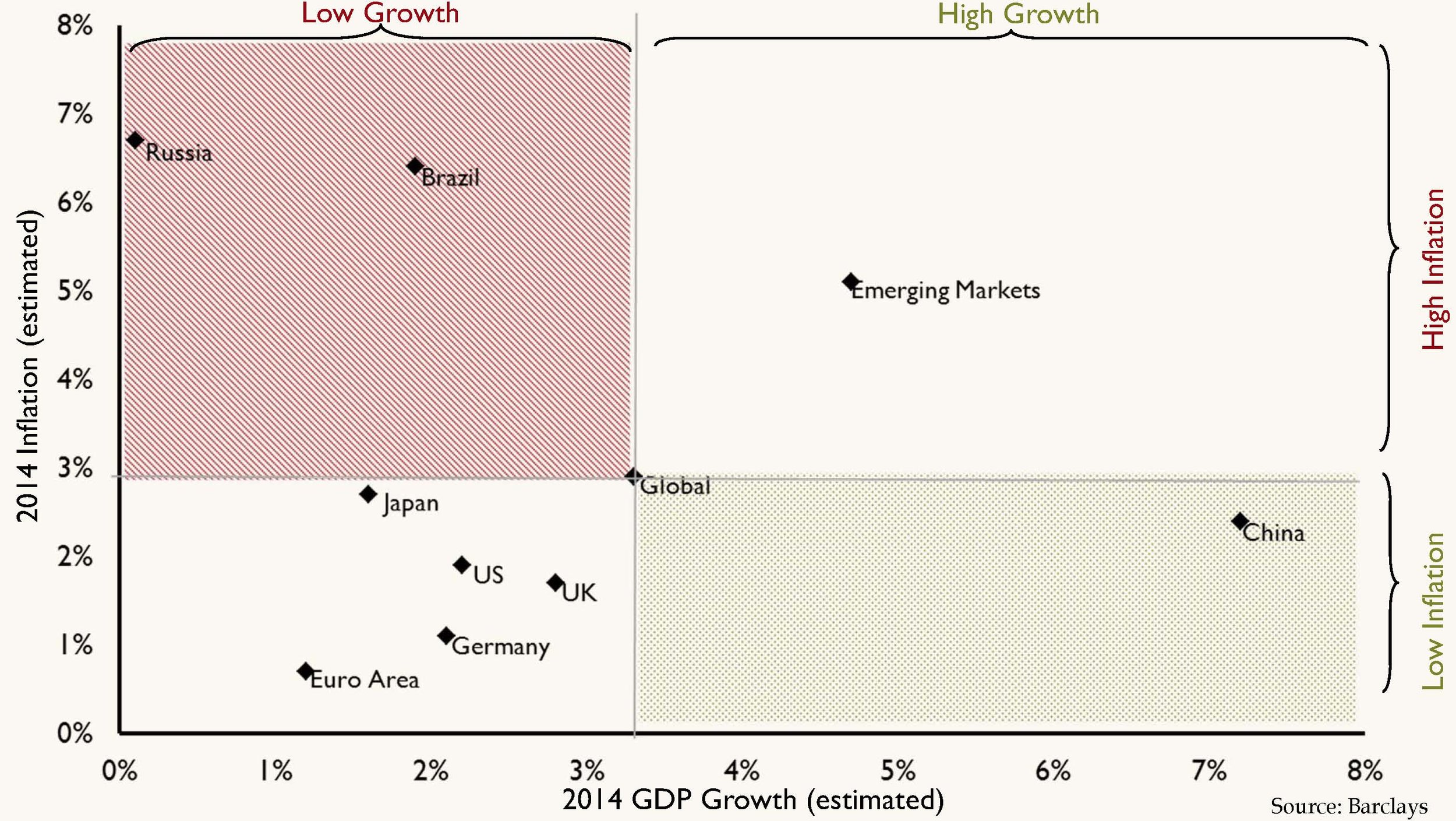
This week, the World Bank lowered their global GDP assumptions for 2014 to 2.8 percent from 3.2 percent. The bank cited the BRICs (Brazil, Russia, India and China) as well as the U.S. as culprits for the lowered estimates. We believe the slowdown in the U.S. is solely a first quarter event due to weather, and we expect to see acceleration throughout the year. China’s growth, though slowing, is still relatively robust and inflation remains under control. Regrettably, Brazil and Russia have not fared as well. As the chart below highlights, Brazil and Russia are stuck in a slowing growth, high inflation environment that is difficult to overcome. With high inflation, there is pressure to raise interest rates, but that leads to increased headwind for growth.Global Growth Chart

Unfortunately for Brazil, the build up for the World Cup has not provided the added stimulus that was hoped for. Corruption and cronyism have proved to be rampant and the economy has not seen the desired lift. There was the expectation that the employment opportunities would bring about an economic boost for their citizens. However, this hasn’t happened and there remains strong sense of frustration among the public.

London Calling

Earlier this week, there were protests centered in London (with minor demonstrations in Paris and other European cities) due to the growth of the online transportation company, Uber. This company is disrupting the “old” taxi cab model by allowing customers to access drivers of vehicles for hire through a mobile app. This disruption allows consumers to by-pass the classic taxi for a private hire, which in many instances, may be cheaper and more convenient. The company started in San Francisco and is expanding globally.

The protests may have had an unintended counter effect. A lot of the general public, especially in Europe, have not heard of Uber, thus these actions just put the start-up on the front pages. Competition for the general public is usually a good thing in pushing prices down and improving service. However, as a CNBC reporter stated, the French public are in favor of the protests, but that doesn’t come as a surprise “in a country where competition is not really a key word and where a strike is probably some sort of national sport.”  On a final note, Uber recently completed a round of financing which valued the company at close to $18 billion.

The Mob Rules

While stocks hit new highs at the beginning of the week, geopolitical issues in the Middle East have tempered those gains. With militants gaining control of key cities in Iraq, the supply of oil has now come into question. This has resulted in a run up in the price of crude. We are of the belief that the price of oil will remain stable as the U.S. continues to increase its supply over the long term. However, we will continue to experience short term volatility due to global tensions and we remain overweight the energy sector based on our thesis that the global economy remains in expansion mode. This recent spike has resulted in the sector being the best performer this last week.

Takeaways for the Week

  • Key emerging markets are struggling with flagging growth and high inflation and investors have to be selective
  • In aggregate, global growth is still healthy and the U.S. should lead the developed world
  • The U.S. will make it out of the first round of the World Cup and Germany will win it all

 Disclosures

Carkin, Faulkner and Krys-Rusoff Invited to Buy More Company Stock

PORTLAND, Ore. – June 10, 2014 – Ferguson Wellman Capital Management recently invited three professionals to purchase additional company shares. Tim Carkin, CAIA, CMT, Mary Faulkner and Deidra Krys-Rusoff accepted the offer, increasing their ownership stake in Ferguson Wellman. Carkin has been with the firm since 2003 and currently heads Ferguson Wellman’s trading and operations departments. Faulkner joined Ferguson Wellman in 2006 and leads the firm’s branding and communications efforts. Krys-Rusoff, who recently celebrated 10 years with Ferguson Wellman, oversees the firm’s municipal bond strategy for client portfolios.

“Tim, Mary and Deidra have all grown the positions they were in when they were first hired,” says Steve Holwerda, CFA, principal and chief operating officer. “We are a better company today because of what they have accomplished in their work.”

In addition to their responsibilities at Ferguson Wellman, these senior vice presidents serve in leadership roles with various organizations in the community. Krys-Rusoff chairs the Oregon Zoo Bond Oversight Committee and is a board member of the YMCA’s Southeast Regional Childcare Council. Faulkner chairs the Lone Fir Cemetery Foundation board, serves on the honorary council for Portland State’s Center for Women’s Leadership and is on the community outreach committee for All Saints School. Carkin is a board member of the Education Recreational Adventures and Oregon Council on Economic Education. He also chairs the Sherwood Budget Committee.

Founded in 1975, Ferguson Wellman Capital Management is a privately owned registered investment adviser that serves more than 650 clients with assets starting at $3 million. The firm works with individuals and institutions in 35 states with a concentration of those clients in the West. Ferguson Wellman manages $3.9 billion that comprises retirement plans; endowments and foundations; and separately managed accounts for individuals and families. In 2013, West Bearing Investments was established, a division of Ferguson Wellman, that manages investment portfolios starting at $750,000. All company information listed above reflects 3/31/14 data.

###


A Little Less Conversation, a Little More Action

RalphCole_032_web_ by Ralph Cole, CFA Executive Vice President of Research

A Little Less Conversation, a Little More Action

The European Central Bank (ECB) finally stopped jawboning the markets this week and put into place additional policies to get the European economy moving forward. Slow growth and disinflation continue to loom over the EU and spurred the ECB to take aggressive actions.

Specifically, the ECB announced the following policy actions1; they are:

1)      Lowering the Eurosystem refinancing rate to .15 percent 2)      Lowering the interest rate on the marginal lending facility to .40 percent 3)      Lowering the deposit facility rate to negative 10 basis points (you have to pay the ECB 10 basis points to hold your money if you are a bank) 4)      They have outlined a new $400 billion long-term refinancing operation (LTRO) to aid bank lending

The ECB stopped short of QE but did not rule out the idea in the future. The central bank is hoping to stimulate bank lending which in turn should promote growth throughout the region. The EU is anticipating that some of this growth comes from a weakening Euro. A weaker currency would encourage tourism and make EU products cheaper abroad.

Working for the Weekend

We would be remiss if we didn’t at least mention the monthly jobs report that comes out the first Friday of the month. We have pointed out to readers that it is probably the most important report for understanding the durability of the recovery and the mood of the American consumer.

At this point in the cycle, we are also starting to look at the monthly jobs report for an additional source of insight about inflation. Wage inflation is a precursor to overall inflation in the economy. Wages in the U.S. have started to rise, albeit slowly. For the month of May average hourly earnings increased 2.4 percent year-over-year. While that is not a level that we would deem inflationary, wages in certain sectors are accelerating.

Takeaways for the Week

  • Equity markets around the world responded positively to the new round of policies announced by the ECB this week
  • Job growth of 217,000 was not enough to trigger sharp wage inflation in the month of May

1Source: Barron’s

Disclosures

Four More Professionals Receive Five Star Wealth Manager Designation

PORTLAND, Ore. – June 3, 2014 – For the fourth consecutive year, several Ferguson Wellman portfolio managers have been recognized as Five Star Wealth Managers by Portland Monthly magazine. Nathan Ayotte, CFP®, Ralph Cole, CFA, Helena Lankton and Jason Norris, CFA, were among the professionals honored. This adds to others in our firm who have been listed as Five Star Wealth Managers, including Dean Dordevic, Lori Flexer, CFA, Marc Fovinci, CFA, Steve Holwerda, CFA, George Hosfield, CFA, Mark Kralj, and Jim Rudd. The Five Star Wealth Manager distinction is a select award recognizing wealth managers that provide quality services to clients, with approximately 13 percent of the wealth managers in the greater Portland area earning this designation.

“We are very pleased that so many of our portfolio managers have been recognized by Portland Monthly and Five Star Professionals for this award,” said Jim Rudd, principal and chief executive officer. “This honor speaks to the investment expertise and experience these professionals bring to our clients.”

The Five Star Wealth Manager designation is based upon 10 objective eligibility and evaluation criteria, ranging from credentials to regulatory history to client retention, that are associated with wealth managers who provide quality service to their candidates. Candidates with “an established practice, good client relationships and a strong reputation” are nominated by peers and firms and verified against the criteria (source: Five Star Wealth Manager Award Program Summary and Research Methodology).

Founded in 1975, Ferguson Wellman Capital Management is a privately owned registered investment adviser that serves more than 650 clients with assets starting at $3 million. The firm works with individuals and institutions in 35 states with a concentration of those clients in the West. Ferguson Wellman manages $3.9 billion that comprises retirement plans; endowments and foundations; and separately managed accounts for individuals and families. In 2013, West Bearing Investments was established, a division of Ferguson Wellman, that manages investment portfolios starting at $750,000. All company information listed above reflects 3/31/14 data.

###

The Five Star Wealth Manager award, administered by Crescendo Business Services, LLC (dba Five Star Professional), is based on 10 objective criteria: 1. Credentialed as a registered investment adviser or a registered investment adviser representative; 2. Active as a credentialed professional in the financial services industry for a minimum of 5 years; 3. Favorable regulatory and complaint history review (As defined by Five Star Professional, the wealth manager has not: A. Been subject to a regulatory action that resulted in a license being suspended or revoked, or payment of a fine; B. Had more than a total of three customer complaints filed against them [settled or pending] with any regulatory authority or Five Star Professional’s consumer complaint process; C. Individually contributed to a financial settlement of a customer complaint filed with a regulatory authority; D. Filed for personal bankruptcy; E. Been convicted of a felony); 4. Fulfilled their firm review based on internal standards; 5. Accepting new clients; 6. One-year client retention rate; 7. Five-year client retention rate; 8. Non-institutional discretionary and/or non-discretionary client assets administered; 9. Number of client households served; 10. Educational and professional designations. Wealth managers do not pay a fee to be considered or awarded. Once awarded, wealth managers may purchase additional profile ad space or promotional products. The award methodology does not evaluate the quality of services provided and is not indicative of the winner’s future performance. 1,558 Portland wealth managers were considered for the award; 190 (13 percent of candidates) were named Five Star Wealth Managers.

Ascending to New Heights

by Shawn Narancich, CFA Executive Vice President of Research

Ascending to New Heights

Subsiding geopolitical tensions in Eastern Europe, tentative steps by Chinese policymakers to support slowing growth, and more deal-making domestically combined to send U.S. stock prices to new record highs this week. Investors expecting negative revisions to previously reported first quarter GDP numbers were undeterred by the latest numbers that proved surprisingly poor, buying shares of economically sensitive companies poised to benefit from a rebounding economy. The fact that benchmark U.S. equities are now up four percent for the year is less surprising to us than the observation that bonds have nearly kept pace. Until just recently, key fixed income indices were outperforming stocks, prompting no small amount of ink to be spilled by investment analysts attempting to explain why bonds have done so well at a time when economic growth domestically is accelerating.

Skating to Where the Puck Will Be

While somewhat shocking at first glance, the one percent first quarter GDP contraction reported by the U.S. Commerce Department earlier this week paints an unrealistically dour view of the US economy. By now, almost anyone who didn’t hibernate through the unusually cold and snowy winter knows what the inclement weather did to economic activity. We are encouraged by recent strength in reported payrolls, rising U.S. energy production and the health of key manufacturing indices that point to rising domestic investment. With retail activity picking up, we do not foresee inventory investment continuing to detract from GDP in the second quarter, and surprisingly low interest rates may very well end up providing a nice boost to the recently lackluster housing market. All told, we expect a strong rebound domestically, one that could produce upwards of four percent GDP growth in the second quarter.

Food Fight

We anticipated that a faster rate of economic growth, relatively low interest rates and high levels of cash on corporate balance sheets would stimulate merger and acquisition activity this year, and that is certainly what has transpired. Deal-making in the cable, telecom and drug industries that has dominated M&A headlines so far this year gave way to activity in the food aisle this week, as meat processors Tyson and Pilgrim’s Pride now find themselves in a bidding war for Jimmy Dean sausage and cold cut company Hillshire Brands. What started as an attempt by Hillshire to expand its grocery store presence by acquiring Pinnacle Foods (purveyor of Birds Eye frozen vegetables and Log Cabin syrup) has turned the hunter into prey. Pinnacle Foods, which soared 13 percent earlier this month on the Hillshire bid, has now given back almost all of its recent gains on the heels of Pilgrim’s Pride’s $45/share bid for Hillshire Farms. The presumption is that the poultry producer wouldn’t want Pinnacle in the fold, opting instead to vertically integrate with Brazil’s JBS, the 75 percent owner of Pilgrim’s Pride. Complicating matters, chicken and pork processing competitor Tyson entered the fray by offering a superior bid of $50/share for Hillshire.

How this game of chicken concludes is hard to tell, but what the frenzied deal making in the food business demonstrates is the industry’s slow growth and ultra-competitive dynamics. Key players are being incented to combine and eliminate duplicative cost structures, produce more favorable margins by vertically integrating from the meatpacking floor to the cold-cut aisle and dampen the cyclicality inherent in livestock production.

Our Takeaways from the Week

  • Contraction in the US economy early this year should give way to stronger growth in the months to come
  • M&A activity continues at a heightened pace as key players jockey for better industry positioning

Disclosures

An Interest in Interest Rates

Furgeson Wellman by Brad Houle, CFA Executive Vice President

At the beginning of the year, we stated our belief that interest rates would gradually rise as three things occurred in 2014: the economy gains strength, unemployment continues to drop and bond market investors anticipate the Fed raising short-term interest rates. Thus far in 2014, the bond market has not been aligned with Ferguson Wellman's interest rate forecast. We continue to look for signs that our thesis was off-the-mark, but the fundamentals that lead us to this conclusion remain. 

After a rough start to the year that was attributed to extreme winter weather, we believe the gross domestic product (GDP) growth can exceed 3 percent without making any heroic assumptions. In 2013, there was significant fiscal drag as government cut spending. This year, the drag of government cuts should roll off and government spending will be additive to GDP growth. Unemployment continues to move downward with the most recent reading being 6.3 percent. In addition, the “wealth effect” of last year's strong stock and real estate returns should add to consumer spending which comprises two-thirds of the economy. With the aforementioned set of economic circumstances, a 10-year Treasury over 3 percent by year-end is not out of the realm of possibilities. 

It is difficult to pinpoint reasons that interest rates have continued to drop this year. Theories include the potential for quantitative easing in Europe, short covering by traders and perceived slowdown in economic growth. Addressing these topics independently, there is thought that the European Central Bank will engage in aggressive quantitative easing similar to what we’ve seen in the U.S. and Japan recently. In other words, the Federal Reserve in the U.S. is buying much of the bond issuance from the U.S. Treasury in an attempt to keep interest rates low. Bonds of developed market countries in the European Union have had strong price performance since the recent debt crisis whereby the yields on Spanish and Italian bonds are not that different than U.S. Treasury bonds. The U.S. has far higher credit quality than these European countries; one can understand investor preference in owing U.S. Treasuries over European country debt.

Intl_Bond_Yield_Crop

Short covering is the unwinding of a position by an investor which is designed to gain in value when interest rates climb. Many investors have positions that are bearish “bets” on U.S. interest rates. As rates have declined this year and have not climbed as anticipated these investments lose value. Then as investors unwind these types of trades, it can cause upward pressure on bond prices which correspondingly moves interest rates lower.

Lastly, belief in slower economic data would also potentially cause interest rates to drop because it would signal a slowing economy and a delay in the Fed raising short-term interest rates. Most recently, a disappointing retail sales report for the month of April was cited by some as evidence that the economy is slowing.

We believe that the recent movement in interest rates is mostly a short-term phenomenon. The economic recovery has solid momentum and as a result interest rates should move higher slowly over time. Presently, we are underweight fixed income for our clients and have invested the accounts defensively as a result of our interest rate forecast.

Our Takeaways for the Week

o   We still believe interest rates will move higher throughout the remainder of 2014

o   The U.S. economy is gaining momentum during the second quarter

Disclosures

Ferguson Wellman Capital Management Ranked 22 on Forbes Magazine’s Top 50 Wealth Managers List

Ferguson Wellman Capital Management Ranked 22 on Forbes Magazine’s Top 50 Wealth Managers List 

PORTLAND, Ore. – April 29, 2014 – Ferguson Wellman Capital Management was recently notified that the firm was named by Forbes Magazine as a top wealth management firm. This is the second year that Ferguson Wellman was represented on the Forbes list.

Specifically, Forbes named Ferguson Wellman 22nd on the “Top Fifty Wealth Managers” list. The data for the rankings is provided by RIA Database and is based on the total discretionary assets under management. The firm moved up from its previous position of 40th on the list in 2013.

“This is an honor earned by everyone at Ferguson Wellman. While it is always gratifying to be ranked highly among your peers – what is most meaningful to us is earning the confidence of clients who entrust us with their assets,” said Jim Rudd, principal and chief executive officer.

According to Forbes, the top 50 list represents 15 percent of the entire registered investment adviser (RIA) industry, collectively managing $224 billion in assets. Over the past five years, Forbes has worked closely with RIA Database to identify “true wealth management” criteria for its readers.

Founded in 1975, Ferguson Wellman Capital Management is a privately owned registered investment adviser that serves over 650 clients with assets starting at $3 million. The firm works with individuals and institutions in 35 states with a concentration of those clients in the West. Ferguson Wellman manages $3.9 billion that comprises union and corporate retirement plans; endowments and foundations; and separately managed accounts for individuals and families. In 2013, West Bearing Investments was established, a division of Ferguson Wellman, that serves clients with assets starting at $750,000. All company information listed above reflects 3/31/14 data.

###

Methodology RIA Database compiled the 2013 FORBES Top Wealth Manager Ranking based on total assets under management as of March 31, 2014. Registered investment advisors (RIAs) were included if they provide wealth management services to high net worth individuals. RIAs were excluded if they own and/or manage a mutual fund, hedge fund or broker/dealer. Firms with regulatory, civil or criminal disclosures were also excluded. RIA Database is a Labworks, LLC company: http://www.RIADatabase.com.

“Forbes Top 50 Wealth Managers 2014”   http://www.forbes.com/top-50-wealth-managers/

Note: Clicking on this link will take you to a third-party website. The information provided by this site is not endorsed or guaranteed by Ferguson Wellman. Clients should contact their portfolio manager with any questions about this topic. 

Should I Stay or Should I Go?

Jason Norris of Ferguson Wellman by Jason Norris, CFA Executive Vice President of Research

Should I Stay or Should I Go

This question seems to more prevalent these days as equity markets muddle along and bonds continue to rally. The yield on the 10-year Treasury fell below 2.5 percent this week as investors attempted to seek safety and income. Economic data hasn’t been great, but it hasn’t been bad and we still believe that the “Spring Thaw” will come to fruition and stocks will outperform bonds in 2014.

Best of Both Worlds

As investors increase their exposure to bonds, driving the yield on the 10-year Treasury below 2.5 percent, it leaves us curious as to what is driving this behavior. One culprit may be that U.S. yields are relatively high on a global basis. Global fixed income investors have a lot of markets to consider, but it seems the U.S. continues to be very attractive. Yields in Germany on 10-year government debt are as low as 1.3 percent, where France isn’t much higher at 1.8 percent. There is relatively no income in Japan, with yields under 0.6 percent. Therefore, the U.S. is competing more with Norway (2.6 percent) and even Spain and Italy (both around 3 percent). It is no wonder with global rates so low, that investors are flocking to the U.S. to boost their coupon.

Gettin’ Better?

We received mixed data on the consumer this week. Retail sales came in with a disappointing 0.1 percent monthly gain, with autos being a drag. Walmart disappointed investors as higher gas prices and lower government assistance programs were a drag on spending. Nordstrom, however, exhibited strong growth in their market segments. Jobless claims hit a seven year low on Thursday with initial applications for benefits dropping 24,000 last week to 297,000 this week. Meanwhile, small business sentiment hit a six year high. We believe the U.S. economy is improving after a poor first quarter, primarily due to weather, and we remain bullish on increasing domestic growth. Cisco Systems reiterated this view on their most recent earnings call citing a “very good month [of April]” with the U.S. leading the way in growth.

A New High in Lows

Global hedge fund data was released and for the first time on record (data inception 2003), hedge funds have lost money for three consecutive months while equity markets rose. It seems that a lot of hedge funds have been long on small cap growth and as we’ve seen that trade unwind (rather quickly), they have been slow to follow. Time will tell if this is a short term phenomenon, or a longer term trend. There have been parts of that market that moved into “bubble” territory. Our small cap exposure tilts toward quality and we still believe this area of the market is attractive due to its exposure to the U.S. economy.

Our Takeaways from the Week:

  • Investors remain skittish and are seeking safety over risk, but this will be a short-term occurrence
  • We believe the U.S. economy will continue to grind higher and will be a stand out for the developed world

 Disclosures